Returning to Work Resume: How to Successfully Re-Enter the Workforce After a Career Break
Most professionals returning to work are far more qualified than their resumes show. The problem isn't your experience—it's how you're framing your story.
Table of Contents
If you're returning to the workforce after time away, you already know the challenge: How do you address your employment gap without it becoming the only thing hiring managers see? Whether you took time off for caregiving, parenting, health reasons, education, or personal circumstances, the question is the same: how do you present your career break strategically while showcasing the skills and experience that make you valuable now?
That's exactly where Paige comes in. As an AI resume builder designed by a Harvard-educated, Certified Professional Resume Writer with over 300 clients across career transitions, Paige doesn't just help you explain your gap. It helps you strategically position your entire professional story so your career break becomes context—not a red flag.
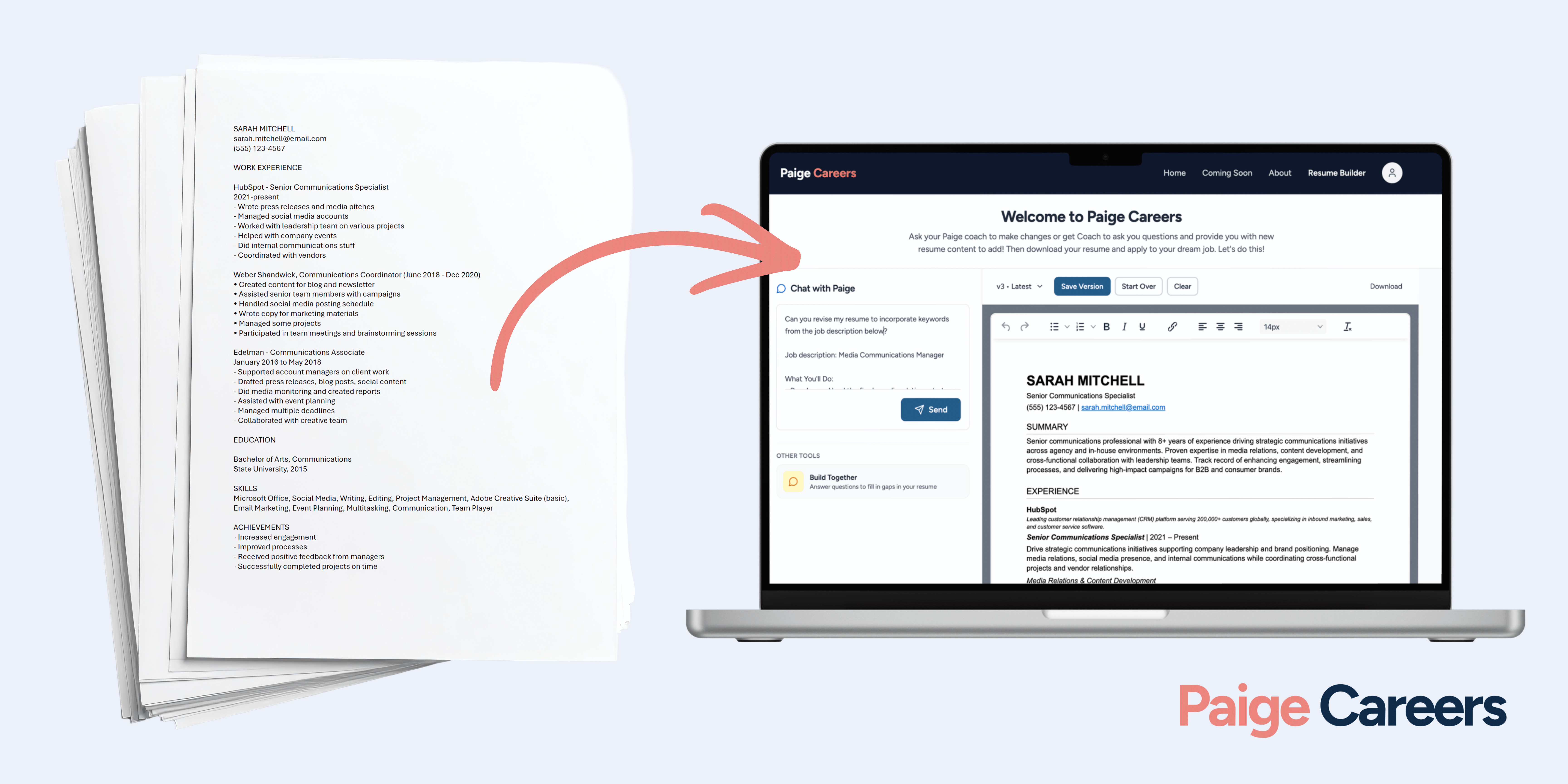
Why Your Current Resume Isn't Working for Your Job Search
Traditional vs. Strategic Return-to-Work Resume
Understanding the critical differences that make or break your return to the workforce
| Requirement | Traditional Approach | Strategic Return-to-Work Resume |
|---|---|---|
| Employment Gap | ❌Employment gap is unexplained or awkwardly justified | ✅Gap is addressed proactively with confidence and context |
| Resume Opening | ❌Resume leads with outdated experience from years ago | ✅Resume leads with current skills and relevant recent activities |
| Skills Section | ❌Skills section lists software from 2015 | ✅Skills section highlights current tools and transferable competencies |
| Professional Summary | ❌Professional summary is generic or missing entirely | ✅Targeted summary positions you for specific roles you're pursuing now |
| Career Break Activities | ❌Volunteer work and professional development buried or omitted | ✅Strategic activities during break are highlighted as evidence of continued growth |
| Language & Tone | ❌Accomplishments use passive, apologetic language | ✅Accomplishments demonstrate ownership, impact, and results |
| Format & Structure | ❌Format looks dated (objective statements, references available upon request) | ✅Modern, ATS-friendly format that positions you as a current professional |
Ready to Reframe Your Story?
Paige automatically transforms your traditional resume into a strategic return-to-work resume that gets results
Get Started with Paige →The Perception Problem Returning Professionals Face
Your return to work hits a wall the moment a hiring manager sees an unexplained gap—or worse, an explained gap that sounds defensive. Here's why:
Your employment gap is getting more attention than your qualifications.
When your resume doesn't address your career break strategically, hiring managers fill in the blanks themselves—and those assumptions are rarely in your favor. An unexplained 3-year gap becomes "out of touch with the industry." A gap explained with too much detail becomes "not serious about returning."
You're apologizing instead of owning your narrative.
Phrases like "seeking to re-enter the workforce" or "looking to refresh my skills" position you as behind before you've even started. The language signals uncertainty rather than readiness.
You're hiding valuable work that kept you current.
Freelance projects, volunteer leadership, professional development courses, community organizing, board service—these aren't "just staying busy." They're evidence of continued professional growth and skill application. But most returning professionals either bury this work or omit it entirely, assuming it doesn't "count."
Your professional summary is missing or generic.
Without a targeted summary that positions you for your next move, hiring managers default to your most recent role—which might be from years ago. You need to control the narrative from the first line.
The returning to work resume problem isn't about your gap. It's about how you're positioning your entire professional story around it.
What Makes Return-to-Work Resume Writing Different
It's Not About Hiding Your Gap—It's About Reframing Your Story
When writing a resume after career break, you're not trying to make your time away disappear. You're strategically positioning your career narrative so your gap becomes one chapter in a larger story of professional growth and readiness.
Here's what return to work resume writing actually requires:
1. Addressing Your Gap Proactively and Confidently
The worst thing you can do is leave your employment gap unexplained. The second worst thing? Over-explaining it.
Your resume needs to acknowledge your career break with just enough context to answer the question—and then immediately redirect attention to what you bring now.
- ●Add a brief entry in your work history. Instead of leaving the gap empty, include 1-2 lines that provide context. For parental or caregiving leave, this looks like: "Sabbatical | 2019–2022 | Primary caregiver for children" or "Sabbatical | 2020–2023 | Primary caregiver for parent."
- ●Show what you did during the break. If your sabbatical was driven by professional development or personal goals, make sure the rest of your resume demonstrates relevant activities during that time: certifications, coursework, volunteer leadership, or consulting projects. Consider elevating significant volunteer work—like a 15-hour-a-week role at a career development center—into your main "Experience" section if it demonstrates competencies relevant to your target roles.
- ●You control what you disclose. If your break was for medical reasons, you're not required to provide details. "Professional sabbatical" is sufficient context on your resume. If questions arise in an interview, a brief response works: "I was managing a health situation that required my full attention, but I'm fully ready to return and excited about this role." Then redirect to your qualifications.
Paige helps you find the right language for your specific situation and structures your resume so the gap is acknowledged but never the focal point.
2. Leading with Current Value, Not Past Roles
Your resume needs to answer one question immediately: "What can you do for us now?"
If your professional summary opens with "Experienced Marketing Manager with 10 years in consumer goods..." and your most recent role ended in 2018, you've already lost the reader. They're doing mental math: "So they haven't worked in marketing in 7 years."
Instead, your return to workforce resume should lead with a targeted professional summary that positions you for the roles you're pursuing today:
✅ Strategic Professional Summary Example:
Strategic Marketing Professional with 12+ years of experience in consumer goods and retail, including 5+ years leading brand strategy and digital campaigns for Fortune 500 brands. Track record of driving 40% revenue growth through integrated marketing initiatives and leading cross-functional teams of 8-12 across product launches. Looking to leverage brand development and team leadership expertise to Marketing Manager role at high-growth consumer tech company.
This summary does three things:
- 1.Establishes current relevance (recent certifications, current skills)
- 2.Highlights quantifiable past impact (40% growth, team leadership)
- 3.Shows intentionality (specific about target role and value proposition)
Your gap is now context, not the story.
3. Showcasing Continued Professional Growth
The strongest return to work resumes don't just explain time away—they show what you did with it.
Even if you weren't formally employed, you likely:
- •Completed online courses or certifications
- •Freelanced or consulted on small projects
- •Served on boards or committees
- •Stayed current through industry webinars or professional associations
All of this demonstrates continued professional capability. Paige helps you identify which activities are most relevant to your target roles and how to position them strategically within your resume without crowding out your more traditional experience.
4. Modernizing Your Resume Format and Language
If your resume still has an "Objective" statement, lists "References available upon request," or looks like it was formatted in 2010, you're signaling that you've been away from the professional world.
Modern resumes:
- •Start with a Professional Summary, not an Objective
- •Use clean, ATS-friendly formatting (single column, standard fonts, clear section headers)
- •Include LinkedIn URL and updated contact information
- •Emphasize results and metrics over duties and responsibilities
- •Use active, ownership language ("Directed," "Delivered," "Managed") rather than passive descriptions
Paige automatically structures your resume with current best practices, so you look like the current professional you are.
5. Taking Ownership with Confident Language
Returning professionals often undermine their own story with apologetic, tentative language—especially when describing work during their career break or their readiness to return.
Here's what that sounds like:
❌ Apologetic framing:
- "Seeking to re-enter the workforce after time away"
- "Hoping to refresh my skills and transition back into..."
- "Volunteered occasionally to stay engaged"
- "Did some freelance work on the side during my break"
✅ Confident framing:
- "Looking to leverage [specific expertise] in [target role]"
- "Maintained industry engagement through strategic consulting projects"
- "Led fundraising initiatives generating $200K annually for local nonprofit"
- "Consulted with 8 small business clients on financial planning and compliance"
The difference isn't just word choice—it's ownership. The first set treats your career break as something to apologize for. The second treats it as one chapter in a continuous professional story.
Paige helps you identify where you're being tentative and reframe your experience with the authority it deserves. Your freelance work wasn't "on the side"—it was client service. Your volunteer leadership wasn't "staying busy"—it was organizational management. Your career break wasn't a detour—it was an intentional decision you're now moving forward from.
How Paige Helps Professionals Return to the Workforce
AI-Powered Resume Strategy Built on Professional Resume Writing Expertise
How Paige Works
Transform your career break into a confident return to the workforce in four simple steps
Upload Your Resume
Start with your most recent experience—Paige identifies transferable skills and frames your career gap strategically
Refine with Paige
Chat with Paige to highlight relevant activities during your break and refresh outdated language to current industry standards
Paige Resume Builder
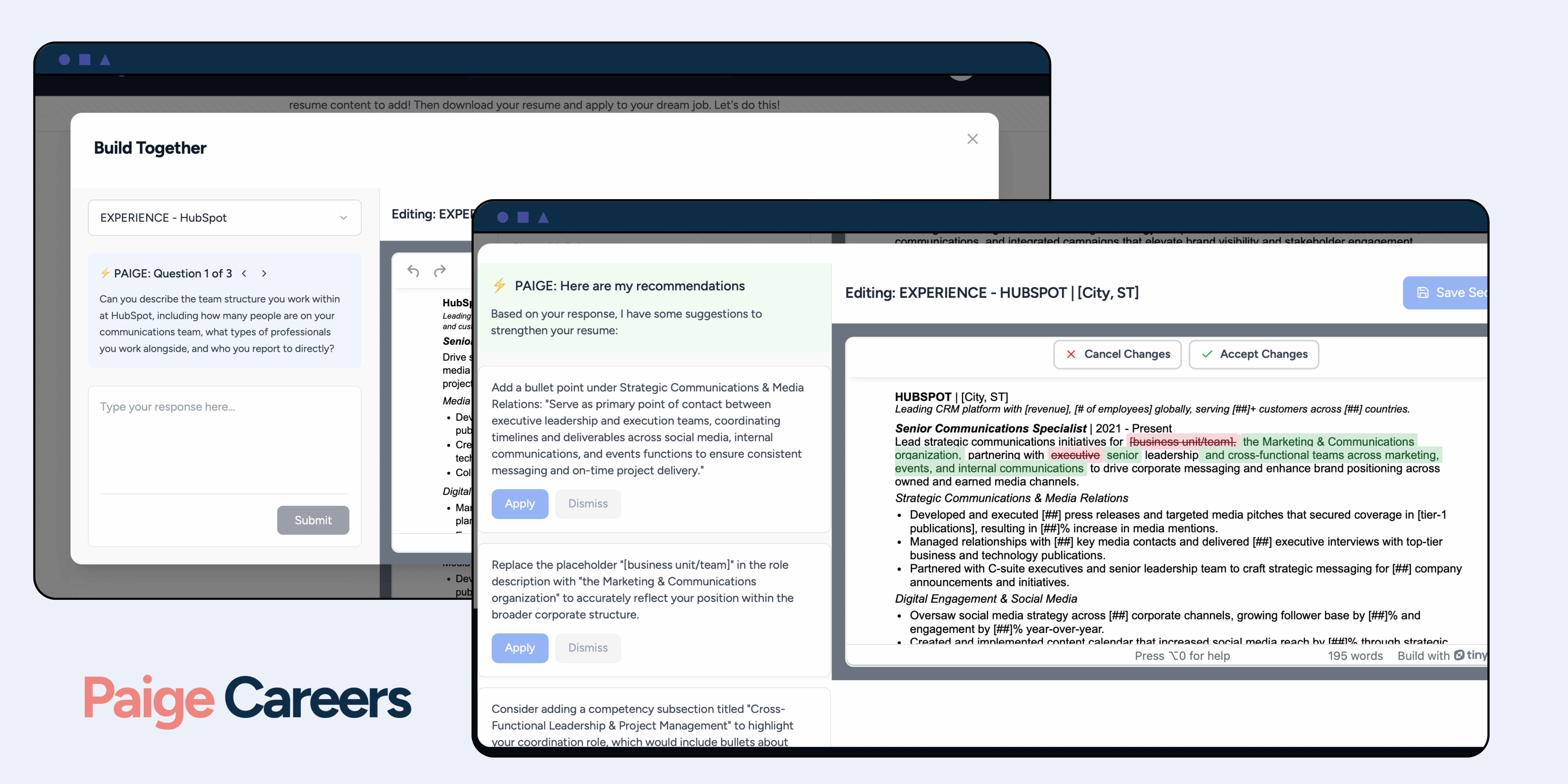
Use the Paige Resume Builder for key sections—strategic questioning extracts transferable skills from caregiving, volunteering, and personal development
Download & Repeat
Download your return-ready resume, then use Versions to customize for each application—unlimited revisions as you target different roles
Paige is a resume builder designed specifically for career transitions. Unlike generic templates that don't understand how to address employment gaps strategically, Paige was built by a Certified Professional Resume Writer who has guided hundreds of professionals through career breaks, pivots, and returns to the workforce.
Here's how Paige works as your returning to work career tool:
Strategic Gap Positioning
After you upload your existing resume, Paige reformats any career break information you've provided—tightening the language, removing apologetic phrasing, and positioning your gap with confidence and clarity.
If you've included professional development, volunteer work, or freelance projects during your break, Paige elevates these activities strategically, showing them as evidence of continued professional engagement rather than "filler."
Haven't addressed your gap yet? Use the Paige Resume Builder to develop your career break narrative from scratch. The Paige Resume Builder walks you through strategic questions about what you did during that time, what skills you maintained or developed, and how you stayed connected to your industry. It helps you craft the brief, confident language that belongs in your work history—turning your gap from something unexplained into evidence of intentional career management. You'll articulate your story in the same professional terms you'll use in interviews.
Professional Summary Creation
Paige generates a targeted professional summary that positions you for the specific roles you're pursuing—highlighting your strongest qualifications, recent activities that demonstrate current capability, and clear value proposition.
This summary becomes the anchor of your resume, controlling the narrative from the first line and ensuring hiring managers see your qualifications before they fixate on your gap.
Modern Format and Structure
Paige automatically formats your resume with current best practices:
- •Professional summary instead of objective statement
- •Clean, ATS-friendly layout
- •Strategic use of white space and section organization
- •Results-oriented bullet points that emphasize impact over duties
You don't need to worry about whether your format looks outdated—Paige ensures it meets current professional standards.
Paige Resume Builder: Strategic Questioning and Resume Coaching at Scale
Paige Resume Builder lets you take a focused, strategic approach to any section of your resume that needs strengthening. Instead of working on your entire resume at once, the Paige Resume Builder zeroes in on specific areas—your career break, your most recent role, a volunteer leadership position—and walks you through targeted questions that extract the details hiring managers actually need to see.
For returning professionals, this is where the real work happens. The Paige Resume Builder helps you:
- •Develop your career break narrative from scratch. If you haven't addressed your gap yet, the Paige Resume Builder asks strategic questions about what you did during that time: professional development, volunteer leadership, freelance projects, community organizing. It helps you identify which activities demonstrate continued professional capability and how to frame them with confidence.
- •Translate non-traditional work into professional competencies. That PTA treasurer role managing a $150K budget? The Paige Resume Builder helps you articulate that as financial oversight and stakeholder coordination. The volunteer consulting you did for three nonprofits? That becomes client relationship management and strategic advising.
- •Ensure your experience connects to your target roles. The Paige Resume Builder doesn't just ask what you did—it helps you understand which aspects of your experience are most relevant to the positions you're pursuing now. This strategic filtering ensures every line on your resume demonstrates value to your next employer.
- •Practice your interview narrative. The questions the Paige Resume Builder asks are the same questions you'll face in interviews: "What did you do during your time away?" "How did you stay current in your field?" "What makes you ready to return now?" By working through these questions in the Paige Resume Builder, you're not just improving your resume—you're developing the confident, clear narrative you'll need when you're sitting across from a hiring manager.
It's not just a resume tool—it's strategic career positioning that helps you own your story and demonstrate readiness to return.
Career Transitions Paige Can Support
Examples across industries and career levels
A former Marketing Manager who took 5 years off for parenting can use Paige to highlight volunteer leadership roles (PTA president managing budgets and coordinating teams), completed certifications (Google Analytics, HubSpot), and freelance projects—repositioning the gap as strategic professional development rather than time away from industry.
- →PTA leadership role → Budget management and team coordination
- →Completed certifications → Current industry knowledge
- →Freelance projects → Continued professional engagement
An Operations Director who stepped away to care for an aging parent can use Paige to showcase project management skills maintained through volunteer work, continuing education completed during evenings, and industry connections maintained through professional associations—demonstrating readiness to return at a senior level.
- →Volunteer project management → Operations leadership skills
- →Continuing education → Current professional development
- →Professional associations → Industry network maintenance
A Finance Analyst who took 2 years off for health reasons can use Paige to frame the gap as a sabbatical, highlight relevant coursework completed during recovery, and position recent freelance financial consulting work as evidence of current capability—shifting the narrative from absence to preparedness.
- →Sabbatical framing → Intentional career management
- →Relevant coursework → Continued skill development
- →Freelance consulting → Current professional capability
An HR professional who completed an MBA while out of the workforce can use Paige to integrate graduate coursework, capstone projects, and internships into a cohesive narrative—showing the career break as strategic professional development rather than a departure from the field.
- →Graduate coursework → Strategic skill enhancement
- →Capstone projects → Applied business experience
- →MBA internships → Professional transition preparation
A former VP who took several years off can use Paige to leverage board service, advisory roles, and strategic consulting work during the gap—positioning these activities as executive-level leadership that kept skills sharp and networks active, opening doors to senior roles.
- →Board service → Strategic governance experience
- →Advisory roles → Executive-level consulting
- →Strategic consulting → Continued industry leadership
Common Questions About Return-to-Work Resumes
Q: Should I include an explanation of my employment gap directly on my resume?
A: Yes, but briefly and strategically. Include a one-line note in your work history section or in your professional summary that provides context without dwelling on details. Focus on what you did during the gap that's professionally relevant, not why you left or personal circumstances. Paige helps you craft this language so it's confident and concise.
Q: How far back should my resume go if I have a long career break?
A: Generally, 15 years of relevant experience is sufficient, even if you have more. If you took 5 years off and your most recent role was 5 years ago, you might include experience from 15 years ago to show depth. The key is strategic relevance—include what matters for the roles you're targeting now. Paige helps you determine what to keep and what to trim based on your target positions.
Q: Should I include volunteer work or freelance projects from my career break?
A: Absolutely, if they demonstrate relevant skills. Volunteer leadership, board service, freelance consulting, and project-based work are all evidence of continued professional capability. The key is framing them strategically rather than as "filler." Paige helps you identify which activities are most valuable and how to position them for maximum impact.
Q: How do I show I'm current with industry tools and practices?
A: Through recent certifications and examples you provide throughout your resume. If you completed online courses, earned certifications, or used current tools in volunteer or freelance work, make that visible. This directly counters the assumption that you're "out of touch." Paige automatically structures this information so your current capabilities are front and center.
Q: How do I explain my gap in a cover letter vs. my resume?
A: Your resume should briefly acknowledge the gap and pivot immediately to current qualifications. Your cover letter can provide slightly more context—one sentence explaining the break, followed by a paragraph on what you bring to this specific role. The cover letter is where you can be more narrative about your journey; the resume is strategic positioning.
Why Returning Professionals Choose Paige for Their Job Search
Paige Provides More Than A New Resume; It Offers Strategic Career Positioning
When you're returning to the workforce, your resume is your first—and often only—chance to control the narrative. Generic resume builders can't help you address employment gaps strategically. And hiring a professional resume writer for every iteration gets expensive fast.
Paige gives you return to work resume help that combines AI efficiency with professional resume writing expertise:
- Strategic gap positioning that's confident, not defensive
- Professional summary that leads with current value
- Modern format that signals you're a current professional
- Skills optimization that demonstrates readiness
- Interview prep through strategic questioning
- Unlimited revisions as you refine your target roles
This is professional resume writing for returning professionals that's accessible, affordable, and designed for your success.
Ready to Position Your Return to Work Strategically?
Your employment gap doesn't have to be a barrier to your next role. With the right positioning, your career break becomes evidence of intentionality, resilience, and readiness—qualities every employer values.
Paige was built for exactly this moment. Start building your return-to-work resume today and see how strategic framing transforms your career story.
Paige Careers was founded by Certified Professional Resume Writer Margaret Gerety, who has coached over 300 professionals—including recent graduates, career changers, and executives—through successful career transitions.