Academic to Nonprofit Resume: How Academics Can Successfully Transition to Nonprofit Careers
Most academics are far more qualified for nonprofit leadership roles than their resumes show. The problem isn't experience—it's translation.
Table of Contents
If you're an academic considering a transition from higher education to the nonprofit sector, you already know your academic CV won't work for nonprofit job applications. Your academic to nonprofit resume needs to speak a different language—one that nonprofit hiring managers can understand and value. Whether you're a tenure-track professor, adjunct instructor, postdoctoral researcher, or graduate student, the challenge is the same: how do you convert academic achievements into language the nonprofit sector understands and values…without losing the power of your experience?
That's exactly where Paige comes in. As an AI resume builder for academics designed by a Harvard-educated, Certified Professional Resume Writer with over 300 clients across higher education, nonprofit, and private sectors, Paige doesn't just reformat your CV. It helps you strategically translate your academic experience into nonprofit-sector results that open doors.
Why Your Academic CV Isn't Working for Nonprofit Jobs
Academic vs. Nonprofit Resume
Understanding the critical differences that make or break your academic-to-nonprofit transition
| Requirement | Academic CV | Nonprofit Resume |
|---|---|---|
| Overall Structure | ❌10-15 pages documenting every publication, presentation, and committee; organized by academic conventions | ✅2-3 pages maximum, strategically organized to showcase mission-aligned impact and transferable skills |
| Experience Inclusion | ❌Comprehensive publication lists, conference papers, and research grants; teaching load described in academic terms | ✅Program development, community impact, stakeholder engagement, and applied outcomes; publications only if mission-relevant |
| Language & Framing | ❌Disciplinary jargon, theoretical frameworks, and scholarly terminology incomprehensible outside academia | ✅Clear, accessible language emphasizing program impact, community outcomes, and organizational value |
| Achievement Style | ❌Scholarly credentials: "Published 15 peer-reviewed articles" or "Presented at 20 conferences" | ✅Mission-aligned impact with metrics: "Designed curriculum serving 200+ students" or "Secured $120K in grants" |
| Value Recognition | ❌Positions teaching and research as ends in themselves; committee service as institutional obligation | ✅Frames teaching as program delivery, research as evaluation, committees as organizational leadership |
| Professional Summary | ❌Scholarly specialization: "Assistant Professor specializing in 19th-century comparative literature" | ✅Mission-aligned summary: "Education leader with 8+ years designing programs that advance equity and access" |
Ready to Make the Translation?
Paige automatically converts your academic CV into nonprofit language that gets results
Get Started with Paige →The Translation Problem Academics Face
Your academic to nonprofit transition hits a wall the moment a nonprofit recruiter opens your CV. Here's why:
Your academic CV is too long.
That 10-15 page curriculum vitae isn't just a formatting issue—it's a deal-breaker. Nonprofit hiring managers expect 2-3 pages maximum, even for senior roles. They're reviewing dozens of applications and simply won't read beyond page 2.
The nonprofit sector doesn't understand your academic CV.
Academic CVs are organized around scholarship and teaching—publications, conference presentations, courses taught, dissertation committees. Nonprofit resumes are organized around impact—programs managed, stakeholders served, resources mobilized, communities affected. Your accomplishments are buried under academic conventions that mean nothing outside the ivory tower.
Academic jargology is killing your chances.
Hermeneutics, phenomenological approaches, critical discourse analysis, postcolonial frameworks—every discipline has its specialized vocabulary. But when nonprofit recruiters see impenetrable academic language, they skip to the next candidate who can clearly articulate their impact.
You're listing publications instead of program impact—and it's hiding your value.
Your CV proudly displays your peer-reviewed articles, book chapters, and conference papers. And that's appropriate for academic positions. But nonprofit employers need to know: What programs did you design? What communities did you serve? What partnerships did you build? What resources did you secure? If your resume leads with scholarship rather than applied impact, they can't see your transferable value.
Your teaching experience is undersold or misunderstood.
You've designed curricula, managed classroom dynamics with 30+ students, adapted complex material for different learning levels, mentored struggling students to success, and assessed learning outcomes. That's instructional design, stakeholder management, communication strategy, and program evaluation—all highly valued in nonprofits. But if your resume just says "Taught Introduction to Sociology" three times, nonprofit readers will miss it entirely.
Your job descriptions are academic, not operational.
"Assistant Professor of English" doesn't tell a nonprofit what you actually did. Were you managing a program? Leading a team? Overseeing a budget? Coordinating with external partners? Academic titles obscure the operational leadership that nonprofits care about.
Your summary is missing or too academic.
You might have specialized research expertise, impressive teaching evaluations, or unique community partnerships, but if it's framed in academic terms, nonprofit readers can't translate it to their needs. Nonprofit resumes need summaries that emphasize mission-aligned impact, not scholarly specialization.
Your value is invisible.
Academic CVs focus on credentials, publications, and teaching load. Nonprofit resumes focus on programs, people served, and measurable outcomes. That's a completely different story—and most academic-to-nonprofit resumes don't tell it.
The academic CV format problem isn't cosmetic. It's strategic. You need academic resume translation—not just editing.
What Makes Academic-to-Nonprofit Resume Writing Different
It's Not Just About Cutting Pages—It's About Rewriting Your Professional Identity
When rewriting your academic CV for nonprofit roles, you're not just condensing content. You're fundamentally repositioning yourself from scholar to practitioner, from researcher to program leader, from teacher to capacity builder.
Here's what translating academic experience for nonprofit audiences actually requires:
1. Showcasing Mission-Aligned Impact
Your academic to nonprofit resume needs metrics that matter to mission-driven organizations: people served, programs developed, partnerships built, community outcomes, resources mobilized, capacity created. Here's what that looks like:
Teaching → Program development & delivery
❌ "Taught 4 courses per semester with average enrollment of 25 students."
✅ "Designed and delivered educational programming for 200+ students annually across 8 distinct courses, adapting curriculum based on learning outcomes assessment."
Research → Needs assessment & program evaluation
❌ "Conducted qualitative research on housing insecurity among immigrant populations."
✅ "Led community-based participatory research project with 50+ immigrant families, producing needs assessment that informed $500K affordable housing initiative."
Committee service → Organizational leadership
❌ "Served on Graduate Admissions Committee, Faculty Senate, and Diversity Task Force."
✅ "Led cross-functional 12-person task force that redesigned graduate recruitment strategy, increasing applications from underrepresented candidates by 35% over 2 years."
Grant writing → Resource development
❌ "Secured $120K in external research funding from NSF and NEH."
✅ "Developed and secured $120K in competitive grant funding, managing multi-year project budgets and deliverables across 3 funding sources including NSF and NEH."
Advising/Mentoring → Capacity building & training
❌ "Advised 15 undergraduate thesis students."
✅ "Mentored 15 students through year-long independent research projects, providing individualized coaching, methodology training, and professional development guidance."
2. Translating Research into Program Design & Strategic Thinking
In your academic role, you've likely designed research projects, managed human subjects protocols, analyzed complex qualitative or quantitative data, and synthesized findings for different audiences. Nonprofit employers value these skills—but only if you frame them in program terms.
❌ Academic language:
"Conducted mixed-methods study examining the efficacy of peer mentoring interventions on academic persistence among first-generation college students."
✅ Nonprofit language:
"Designed and evaluated peer mentoring program serving 80 first-generation college students, using data-driven assessment to refine program model and increase student retention by 22% over baseline."
3. Reframing Teaching as Training, Facilitation & Stakeholder Engagement
Academic culture sees teaching as content delivery and assessment. Nonprofit culture sees training as capacity building and empowerment. Your resume needs to bridge that gap.
❌ Academic language:
"Taught Introduction to Public Health to classes of 40-60 students, incorporating active learning pedagogies and community-engaged projects."
✅ Nonprofit language:
"Designed and facilitated community health education programming for 120+ students annually, partnering with 5 local organizations to create applied learning experiences on public health challenges."
Notice how the nonprofit version emphasizes partnership, applied learning, and community impact—exactly what nonprofit employers are looking for.
4. Eliminating Academic Jargon & Adding Organizational Context
Every academic to nonprofit career transition requires ruthlessly cutting disciplinary terminology, theoretical frameworks, and scholarly conventions. If someone outside your field wouldn't immediately understand it, it needs translation.
This is especially true for specialized research areas and academic sub-disciplines."Examining feminist epistemologies through a poststructuralist lens" tells nonacademic readers very little other than you can use big words. Instead try: "Analyzed gender bias in organizational decision-making through case study research, producing assessment framework adopted by 4 nonprofits to evaluate their leadership practices."
Similarly, if you worked in a specialized research center—like the Institute for Advanced Study or the Center for Comparative Studies in Race and Ethnicity—don't assume the name explains itself. That’s why Paige always adds a company description to provide an organizational overview like: "university research institute focused on interdisciplinary social science" or "academic center supporting faculty research on racial and ethnic equity."
And if your title is discipline-specific—Assistant Professor of Comparative Literature, Postdoctoral Fellow in Computational Biology, Visiting Scholar in Urban Studies—Paige Careers will urge you to include a brief job description that makes your role intelligible: "Serve as teaching and research faculty specializing in cross-cultural communication" or "Recruited into university’s 15-person chemistry department as senior-level scientist developing data analysis methods for public health applications."
How Paige Helps Academics Transition to Nonprofit Careers
AI-Powered Resume Translation Built on Professional Resume Writing Expertise
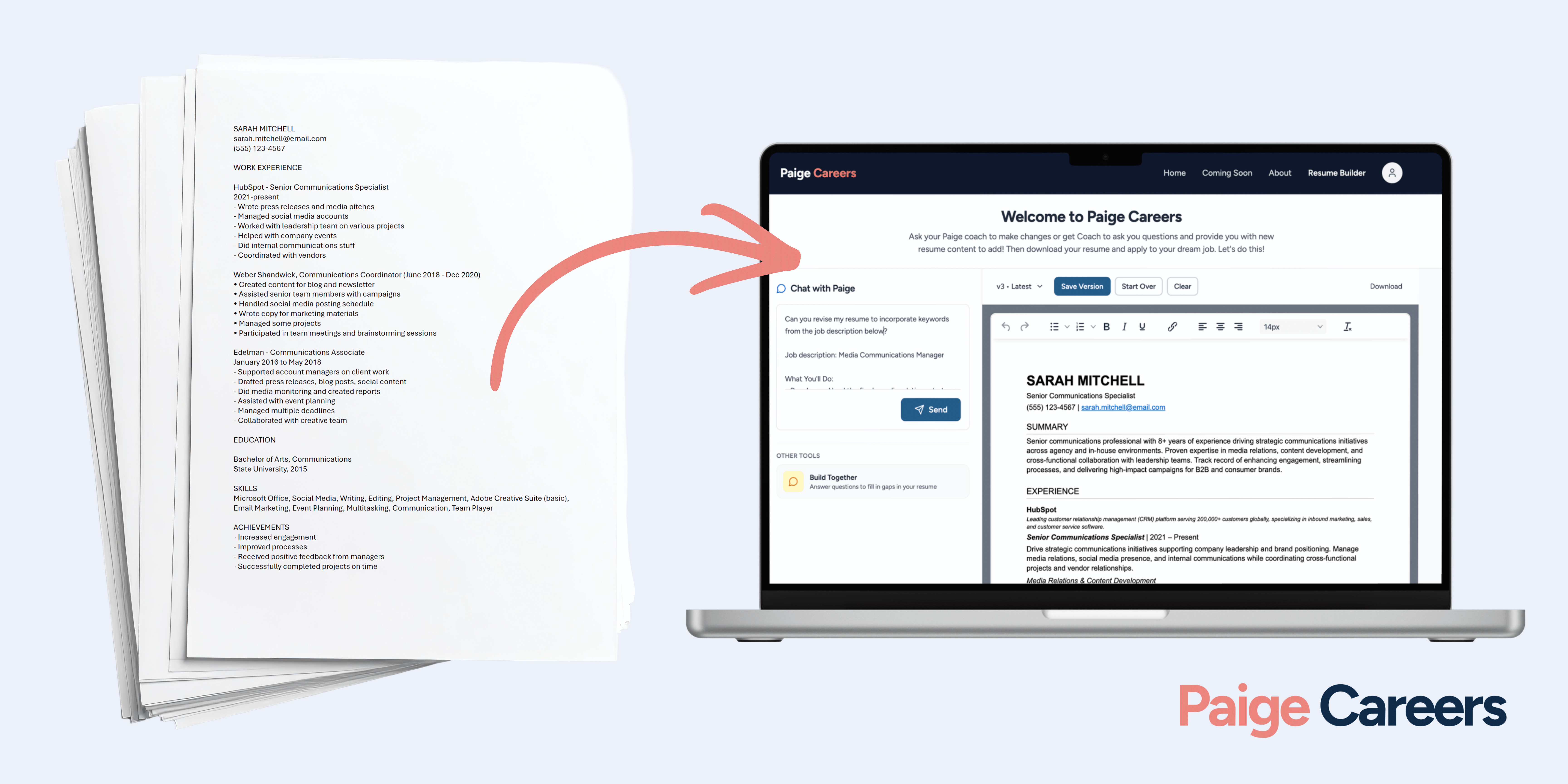
How Paige Works
Transform your academic CV into a mission-aligned nonprofit resume in four simple steps
Upload Your CV
Start with your academic CV, or simply share your experience—Paige identifies transferable skills and eliminates academic CV pitfalls
Refine with Paige
Chat with Paige to translate academic language into nonprofit terminology and reframe scholarship to highlight mission-aligned impact
Paige Resume Builder
Use the Paige Resume Builder for key sections—strategic questioning extracts program impact from teaching, research, and service work
Download & Repeat
Download your nonprofit-ready resume, then use Versions to customize for each application—unlimited revisions as you target different roles
Paige is a resume builder for academics designed to help you tactically navigate academic-to-nonprofit career transitions. Unlike generic resume templates or AI tools that don't understand the academic-to-nonprofit challenge, Paige was built by a Certified Professional Resume Writer who has guided hundreds of academics and mission-driven professionals through this exact transition.
Here's how Paige works as your academic career transition tool:
Automatic Academic-to-Nonprofit Translation
After you upload your CV, Paige automatically clears out academic formatting and rewrites your work in nonprofit language. It identifies the kinds of competencies the nonprofit sector values—program design, community engagement, stakeholder management, partnership development, data-driven decision making—and reorganizes your bullet points to showcase these skills immediately.
For example, instead of a chronological list of courses taught and publications, Paige might organize your experience like this:
Program Design & Delivery
- ●Designed and taught 6 courses at undergraduate and graduate levels, serving 250+ students annually.
- ●Created and facilitated professional development workshop series for graduate students on grant writing and research project management, training 25+ emerging scholars.
Organizational Leadership & Operations
- ●Serve as Vice Chair of Chemistry Department, overseeing strategic planning and faculty hiring processes for 40-person academic unit.
- ●Led departmental curriculum review committee of 8 faculty members, conducting needs assessment and implementing program revisions impacting 1,000 students.
Research Management & Resource Development
- ●Direct research lab with 2 staff members and 6 graduate assistants, managing project timelines, resource allocation, and professional development across 20+ projects.
- ●Secured $450K in grant funding from NSF and private foundations, managing multi-year budgets, deliverables, and compliance reporting across 3 simultaneous research grants.
This reorganization makes your transferable skills immediately visible—exactly what nonprofit hiring managers are looking for.
Don't have identifiable metrics in your CV? Paige puts in placeholders where these would make the most impact and reminds you to insert real data and results.
Want even more targeted translation? On the home page, simply ask Paige to "modify my experience to match a nonprofit [specific job description]" and you'll get hyper-specific language changes and strategic recommendations tailored to that exact position. It's like having a professional resume writer who understands both your academic background and your target mission.
This is the resume translation tool for academics you've been looking for.
Optimized Length and Format
Paige knows that your 10-15 page academic CV needs to become a 2-3 page powerhouse. It prioritizes your most mission-relevant accomplishments, eliminates academic detail that doesn't translate to nonprofit value, and structures your experience for maximum impact—all while keeping your voice authentic.
Paige Resume Builder: Strategic Questioning and Resume Coaching at Scale
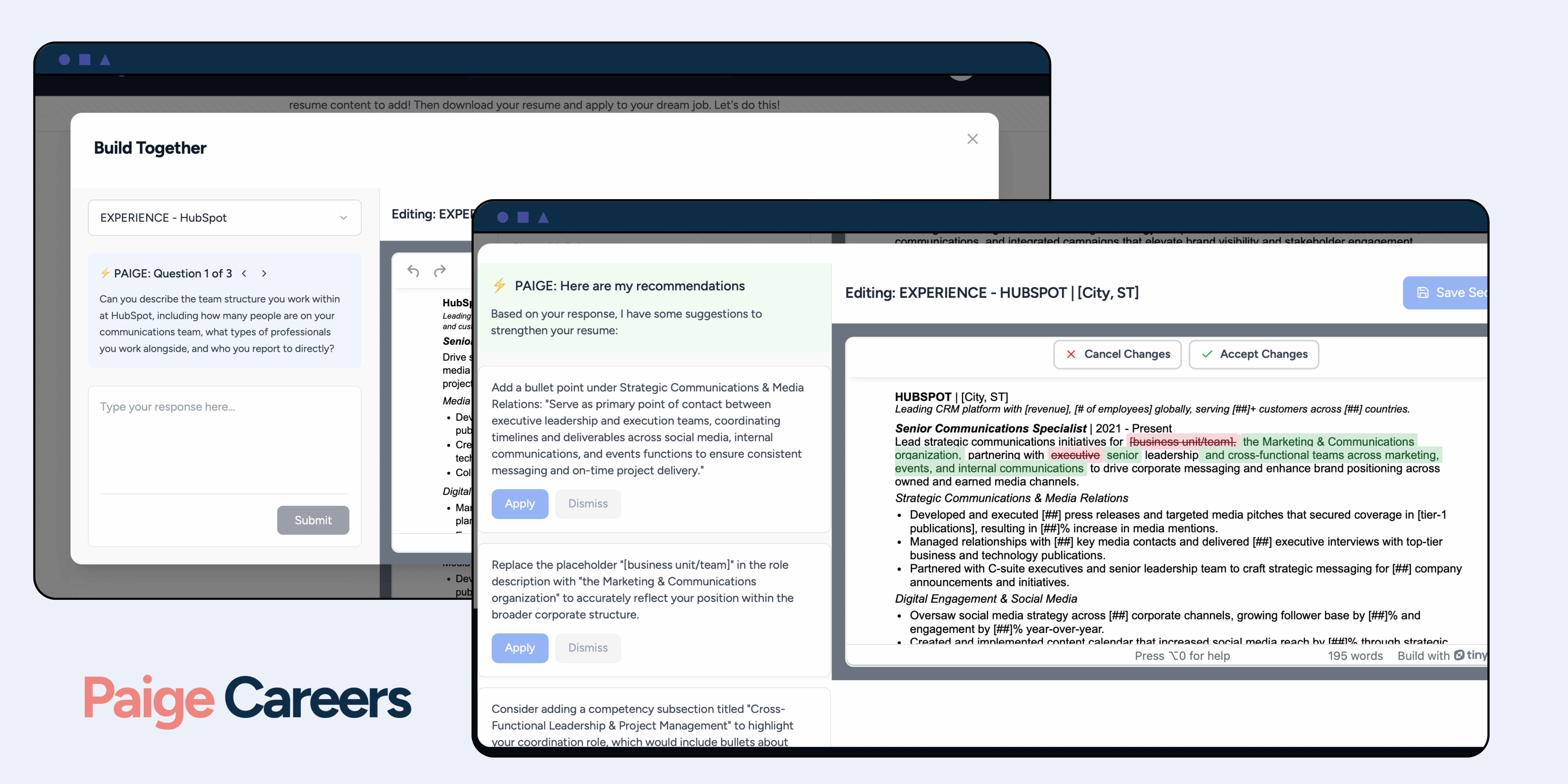
Paige Resume Builder mirrors a one-on-one consultation with a professional resume writer. It lets you take a deep dive into a specific section of your resume—for example, your current teaching role—and receive specific, nonprofit-focused resume coaching.
Through conversational AI, Paige asks strategic questions about your academic work that extract the information nonprofit employers actually care about. For example, it might ask:
- •"How many students did you typically work with each semester? What was the range of their backgrounds and learning needs?"
- •"Did any of your courses involve community partnerships or applied projects? What organizations did you work with?"
- •"What outcomes did you track in your teaching? How did you assess whether students were learning?"
- •"Beyond your formal teaching, did you advise student organizations, mentor students one-on-one, or support students navigating challenges?"
These questions help you unearth the program management, stakeholder engagement, and impact assessment hiding in your teaching experience. Then Paige makes specific, actionable recommendations that you can apply to your resume with a single click.
The kinds of questions you encounter in the Paige Resume Builder are similar to what you might face in an interview with a nonprofit hiring manager. This means the Paige Resume Builder isn't just a bullet point generator—it's an interview prep tool that helps you articulate your academic experience in mission-aligned terms.
Academic Transitions Paige Can Support
Examples across academic roles and career levels
A doctoral candidate managing community-based research projects while teaching multiple courses can use Paige to translate research coordination into program management, teaching into training and facilitation, and committee work into cross-functional collaboration—showcasing the operational skills nonprofits need for Program Coordinator and Research Associate roles.
- →Research coordination → Program management
- →Teaching → Training and facilitation
- →Committee work → Cross-functional collaboration
Adjunct faculty juggling multiple courses across institutions can use Paige to reframe course design as curriculum development, classroom management as facilitation and stakeholder engagement, and adaptation to diverse student populations as inclusive program design—opening doors to Education Manager, Training Coordinator, and Learning & Development roles at nonprofits.
- →Course design → Curriculum development
- →Classroom management → Facilitation and stakeholder engagement
- →Student adaptation → Inclusive program design
Postdocs leading independent research projects with external funding can use Paige to translate grant writing into resource development, research design into program evaluation frameworks, and scholarly publishing into communications and thought leadership—language that resonates with nonprofits seeking Research Directors and Evaluation Managers.
- →Grant writing → Resource development
- →Research design → Program evaluation frameworks
- →Scholarly publishing → Communications and thought leadership
Faculty members managing research labs, advising students, serving on committees, and maintaining community partnerships can use Paige to reposition their experience as program leadership at scale: team management, budget oversight, stakeholder coordination, and strategic planning—making them competitive for Program Director, Director of Research, and even VP-level roles at larger nonprofits.
- →Research lab management → Program leadership at scale
- →Student advising → Team management
- →Community partnerships → Stakeholder coordination
Directors of academic programs, department chairs, and associate deans managing budgets, staff, and strategic initiatives can use Paige to translate administrative leadership into nonprofit operations expertise: resource management, team development, cross-functional coordination, and organizational strategy—opening doors to Chief Operating Officer, VP of Programs, and Executive Director positions.
- →Administrative leadership → Nonprofit operations expertise
- →Budget management → Resource management
- →Strategic initiatives → Organizational strategy
Faculty in humanities and social sciences with strong writing, critical analysis, and public engagement skills can use Paige to reframe research as thought leadership, teaching as training and facilitation, and public scholarship as communications strategy—making them competitive for Communications Director, Policy Analyst, and Advocacy Manager roles.
- →Research → Thought leadership
- →Teaching → Training and facilitation
- →Public scholarship → Communications strategy
Common Questions About Academic-to-Nonprofit Resume Writing
Q: How long should my academic resume be for nonprofit applications?
A: 2 to 3 pages, maximum, even if you're a tenured professor with 20 years of publications. Most nonprofit hiring managers won't read beyond page 2. Your most relevant program experience, impact, and transferable skills need to be front and center—not buried on page 7 after your dissertation abstract and comprehensive publication list. Paige helps you prioritize mission-aligned accomplishments and eliminate academic conventions that don't serve you.
Q: What do I do with my publications list?
A: For most nonprofit roles, drastically condense it. Providing 3 or 4 highly relevant publications is sufficient unless the nonprofit is specifically looking for subject matter expertise. If you're applying to a policy thinktank and are expected to publish whitepapers and op-eds regularly, curate your list to show versatility and thought leadership. Your 40-publication list of peer-reviewed journal articles doesn't belong on a nonprofit resume. Nonprofit employers care about impact and applied experience, not h-index. Save the full CV for academic job applications.
Q: Should I include my dissertation on my resume?
A: Only if it's directly relevant to the nonprofit's mission and you can describe it in plain language that shows applied impact. Instead of the full academic title, try: "Conducted multi-year research project examining how language shapes community identity, with implications for nonprofit communications and stakeholder engagement strategies." Unless your dissertation led to a published book or produced findings that nonprofits actually used, consider leaving it off entirely and focusing on your teaching, program development, and university engagement instead.
Q: How do I show I can work in a fast-paced nonprofit environment when academia is known for being slow?
A: By highlighting the operational and time-sensitive aspects of your academic work. Did you design a new course in 6 weeks? Manage a research project with tight grant deadlines? Coordinate a conference with 200+ attendees? Revise curriculum mid-semester based on student feedback? Juggle teaching 4 classes while advising 15 students and serving on 3 committees? Academia requires extraordinary time management, adaptability, and the ability to deliver under pressure—nonprofits just need to see you frame it that way. Paige's strategic questioning naturally surfaces these examples.
Q: I don't have metrics for teaching. How do I quantify impact?
A: You have more metrics than you think: number of students taught, courses designed, curriculum revisions made, office hours held, students advised, committees served on, community partners engaged, grant dollars secured, program participants served through community-engaged research. "Soft" accomplishments can still be quantified: "Mentored 15 thesis students to completion" is a metric. "Adapted course materials for 30+ students with diverse learning needs" is a metric. Paige helps you identify where metrics belong and prompts you to fill them in.
Why Academics Choose Paige for Career Transitions
Paige Provides More Than a New Resume; It Offers Strategic Career Repositioning
When you're figuring out how to transition from academia to nonprofit, your resume is your first—and often only—chance to make an impression. Generic resume builders can't handle the complexity of academic experience on nonprofit resumes. And hiring a professional resume writer for every iteration gets expensive fast.
Paige gives you academic resume help that combines AI efficiency with professional resume writing expertise:
- Unlimited revisions as you refine your target roles
- Real-time translation of academic experience to nonprofit impact
- Strategic positioning for the roles you actually want
- Format optimization for ATS systems and human readers
- Professional-quality output in a fraction of the time
This is professional resume writing for academics that's accessible, affordable, and designed for your success.
Ready to Make Your Academic Experience Work in the Nonprofit Sector?
Your academic to nonprofit resume doesn't have to be a barrier to your next career move. With the right translation, your academic experience becomes a competitive advantage—demonstrating research expertise, program leadership, capacity building skills, and proven ability to drive impact.
Paige was built for exactly this moment. Start building your nonprofit resume today and see how strategic translation transforms your career story.
Paige Careers was founded by Certified Professional Resume Writer Margaret Gerety, who has coached over 300 professionals through successful career transitions.