Federal to Private Sector Resume: How Federal Employees Can Successfully Transition Careers
Most federal professionals are far more qualified for private-sector leadership roles than their resumes show. The problem isn't experience—it's translation.
Table of Contents
If you're a federal employee considering a transition from federal government to private sector, you already know your federal resume won't work in the private sector job market. Your government to private sector resume needs to speak a different language—one that hiring managers outside the federal system can understand and value. Whether you're a GS employee, civil servant, SES leader, or federal contractor, the challenge is the same: how do you convert federal government speak to language the private sector understands and values…without losing the power of your experience?
That's exactly where Paige comes in. As an AI resume builder for federal employees designed by a Harvard-educated, Certified Professional Resume Writer with over 300 clients across federal, nonprofit, and private sectors, Paige doesn't just reformat your resume. It helps you strategically translate your federal experience into private-sector results that open doors.
Why Your Federal Resume Isn't Working for Private Sector Jobs
Federal vs. Private Sector Resume
Understanding the critical differences that make or break your career transition
| Requirement | Federal Resume | Private Sector Resume |
|---|---|---|
| Length | ❌5-7 pages (often longer) | ✅1-3 pages maximum |
| Primary Focus | ❌Duties and responsibilities | ✅Results and measurable impact |
| Required Details | ❌GS levels, hours per week, supervisor contact info | ✅Scope, scale, and strategic context |
| Voice & Ownership | ❌Passive voice or team attribution without clear individual role | ✅Strong action verbs showing individual leadership and collaboration |
| Language Style | ❌Agency acronyms and federal jargon | ✅Plain language and business terminology |
| Job Context | ❌Long titles, department codes, secondments | ✅Clear role overview and business purpose |
Ready to Make the Translation?
Paige automatically converts your federal resume into private-sector language that gets results
Get Started with Paige →The Translation Problem Federal Employees Face
Your federal to private sector transition hits a wall the moment a private-sector recruiter opens your resume. Here's why:
Your federal resume is too long.
That 5-7 page USAJobs resume vs private sector resume isn't just a formatting issue—it's a deal-breaker. Private sector hiring managers expect 1-3 pages maximum, even for senior roles.
The private sector doesn't understand your federal resume.
Federal resumes are typically dense with long job titles, secondments, complex compliance requirements (like listing the number of hours you spend each week, your GS level, and your manager's phone number!), and government jargon that not only bloats your resume, it means nothing to folks outside of your agency. Your accomplishments are buried under procedural detail.
Federal acronyms are killing your chances.
OMB, CFR, GSA—every agency has dozens of these federal acronyms, shortening offices, titles, or strategic projects. But when private-sector recruiters see alphabet soup, they skip to the next candidate.
You're using "we" instead of "I"—and it's hiding your value.
Federal culture emphasizes team accomplishments, which often means your resume is full of "we managed," "the team delivered," "our office coordinated." But private-sector employers need to know what you specifically contributed. If you can't articulate your individual role and ownership, they assume you were a passenger, not a driver.
Your job overview is missing or incomprehensible.
Many federal professionals dive straight into duties without explaining the role's strategic importance. What was your position's purpose? What problems did it exist to solve? How did it fit into the broader mission? Without this context, private-sector readers can't gauge the weight of your experience, especially if your title is something like "Mission Support Specialist, GS-13" which could mean anything.
Your summary is also missing, or isn't translatable.
You might have impressive international experience, specialized technical expertise, or unique policy knowledge, but if it's not relevant to the roles you're targeting now, it's just noise. Federal resumes often lead with everything you've ever done rather than what matters most for your next move. Private-sector resumes prioritize strategically, showing your most transferable and valuable expertise first. They also start with targeted professional summaries at the top, which give an overview of your core competencies, experience, and show a hiring manager, quickly, what you bring to the table.
Your value is invisible.
Federal resumes focus on duties, regulations, and scope. Private-sector resumes focus on impact, results, and business value. That's a completely different story—and most former federal employee resumes don't tell it.
The federal resume format problem isn't cosmetic. It's strategic. You need federal resume translation—not just editing.
What Makes Federal-to-Private Sector Resume Writing Different
It's Not Just About Cutting Pages—It's About Rewriting Your Story
When rewriting your federal resume for private sector roles, you're not just condensing content. You're fundamentally repositioning your professional identity.
Here's what translating federal experience for private sector audiences actually requires:
1. Showcasing quantifiable impact
Your government to private sector resume needs metrics that matter in business: budget size, management experience, cost savings & efficiency gains, client satisfaction, team performance. Here's what that looks like:
- ●Budget responsibility → "Managed $45M annual budget" (not "Administered appropriations in accordance with OMB guidelines")
- ●Team leadership → "Led 25-person cross-functional team across 3 locations in the U.S., Asia, and LatAm" (not "Supervised GS-11 through GS-13 staff in accordance with agency protocols")
- ●Efficiency gains → "Reduced procurement cycle time by 40%, saving 120 staff hours per quarter" (not "Streamlined acquisition processes through improved coordination")
- ●Stakeholder impact → "Supported 500+ internal clients across 8 departments in the DoD, including leading ~50 technical workshops and hundreds of 1-on-1 training sessions" (not "Provided technical assistance to agency personnel")
- ●Scale → "Oversaw 15 simultaneous projects with combined value of $200M" (not "Managed project portfolio")
2. Translating cross-functional leadership in the government context
In your government role, you've likely managed cross-functional teams, navigated complex stakeholder environments, and driven large-scale initiatives. Private sector employers value these federal job skills for private sector roles—but only if you frame them in business terms that clearly demonstrate your leadership impact.
Here's the reality: federal work often involves coordinating across multiple agencies, implementing complex regulatory frameworks, and managing projects governed by complex policies. You might have worked with stakeholders from DOD, DHS, Treasury, and State—all with competing priorities. Or led implementation of Executive Orders across regional offices. This is sophisticated program management at massive scale, but private-sector readers won't recognize it unless you translate the language and make it specific. That way the hiring manager can see what exactly you did and how those skills may be useful to their organization.
❌ Federal language:
"Served as program manager for interagency working group coordinating policy implementation across multiple federal departments."
✅ Private sector language:
"Managed interagency working group on small business loan programs across 6 federal departments, delivering final 100-page policy recommendations to senior leadership 3 months before deadline."
3. Taking ownership: The "We" vs. "I" problem
Federal culture—especially in military and large agency contexts—emphasizes collective achievement. Your resume likely shies away from taking credit for the work you and your team achieved together. While showcasing collaboration and coordination within and among teams is a key soft skill to highlight, not taking more ownership can hide your specific contribution and leadership.
Private-sector employers need to see what you did as part of that team effort. Paige helps you identify your exact role and claim it with the strongest possible active verb—while still acknowledging the collaborative nature of your work. The result? You sound both authoritative and team-oriented.
For Example:
❌ "Coordinated team in successfully activating inter-agency response."
✅ "Led 15-person inter-agency response team across DOD, FEMA, and DHS, coordinating real-time communications and tracking deployment of $100M in resources during crisis event."
Notice how the second version shows your leadership role while making it clear you worked collaboratively across agencies. That's the balance private-sector employers are looking for.
4. Eliminating insider language & adding organizational content
Every federal employee career transition requires a hard look at acronyms, agency-specific terminology, and bureaucratic framing. If someone outside your agency wouldn't immediately understand it, it needs translation.
This is especially true for specialized titles and military contexts. "Branch Chief, Office of Strategic Initiatives, DAS/CT" tells a private-sector reader absolutely nothing. Instead: "Senior Operations Leader, Counterterrorism Strategy, directing 40-person team supporting threat analysis and interagency coordination."
Similarly, if you worked in a specialized sub-unit—like the Bureau of International Labor Affairs or the Office of Surface Mining Reclamation and Enforcement—don't assume the name explains itself. Add brief context: "within the Department of Labor's international programs division" or "federal regulatory office overseeing environmental compliance for mining operations."
How Paige Helps Federal Employees Transition to Private Sector Careers
AI-Powered Resume Translation Built on Professional Resume Writing Expertise
How Paige Works
Transform your federal resume into a private-sector powerhouse in four simple steps
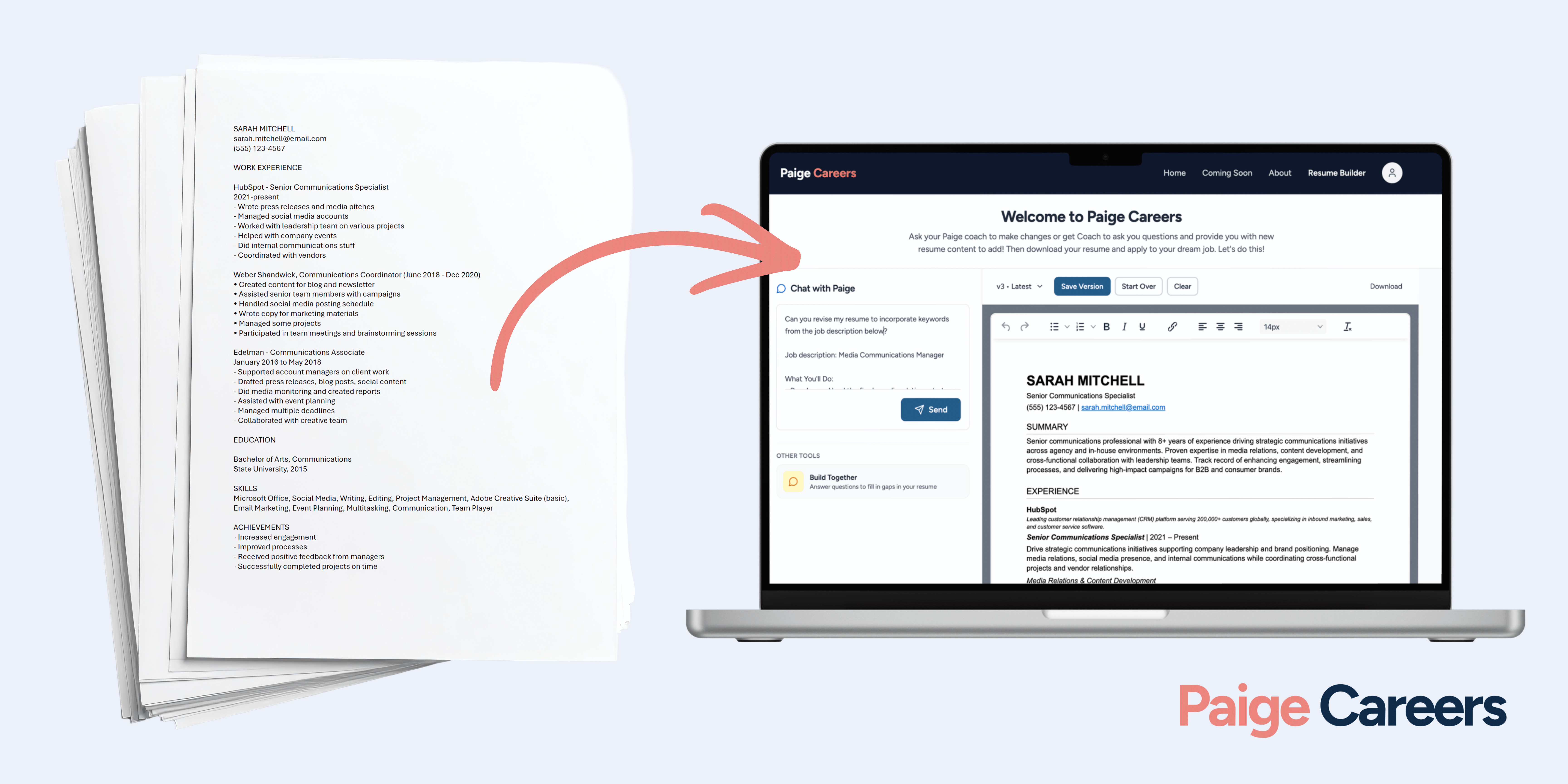
Upload Your Documents
Start by uploading your federal resume or any career documents—Paige automatically optimizes format and clears federal clutter
Refine with Paige
Chat with Paige to refine content, translate federal language, and ask questions about positioning for your target roles
Paige Resume Builder
Use the Paige Resume Builder for key sections—strategic questioning extracts private-sector impact from your federal experience
Download & Repeat
Download your polished resume, then use Versions to customize for each job—unlimited revisions as your search evolves
Paige is a resume builder for government employees that can help tactically navigate federal-to-private sector career transitions. Unlike generic resume templates or AI tools that don't understand the federal-to-private challenge, Paige was built by a Certified Professional Resume Writer based in the Beltway, who has guided hundreds of federal and government-adjacent professionals through this exact transition.
Here's how Paige works as your federal career transition tool:
Automatic Federal-to-Private Sector Translation
After you upload your old resume, Paige automatically clears out USA Jobs resume clutter and rewrites your work in private-sector language. It identifies the kinds of competencies the private sector values—risk management, stakeholder coordination, program oversight, change management—and nests your bullet points under them so employers can quickly see how you've demonstrated these skills in your work.
For example, instead of a chronological list of duties, Paige might organize your experience like this:
Strategic Program Management
- ●Directed $30M modernization initiative across 5 regional offices, delivering on time and 12% under budget.
- ●Coordinated 40+ stakeholders across competing priorities to achieve consensus on policy rollout.
Risk & Compliance Leadership
- ●Developed compliance framework that reduced audit findings by 65% over 18 months.
- ●Managed regulatory risk assessment process for 200+ operational policies.
This reorganization makes your transferable skills immediately visible—exactly what private-sector hiring managers are looking for.
Don't have identifiable metrics in the materials you give Paige? Paige puts in placeholders where it thinks these would make the most impact, and reminds you to insert real data and results.
Want even more targeted translation? On the home page, simply ask Paige to "modify my role to match a private sector [specific job description]" and you'll get hyper-specific language changes and strategic recommendations tailored to that exact position. It's like having a professional resume writer who understands both your federal background and your target industry.
This is the resume translation tool for federal workers you've been looking for.
Optimized Length and Format
Paige knows that your 7-page USAJobs resume needs to become a 2-3 page powerhouse. It prioritizes your most relevant accomplishments, eliminates redundancy, and structures your experience for maximum impact—all while keeping your voice authentic.
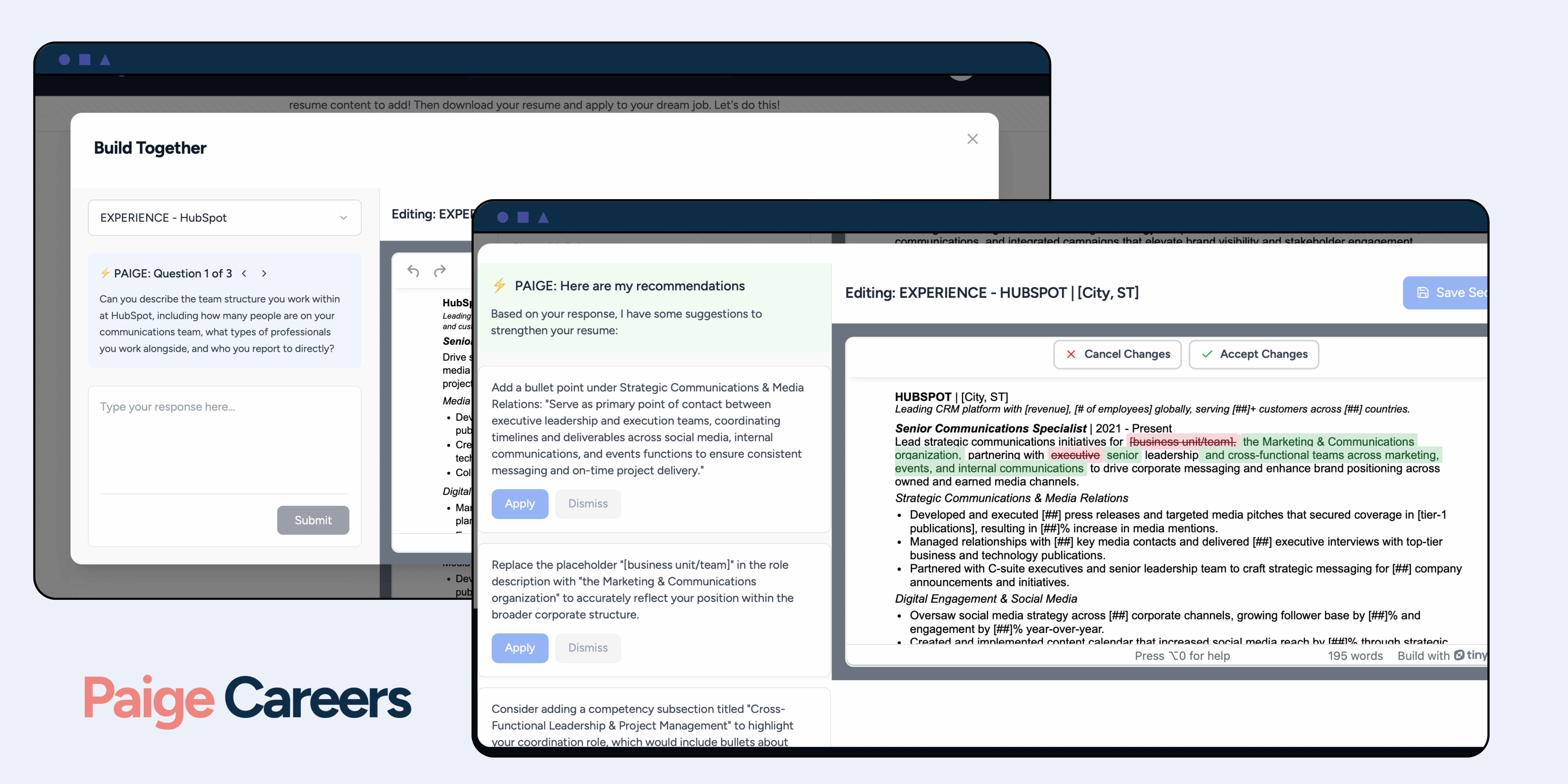
Paige Resume Builder: Strategic Questioning and Resume Coaching at Scale
Paige Resume Builder mirrors a one-on-one consultation with a professional resume writer. It lets you take a deep dive into a specific section of your resume—for example, your current role—providing specific, private-sector resume coaching. Through conversational AI, Paige asks strategic questions about your federal role that extract the information private-sector employers actually care about. For example, it may ask you targeted questions about your role, your team, and your impact to help you unearth key aspects of your experience. And then Paige makes specific, actionable recommendations that you can make to your resume. With a click of a button, you can apply those changes to your working draft.
The kinds of questions you are asked in the Paige Resume Builder are the types you might expect in an interview, or by a hiring manager who feels they're missing something when going through their resume. This means that the Paige Resume Builder is not only a bullet point generator, filling in key holes and strengthening your resume content—it is an interview prep tool that helps you anticipate the types of conversations you'll expect when you meet a live person.
Federal Transitions Paige Can Support
Examples across federal roles and career levels
A GS-13 operations analyst at DHS managing complex programs with multi-million dollar budgets can use Paige to translate program oversight into strategic operations leadership—showcasing stakeholder management, process improvement, and cross-functional team leadership for roles like Senior Operations Manager at Fortune 500 companies.
- →Program oversight → Strategic operations leadership
- →Federal stakeholder coordination → Executive stakeholder management
- →Agency process improvement → Business process optimization
An SES resume for private sector roles requires a completely different approach. Senior Executive Service leaders who've overseen large divisions and substantial budgets can use Paige to reposition their experience as executive leadership transformation, strategic planning, and budget oversight—opening doors to VP and C-suite roles.
- →Division oversight → Executive leadership at scale
- →Agency transformation → Organizational change management
- →Budget authority → P&L accountability
Policy analysts with strong analytical skills and big-picture thinking can use Paige to reframe regulatory expertise as compliance leadership, or stakeholder engagement as client relationship management—making their private sector jobs for strategic consulting search far more successful.
- →Policy analysis → Business strategy
- →Regulatory expertise → Compliance leadership
- →Stakeholder engagement → Client relationship management
Government program managers running large-scale IT modernization projects can use Paige to translate their federal experience into Agile leadership, vendor management, and cross-functional project delivery—language that resonates with tech companies and consulting firms seeking digital transformation expertise.
- →IT modernization → Digital transformation
- →Federal project management → Agile leadership
- →Contractor coordination → Vendor management
Many federal contractors live in a hybrid space—they're not technically federal employees, but their resumes still carry federal formatting and language. Contractors supporting government operations can use Paige to translate contractor oversight into business operations, compliance monitoring into risk management, and government client relationships into account management expertise.
- →Contractor oversight → Business operations
- →Compliance monitoring → Risk management
- →Government client relationships → Account management
Common Questions About Federal-to-Private Sector Resume Writing
Q: How long should my federal employee resume be for private sector applications?
A: 2 to 3 pages, maximum, even if you're an SES leader with 25 years of experience. Most private-sector hiring managers won't read beyond page 2; the majority of their time is focused on the first page. Paige helps you prioritize your most relevant accomplishments and eliminate everything else.
Q: Should I keep my GS level on my resume?
A: Only if you're applying to companies that regularly recruit from the public sector. For most private-sector employers, "GS-14" means nothing. Instead, focus on scope: team size, organizational level, and strategic impact. Paige automatically helps you reframe seniority in business terms.
Q: Can I use my federal resume on LinkedIn?
A: No. Your LinkedIn profile should already be written in private-sector language; it's a separate project from your resume. Paige focuses on your resume for applications, but the same principles of translation apply to your LinkedIn presence.
Q: How do I show I can work in a faster-paced private sector environment when my federal experience is known for bureaucracy?
A: By highlighting speed and efficiency in your accomplishments. Did you accelerate a process? Meet an aggressive deadline? Navigate obstacles to deliver results? Having a streamlined, strategically focused private-sector resume is itself a demonstration of adaptability. It shows you can prioritize what matters, communicate concisely, and see the forest for the trees—all qualities private-sector employers value.
Why Federal Professionals Choose Paige for Career Transitions
Paige Provides More Than A New Resume; It Offers Strategic Career Positioning
When you're figuring out how to leave federal government for private sector roles, your resume is your first—and often only—chance to make an impression. Generic resume builders can't handle the complexity of federal experience on private sector resume translation. And hiring a professional resume writer for every iteration gets expensive fast.
Paige gives you federal resume help that combines AI efficiency with professional resume writing expertise:
- Unlimited revisions as you refine your target roles
- Real-time translation of federal experience to private-sector impact
- Strategic positioning for the roles you actually want
- Format optimization for ATS systems and human readers
- Professional-quality output in a fraction of the time
This is professional resume writing for federal employees that's accessible, affordable, and designed for your success.
Ready to Make Your Federal Experience Work in the Private Sector?
Your federal to private sector resume doesn't have to be a barrier to your next career move. With the right translation, your government experience becomes a competitive advantage—demonstrating leadership at scale, expertise in complex environments, and proven ability to deliver results under pressure.
Paige was built for exactly this moment. Start building your private-sector resume today and see how strategic translation transforms your career story.
Paige Careers was founded by Certified Professional Resume Writer Margaret Gerety, who has coached over 300 professionals through successful career transitions.