International Professional Resume: How International Professionals Can Successfully Enter the US Job Market
Most international professionals are far more qualified for US roles than their resumes show. The problem isn't experience—it's translation.
Table of Contents
If you're an international professional considering a transition to the US job market, you already know your current resume won't work with American employers. Your international resume for US jobs needs to speak a different language—one that US hiring managers and recruiters can understand and value. Whether you're on an H-1B visa, seeking sponsorship, holding a green card, or a US citizen with international work experience, the challenge is the same: how do you convert international credentials and experience to language the US market understands and values…without losing the power of your experience?
That's exactly where Paige comes in. As an AI resume builder designed by a Harvard-educated, Certified Professional Resume Writer with over 300 clients across international, nonprofit, and private sectors, Paige doesn't just reformat your resume. It helps you strategically translate your international experience into US-market results that open doors.
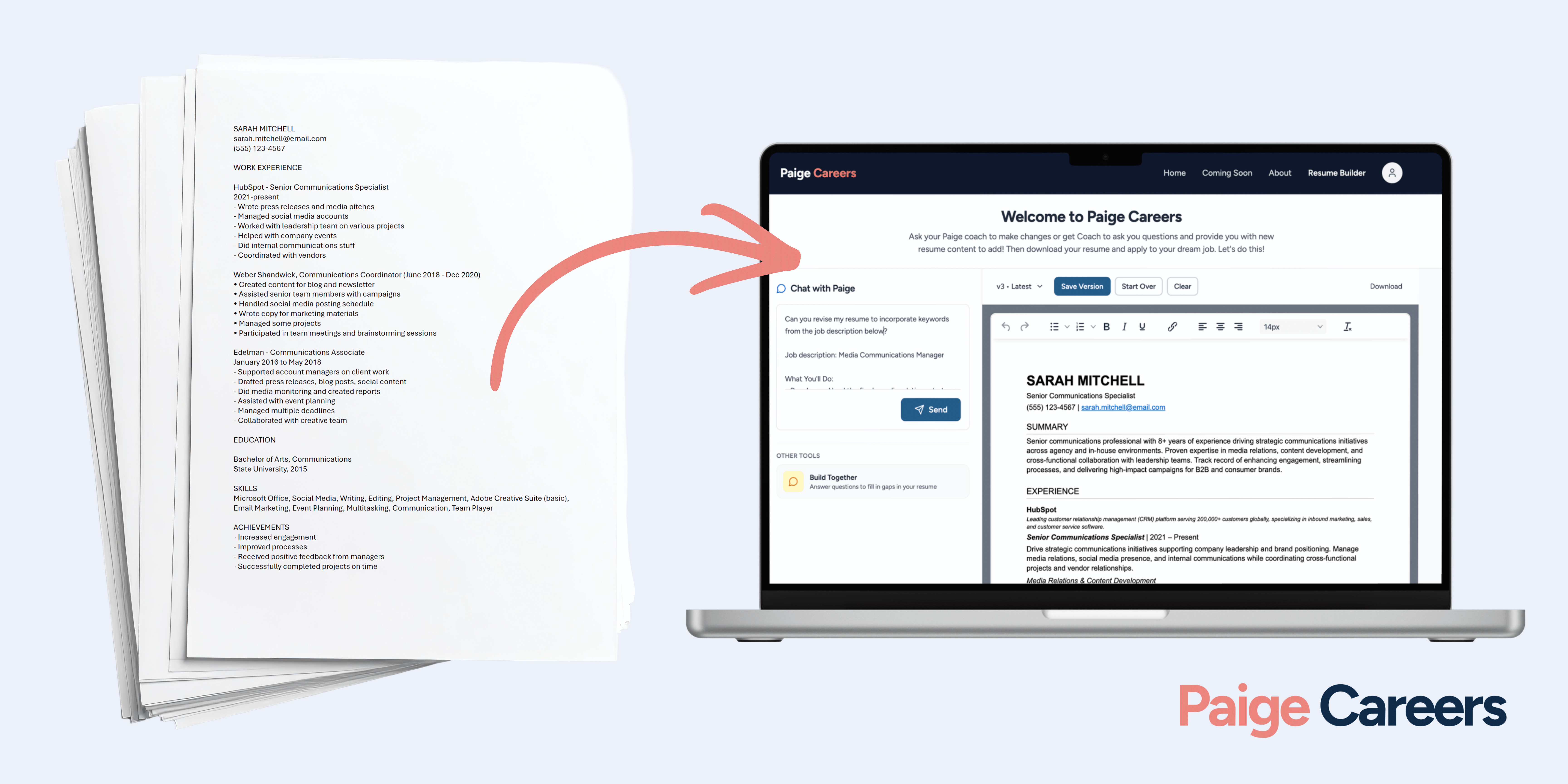
Why Your International Resume Isn't Working for US Positions
International vs. US Market Resume
Understanding the critical differences that make or break your US job market entry
| Requirement | International Resume Format | US Resume Format |
|---|---|---|
| Overall Structure | ❌Often 3-5+ pages with comprehensive career history | ✅1-2 pages (max 3 for senior executives) focused on recent, relevant experience |
| Personal Information | ❌Includes photo, date of birth, marital status, nationality | ✅Name, location (city/state), phone, email, LinkedIn only—NO photos, age, marital status |
| Work Authorization | ❌Often omitted or unclear | ✅Clear statement if applicable (e.g., "Authorized to work in US" or "H-1B visa holder") |
| Language & Spelling | ❌British English spelling (organised, analyse, specialised) or non-US phrasing | ✅American English spelling (organized, analyze, specialized) and business terminology |
| Job Titles | ❌May use UK/European/Asian title conventions that don't translate | ✅Translated to US-equivalent roles that recruiters understand |
| Resume Structure | ❌Often includes "Personal Statement," "Referees," detailed coursework | ✅"Professional Summary," accomplishments-focused bullets, no references on resume |
Ready to Make the Translation?
Paige automatically converts your international experience into US resume language that opens doors
Get Started with Paige →The Translation Problem International Professionals Face
Your international to US resume hits a wall the moment an American recruiter opens it. Here's why:
Your resume format doesn't match US expectations
That CV-style international resume with your photo, date of birth, marital status, and "References available upon request" immediately flags you as unfamiliar with US hiring norms. American employers never expect photos on resumes (and including one can actually work against you due to discrimination concerns), and personal demographic information beyond work authorization status is both unnecessary and potentially problematic.
US employers don't understand your credentials
A "First Class Honours" degree from a UK university, a "Diplôme Grande École" from France, or a professional qualification from India means nothing to most US recruiters. Your academic achievements and professional credentials need translation into US-equivalent terms that hiring managers can quickly evaluate and compare to other candidates.
Your job titles don't translate
"Managing Director" in the UK doesn't mean the same thing as "Managing Director" in the US. "Senior Consultant" at an Indian IT services firm has different scope than the same title at a US company. Even within the same company, international divisions often use different title structures. Without translation and context, US recruiters can't assess your seniority level or scope of responsibility.
You're using British English or non-US terminology
If your resume says you "organised" a project, "analysed" data, or "specialised" in a technical area, American recruiters immediately see you as an international candidate—which may or may not work in your favor. But beyond spelling, the bigger issue is business terminology. What you call "redundancy" in the UK is "layoffs" in the US. "Revenue" vs. "turnover," "roster" vs. "rota," "staff" vs. "employees"—these distinctions matter for ATS optimization and human readability.
Your work authorization status is unclear or buried
One of the first questions a US employer has about an international candidate is: "Can we actually hire this person?" If your visa status isn't immediately clear—or worse, if it's unclear whether you need sponsorship—many recruiters won't take the time to find out. They'll move on to candidates whose work authorization is obvious.
Your experience doesn't connect to US industry context
You may have worked for major companies or prestigious organizations in your home country, but if US employers don't recognize those names or understand the market context, your experience loses impact. A senior role at a top-3 consulting firm in India, a leadership position at a UK government ministry, or product management at a major Latin American retailer needs to be positioned so US employers can gauge the scale, prestige, and transferability of your experience.
The US resume cultural difference isn't superficial. It's strategic. You need international resume translation—not just editing.
What Makes International-to-US Resume Writing Different
It's Not Just About Removing Your Photo—It's About Repositioning Your Professional Identity
When rewriting your international resume for US jobs, you're not just adjusting format. You're fundamentally repositioning how American employers perceive your qualifications, experience, and readiness to succeed in the US market.
Here's what translating international experience for US audiences actually requires:
1. Translating credentials and qualifications
Your international resume for US employers needs to make your educational and professional credentials immediately recognizable. Here's what that looks like:
- ●Academic credentials → "Bachelor of Engineering (First Class Honours), equivalent to US 3.8-4.0 GPA" (not just "B.Eng First Class")
- ●Professional certifications → "Chartered Accountant (UK), equivalent to US CPA" (not just "ACA qualified")
- ●Professional qualifications → "Chartered Financial Analyst (CFA) Level III candidate" or "Prince2 Practitioner (UK project management certification)" with brief context if the credential isn't widely known in the US
- ●Market context for accomplishments → When describing achievements, provide scale and context: "Launched product across 15 European markets generating €8M revenue ($9M USD)" gives US employers the full picture
2. Demonstrating US-relevant business impact
International professionals often have exceptional experience—you just need to frame it in ways that resonate with US employers. This means converting your accomplishments into metrics and context that translate across borders.
❌ International language:
"Managed P&L of £8M for European division."
✅ US-market language:
"Directed P&L of $10M+ for European division serving 500+ enterprise clients across UK, Germany, and France."
The difference? Currency conversion, market size indicators, and client scope that US employers can quickly evaluate.
Similarly, when describing team leadership:
❌ International language: "Led team of consultants across EMEA region."
✅ US-market language: "Managed 12-person consulting team across 15 European and Middle Eastern markets, delivering $25M in annual revenue."
3. Clarifying work authorization from the start
US employers need to know immediately whether hiring you involves visa sponsorship, transfer complications, or no barriers at all. Your resume for US jobs as international candidate should make this crystal clear.
If you're authorized to work:
- •"Authorized to work in the US for any employer" (green card holders, US citizens)
- •"Authorized to work in the US without sponsorship" (EAD holders, certain visa categories)
If you need sponsorship:
- •"H-1B visa holder, no sponsorship required for current employer or transfer"
- •"Seeking H-1B sponsorship for 2026" (if you're currently in student status)
If you have time-limited authorization:
- •"Work authorization through [date], currently pursuing permanent residency"
Where to put this: Right below your contact information in your professional summary section, or in a single line between your header and summary. Don't bury this information at the bottom or leave it ambiguous.
4. Americanizing language and spelling throughout
Every international professional applying to US jobs needs to run a careful spelling and terminology check. American English isn't just about dropping the "u" from "colour"—it's about using the business vocabulary that US employers expect.
Common spelling changes:
- •organise → organize
- •analyse → analyze
- •specialise → specialize
- •optimise → optimize
- •recognise → recognize
- •realise → realize
- •favour → favor
- •labour → labor
Business terminology translation:
- •CV → Resume
- •Redundancy → Layoff / workforce reduction
- •Turnover (UK) → Revenue (US)
- •Managing Director (UK) → CEO / General Manager (US, depending on context)
- •Rota → Schedule / roster
- •Holiday → Vacation / PTO
- •Graduate scheme → Management trainee program / rotational program
- •Gap year → Career break (with context)
Paige automatically catches these differences and suggests US-market alternatives, ensuring your resume sounds native to American recruiters.
5. Eliminating location-specific jargon and adding context
Every international market has its own business norms, company hierarchies, and industry shorthand. If someone in the US wouldn't immediately understand it, it needs translation or context.
For example:
- •"Coordinated with NHS trusts" → "Collaborated with UK's public healthcare system administrators serving populations of 500K+"
- •"Managed FTSE 100 client relationships" → "Served C-suite executives at 8 UK Fortune 500-equivalent corporations"
- •"Led Mittelstand market expansion" → "Drove growth strategy targeting Germany's mid-market manufacturing sector ($10M-$1B revenue)"
- •"Supported IIM graduates in placement" → "Advised MBA students from India's top business school (acceptance rate <1%) in corporate recruitment"
Don't assume US employers know your country's business ecosystem, company rankings, or institutional prestige. Make it explicit.
How Paige Helps International Professionals Enter the US Job Market
AI-Powered Resume Translation Built on Professional Resume Writing Expertise
How Paige Works
Transform your international experience into a US-market resume in four simple steps
Upload Your Documents
Start with your current CV or resume—Paige identifies international formatting issues and eliminates US resume pitfalls
Refine with Paige
Chat with Paige to translate international credentials into US-recognizable qualifications and reframe experience in American business language
Paige Resume Builder
Use the Paige Resume Builder for key sections—strategic questioning extracts US-relevant impact from international roles and clarifies work authorization
Download & Repeat
Download your US-optimized resume, then use Versions to customize for each application—unlimited revisions as you target different roles
Paige is a resume builder for international professionals that can help tactically navigate your US job market entry. Unlike generic resume templates or AI tools that don't understand the international-to-US challenge, Paige was built by a Certified Professional Resume Writer who has guided hundreds of professionals—including international students, visa holders, and global professionals—through this exact transition.
Here's how Paige works as your international career transition tool:
Automatic International-to-US Resume Translation
After you upload your current CV or resume, Paige automatically identifies and corrects international formatting conventions and rewrites your experience in US business language. It:
- •Removes personal information that US employers don't expect (photos, birth dates, marital status, nationality—unless work authorization is relevant)
- •Converts spelling from British English or other variants to American English throughout
- •Adds company context automatically - Paige provides descriptions of international employers (company size, revenue, market position) so US recruiters can quickly gauge the scale and prestige of your experience
- •Reorganizes structure to prioritize professional summary and accomplishments over duties
For example, instead of a chronological list of responsibilities under a vague international role, Paige might organize that experience like this:
Strategic Planning & Investment Management
- ●Supported planning and monitoring of capital investment and rehabilitation programs exceeding €20M ($22M USD) annually across infrastructure portfolio.
- ●Coordinated cross-functional issues between 8 departments to ensure alignment on strategic priorities and operational execution.
Regulatory Compliance & Stakeholder Relations
- ●Coordinated with 5 state regulatory agencies (Transportation, Environmental Protection, Finance) to secure funding approvals for 12 infrastructure projects totaling €15M ($16.5M USD) annually.
- ●Prepared 30+ formal decision papers and briefing materials annually for Executive Board and Administrative Council meetings.
This reorganization makes your transferable skills for US jobs immediately visible—exactly what American hiring managers are looking for.
Don't have clear metrics? Paige inserts placeholders where data would strengthen your impact and prompts you to add specific numbers.
Want even more targeted translation? Simply ask Paige to "modify my experience to match this US job description" and you'll get hyper-specific language changes and strategic recommendations tailored to that exact position. It's like having a professional resume writer who understands both your international background and your target US industry.
This is the resume translation tool for international professionals you've been looking for.
Work Authorization Clarity
Paige helps you position your visa status or work authorization clearly and strategically—addressing the question US employers need answered without making it your defining feature. Still not confident what language to use or where to put it? Just use the chat box to ask, and Paige will make well-informed, well-researched suggestions you can apply directly to your resume.
American English and Business Terminology Coaching
Through Paige's conversation mode, you'll get real-time feedback on language that doesn't translate well to US business contexts, with suggested alternatives that make your experience resonate with American recruiters.
Paige Resume Builder: Strategic Questioning and Resume Coaching at Scale
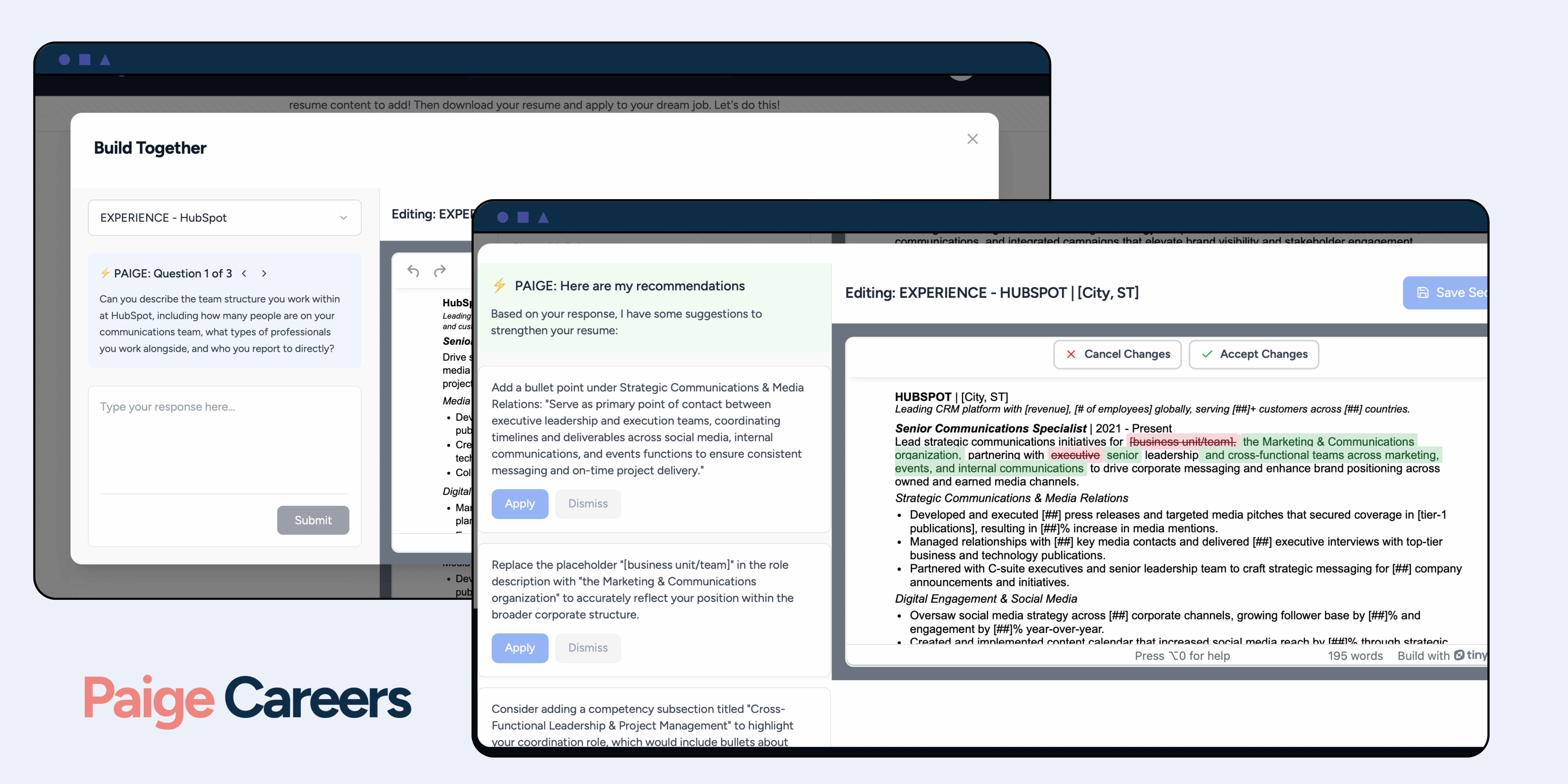
Paige Resume Builder mirrors a one-on-one consultation with a professional resume writer. Through conversational AI, Paige asks strategic questions about your international experience that extract the information US employers actually care about.
For example, Paige might ask:
- •"What was the size and revenue of the company where you worked?" (to establish scale)
- •"How does your job title compare to equivalent roles in US companies?" (to clarify seniority)
- •"What specific markets or countries did you operate in?" (to show global scope)
- •"How would you describe this accomplishment in terms US employers would understand?" (to translate impact)
These questions help you unearth how to present international experience on resume in the most compelling way. And then Paige makes specific, actionable recommendations that you can apply to your draft with a single click.
This isn't just a bullet point generator—it's interview prep. You'll be ready to answer the questions US employers will ask about your background.
International Transitions Paige Can Support
Examples across countries, industries, and career levels
A management consultant from London with experience at a Big 4 firm can use Paige to translate UK business terminology into American English, convert British academic credentials (First Class Honours) into US-recognized achievements, and reframe "managing director" title to appropriate US equivalent—opening doors to strategy consulting or corporate strategy roles at US firms.
- →UK business terminology → American English and US market language
- →British credentials → US-recognized achievements and qualifications
- →UK job titles → US-equivalent roles and responsibilities
A software engineer or tech lead from Bangalore with experience at an Indian IT services giant can use Paige to provide company context that US employers understand (scale, revenue, global clients), translate technical project scope into metrics that resonate with Silicon Valley, and clarify H-1B status—positioning for software engineering roles at US tech companies.
- →Indian IT company experience → US-recognizable company scale and context
- →Technical project scope → Silicon Valley-style metrics and achievements
- →Visa status → Clear work authorization positioning
An MBA graduate from a top European business school (INSEAD, LBS, IE Business School) can use Paige to translate their degree into US-recognizable prestige, convert thesis or consulting projects into measurable business impact, and position post-MBA work experience for US employers—whether in consulting, finance, or corporate leadership.
- →European MBA → US-recognizable business school prestige
- →Thesis/consulting projects → Measurable business impact
- →Post-MBA experience → US market positioning for consulting/finance roles
A country manager or regional director from Mexico, Brazil, or Argentina with P&L responsibility can use Paige to convert local currency metrics to USD equivalents, clarify market scale and competitive positioning, and frame Latin American business experience as emerging market expertise that US companies value—opening VP and C-suite opportunities.
- →Local currency metrics → USD equivalents and US market context
- →Market scale → Competitive positioning and business context
- →Latin American experience → Emerging market expertise for US companies
A financial analyst, business analyst, or operations coordinator from Europe, Asia, or Latin America with 2-3 years of experience can use Paige to translate their international company experience into US-recognizable achievements, reframe entry-level responsibilities to highlight measurable impact and independent contributions, and position authorization status clearly—making the transition to US entry-level or associate roles without appearing overqualified or under-experienced.
- →International company experience → US-recognizable achievements
- →Entry-level responsibilities → Measurable impact and independent contributions
- →Authorization status → Clear work eligibility positioning
A marketing director or operations leader from Sydney or Auckland can use Paige to translate APAC regional scope into US business terms, convert Australian English spelling and terminology throughout, and position Asia-Pacific market experience as global business expertise—making the transition to US roles seamless.
- →APAC regional scope → US business terms and market context
- →Australian English → American English spelling and terminology
- →Asia-Pacific experience → Global business expertise
A recent graduate from a US university on Optional Practical Training (OPT) can use Paige to highlight education from a US institution, clarify work authorization status and timeline, position internships and projects for maximum impact, and translate any international pre-university experience—landing that critical first job in the US market.
- →US university education → Highlighted US institution credentials
- →OPT status → Clear work authorization and timeline
- →Internships/projects → Maximum impact positioning for first job
A C-suite executive with international career spanning multiple countries can use Paige to streamline decades of experience into a targeted 2-3 page executive resume, translate complex international organizational structures into clear US business terms, and position global leadership as a competitive advantage—rather than a barrier.
- →Decades of international experience → Targeted 2-3 page executive resume
- →International organizational structures → Clear US business terms
- →Global leadership → Competitive advantage positioning
Common Questions About International-to-US Resume Writing
Q: Should I include my visa status on my resume?
A: Yes, if you're legally authorized to work. Be clear and upfront: "Authorized to work in the US without sponsorship" (green card holders, US citizens, EAD holders), "H-1B visa holder, authorized through [year]," or "Seeking H-1B sponsorship." Some employers won't sponsor, but the ones who will appreciate the clarity.
Q: How long should my resume be for US applications?
A: 1 page for early career professionals (under 3 years of post-graduate experience), and 2-3 pages for all other levels, even for senior executives with 35+ years of experience. US employers expect concise, results-focused resumes. Paige helps you prioritize the experience that matters most for your target US roles.
Q: Should I remove my photo from my resume for US jobs?
A: Absolutely yes. Photos on resumes are not standard in the US and can actually work against you. American employers are trained to avoid any appearance of implicit bias or discrimination; photos introduce age, race, and appearance bias into the process. Removing your photo is expected and makes you look more familiar with US hiring norms.
Q: How do I address my non-US degree?
A: Provide context so US employers can evaluate your credentials: Include GPA equivalent if strong (e.g., "First Class Honours (equivalent to 3.8+ GPA)"); Name the institution with country; Add prestige indicators if relevant; For MBA or master's degrees, mention accreditation if applicable. Don't assume US recruiters know your university or degree classification system.
Q: Can I use the same resume for US and international applications?
A: No. International markets have different resume expectations (length, personal information, format). A US-optimized resume with American English spelling and no photo won't work in Germany or the UK, just as a British CV with a photo won't work in the US. Paige focuses on creating your US-market resume, but you may need different versions for other markets.
Q: How do I explain gaps in my employment if I was between visas or relocating?
A: Be honest and matter-of-fact. US employers understand that international transitions take time. Examples: "Career break: Relocating from Singapore to US"; "Visa processing: Transitioning from F-1 student status to H-1B"; "Family relocation: Moving from UK to US, maintained freelance consulting during transition." Keep it brief, factual, and don't over-explain. A 3-6 month gap for international relocation is completely understandable.
Q: Should I include my international work experience if I'm trying to emphasize my US experience?
A: Yes, but be strategic about how much detail you include. If you have strong US experience, lead with that and include a professional summary that emphasizes your US market knowledge. Your international experience still adds value—it shows global perspective, cross-cultural skills, and often larger-scale operations. If your international experience is more senior or more relevant to your target role than your US experience, don't bury it.
Q: How do I handle spelling differences between British and American English?
A: Be absolutely consistent throughout your resume. Choose American English spelling for all US applications: Use -ize endings (organize, optimize) not -ise; Use -or endings (favor, labor) not -our; Use -yze endings (analyze) not -yse; Use -er endings (center, liter) not -re; Use -ense endings (defense, license) not -ence. Also check business terminology: use "resume" not "CV," "vacation" not "holiday," "laid off" not "made redundant." Paige automatically catches these spelling differences and converts them to American English standards.
Why International Professionals Choose Paige for US Career Transitions
Paige Provides More Than A New Resume; It Offers Strategic Market Entry Positioning
When you're figuring out how to get a job in the US as an international professional, your resume is your first—and often only—chance to make an impression. Generic resume builders can't handle the complexity of international experience translation. And hiring a US-based professional resume writer for every iteration gets expensive fast, especially when you're navigating currency exchange and may not yet have US income.
Paige gives you international resume help that combines AI efficiency with professional resume writing expertise:
- Unlimited revisions as you refine your target roles
- Real-time translation of international experience to US market impact
- Strategic positioning for the roles you actually want
- Format optimization for US ATS systems and American recruiters
- American English spelling and terminology correction throughout
- Work authorization positioning that's clear without being limiting
- Professional-quality output in a fraction of the time and cost
This is professional resume writing for international professionals that's accessible, affordable, and designed for your US market success.
Ready to Make Your International Experience Work in the US Market?
Your international professional resume for US jobs doesn't have to be a barrier to your next career move. With the right translation, your global experience becomes a competitive advantage—demonstrating cross-cultural leadership, expertise in complex international environments, and proven ability to deliver results across markets and time zones.
Paige was built for exactly this moment. Start building your US-market resume today and see how strategic translation transforms your career story.
Get Started with Paige →Paige Careers was founded by Certified Professional Resume Writer Margaret Gerety, who has coached over 300 professionals—including international students, visa holders, and global professionals—through successful US career transitions.