Military to Civilian Resume: How Veterans and Active Duty Personnel Can Successfully Transition to Civilian Careers
Most military professionals are far more qualified for civilian leadership roles than their resumes show. The problem isn't experience—it's translation.
Table of Contents
If you're transitioning from military to civilian careers, you already know your military resume won't work in the civilian job market. Your veteran resume needs to speak a different language—one that civilian hiring managers can understand and value. Whether you're an enlisted service member, NCO, warrant officer, or commissioned officer across any branch—Army, Navy, Air Force, Marines, Coast Guard, or Space Force—the challenge is the same: how do you convert military speak to language civilians understand and value…without losing the power of your experience?
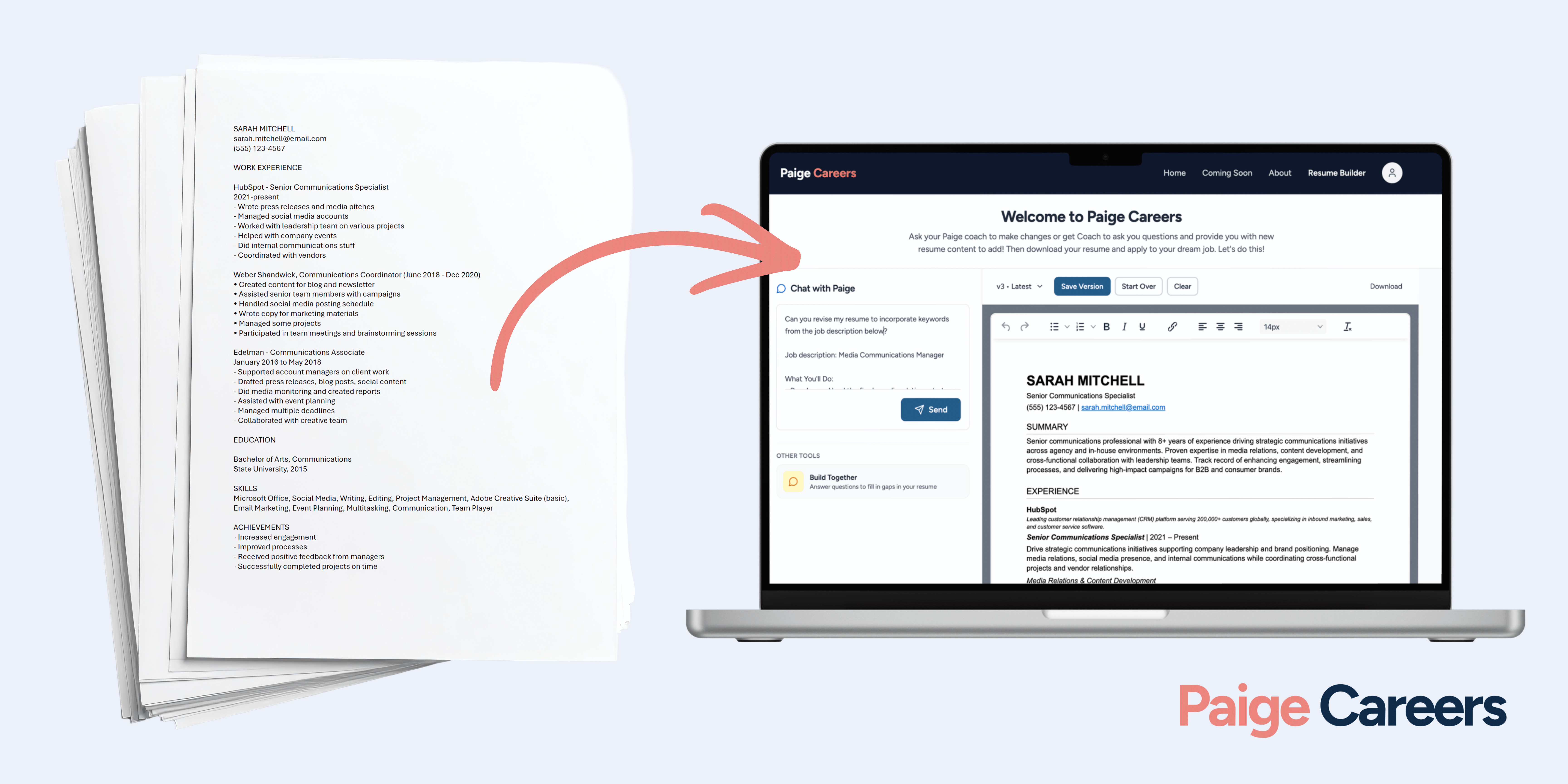
That's exactly where Paige comes in. As an AI resume builder for veterans designed by a Harvard-educated, Certified Professional Resume Writer with over 300 clients across military, federal, and private sectors, Paige doesn't just reformat your resume. It helps you strategically translate your military experience into civilian results that open doors.
Why Your Military Resume Isn't Working for Civilian Jobs
Military vs. Civilian Resume
Understanding the critical differences that make or break your career transition
| Requirement | Military Resume | Civilian Resume |
|---|---|---|
| Length | ❌Often comprehensive service records with multiple pages | ✅2-3 pages maximum, strategically focused |
| Primary Focus | ❌Duties and tasks from training manuals | ✅Results and measurable impact |
| Required Details | ❌Rank progression, duty stations, full service history | ✅Team size, budget scope, and strategic context |
| Voice & Ownership | ❌Team/unit attribution without clear individual role | ✅Strong action verbs showing individual leadership and collaboration |
| Language Style | ❌MOS codes, military acronyms (NCOIC, OIC, TAD, PCS), and branch jargon | ✅Plain language and business terminology |
| Rank & Authority | ❌Rank codes (E-7, O-3) that mean nothing to civilians | ✅Clear scope with team size, budget, and organizational level |
| Job Context | ❌Military titles and unit designations without explanation | ✅Clear role overview with business purpose and complexity |
| Professional Summary | ❌Missing or filled with military terminology | ✅Targeted professional summary in civilian language |
Ready to Make the Transition?
Paige automatically converts your military resume into civilian language that gets results
Get Started with Paige →The Translation Problem Military Service Members Face
Your military to civilian transition hits a wall the moment a civilian recruiter opens your resume. Here's why:
Your military resume uses language civilians don't understand.
MOS codes, duty stations, and military job titles mean everything within the service but nothing outside it. "35F Intelligence Analyst" or "Fire Controlman Second Class" tells a civilian hiring manager absolutely nothing about what you actually did or can do for their organization.
Military acronyms are killing your chances.
NCOIC, OIC, TAD, PCS, OPTEMPO, SITREP—every branch has hundreds of these military acronyms. When civilian recruiters see alphabet soup, they skip to the next candidate. Your accomplishments are buried under terminology that requires a military decoder ring.
You're hiding your leadership under rank structure.
In the military, "E-7" or "O-3" immediately signals your level of responsibility. In the civilian world, it means nothing. Worse, listing your rank without translating scope makes you sound junior even if you commanded 200 people and millions of dollars in equipment or resources.
Your focus is on duties, not impact.
Military resumes often read like duty descriptions from a training manual: "Maintained equipment readiness," "Conducted personnel evaluations," "Supervised daily operations." These are tasks, not accomplishments. Civilian employers need to see the results you delivered—cost savings, efficiency gains, mission success, team performance.
You're underselling your scope and complexity.
Managing logistics for a battalion deployment across three countries? That's supply chain management at massive scale. Coordinating air operations across multiple platforms? That's complex project management with life-or-death stakes. Leading a fire team in combat? That's crisis leadership under extreme pressure. But if your resume just says "Squad Leader," civilians miss the full picture.
Your resume format follows military conventions that don't translate.
Whether you're using the TAP resume format or something you created yourself, military resumes often include details that don't belong on civilian resumes: full rank progression, specific duty stations, security clearance levels in the header, or chronological lists of every assignment. Civilian resumes are strategically focused on relevant accomplishments, not comprehensive service records.
You're not claiming your individual contribution.
Like federal employees, military culture emphasizes team accomplishment and mission success. Your resume probably says "the team," "our unit," or "supported the command." But civilian employers need to know what you specifically did. If you can't articulate your individual leadership and ownership, they assume you were following orders, not making decisions.
Your summary is missing or filled with military terminology.
You might have impressive combat experience, specialized technical training, or unique operational expertise, but if it's not relevant to civilian roles or framed in civilian language, it's just noise. Civilian resumes start with targeted professional summaries that immediately show hiring managers what you bring to the table—in language they understand.
The military resume format problem isn't cosmetic. It's strategic. You need military resume translation—not just editing.
What Makes Military-to-Civilian Resume Writing Different
It's Not Just About Removing Rank—It's About Rewriting Your Story
When rewriting your military resume for civilian roles, you're not just swapping out acronyms. You're fundamentally repositioning your professional identity.
Here's what translating military experience for civilian audiences actually requires:
1. Showcasing quantifiable impact in business terms
Your military to civilian resume needs metrics that matter in the civilian world: team size, operational scale, training impact, efficiency gains, and mission success. Here's what that looks like:
- ●Team leadership → "Led 75-person cross-functional team across 3 locations in Europe and CENTCOM" (not "NCOIC for Charlie Company, 2nd Battalion")
- ●Efficiency gains → "Reduced maintenance cycle time by 35%, increasing operational readiness from 78% to 94%" (not "Improved unit readiness through enhanced maintenance procedures")
- ●People impact → "Designed and delivered leadership training program for 200+ personnel, resulting in 40% increase in promotion rates" (not "Conducted NCO professional development")
- ●Operational scale → "Coordinated logistics for 15 simultaneous operations across 4 countries involving 500+ personnel" (not "Managed deployment operations")
- ●Equipment value → "Oversaw maintenance and readiness for $85M in aviation assets, achieving 95% mission-capable rate" (not "Managed aircraft maintenance")
- ●Mission success → "Led 150+ high-risk operations with 100% mission success rate and zero personnel casualties" (not "Conducted combat operations")
2. Translating military leadership into civilian management skills
In your military role, you've led teams in high-pressure environments, made critical decisions with incomplete information, and delivered results under extreme constraints. Civilian employers value these military skills for civilian jobs—but only if you frame them in business terms that clearly demonstrate your leadership impact.
Here's the reality: military work often involves managing complex operations across multiple units, coordinating with joint service partners, and executing missions with zero margin for error. You might have led a platoon through a deployment, managed aircraft maintenance for a carrier air wing, or coordinated intelligence operations across theater. This is sophisticated leadership and program management, but civilian readers won't recognize it unless you translate the language and make it specific.
❌ Military language:
"Served as Platoon Sergeant for infantry platoon conducting combat operations in support of Operation Enduring Freedom."
✅ Civilian language:
"Led 40-person team through 12-month deployment in hostile environment, maintaining 100% personnel accountability while executing 150+ high-risk operations with zero mission failures."
3. Taking ownership: The "We" vs. "I" problem
Military culture—especially in combat arms and operational communities—emphasizes unit cohesion and collective achievement. Your resume likely avoids personal credit in favor of team success. While showcasing teamwork is valuable, not taking ownership can hide your specific contribution and decision-making authority.
Civilian employers need to see what you did as part of that team effort.
Paige helps you identify your exact role and claim it with the strongest possible active verb—while still acknowledging the collaborative nature of your work. The result? You sound both authoritative and team-oriented.
For example:
❌ "Unit successfully completed deployment with all personnel and equipment returning safely."
✅ "Led 120-person unit through 9-month deployment in Afghanistan, coordinating logistics for $85M in equipment across 4 forward operating bases."
Notice how the second version shows your leadership role while making it clear you worked collaboratively as part of a larger mission. That's the balance civilian employers are looking for.
4. Eliminating insider language & adding organizational context
Every military to civilian career transition requires a hard look at acronyms, branch-specific terminology, and military framing. If someone outside the military wouldn't immediately understand it, it needs translation.
This is especially true for specialized MOS/ratings and unit designations. "92A, 3rd STB, 1st ABCT" tells a civilian reader absolutely nothing. Instead provide a job overview in the first line of your role: "Served as Logistics Manager, Brigade Support Battalion, directing 30-person team managing supply chain operations for 4,000-person combat brigade."
Similarly, if you worked in a specialized unit—like Naval Special Warfare or Air Force Special Operations—don't assume the name explains itself. Add brief context before diving into your key achievements: "elite special operations unit conducting counter-terrorism missions" or "rapid deployment force supporting crisis response operations."
Don't just delete military terms—replace them with civilian equivalents:
- •"Battalion" → "1,000-person organization"
- •"Company/Battery/Troop" → "100-150 person team"
- •"NCOIC" → "Operations Manager" or "Team Lead"
- •"OIC" → "Director" or "Program Manager"
- •"Fire team/Squad" → "4-12 person team"
- •"Platoon" → "30-40 person team"
How Paige Helps Veterans Transition to Civilian Careers
AI-Powered Resume Translation Built on Professional Resume Writing Expertise
How Paige Works
Transform your military experience into civilian career success in four simple steps
Upload Your Resume
Start with your military resume—Paige identifies transferable skills and eliminates military jargon that doesn't work in civilian roles
Refine with Paige
Chat with Paige to translate military language into civilian terminology and reframe operational experience to highlight leadership and management impact
Paige Resume Builder
Use the Paige Resume Builder for key sections—strategic questioning extracts team size, operational scope, and leadership impact from your service
Download & Repeat
Download your civilian-ready resume, then use Versions to customize for each role—unlimited revisions as you target different industries
Paige is a resume builder for veterans and transitioning service members that can help tactically navigate military-to-civilian career transitions. Unlike generic resume templates or AI tools that don't understand the military-to-civilian challenge, Paige was built by a Certified Professional Resume Writer who has guided hundreds of military and veteran professionals through this exact transition.
Here's how Paige works as your military career transition tool:
Automatic Military-to-Civilian Translation
After you upload your military resume, Paige automatically clears out military jargon and rewrites your experience in civilian language. It identifies the kinds of competencies civilian employers value—operations management, team leadership, process improvement, crisis management, training & development—and organizes your bullet points under them so employers can quickly see how you've demonstrated these skills in your service.
For example, instead of a chronological list of duty positions, Paige might organize your experience like this:
Operations & Program Management
- ●Directed 24/7 operations center managing $40M in assets across 5 locations, maintaining 98% mission readiness.
- ●Coordinated complex logistics for 200-person deployment, delivering all personnel and equipment on schedule despite weather delays.
Team Leadership & Development
- ●Led 45-person team through high-pressure operational environment, achieving 100% retention and 85% promotion rate.
- ●Mentored 15 junior leaders, resulting in 12 successful promotions and 3 competitive program selections.
Process Improvement & Quality Control
- ●Redesigned training program that reduced qualification time by 30% while improving assessment scores by 25%.
- ●Implemented safety protocol that decreased incident rate by 60% over 18 months.
This reorganization makes your transferable skills immediately visible—exactly what civilian hiring managers are looking for.
Don't have identifiable metrics in the materials you give Paige? Paige puts in placeholders where it thinks these would make the most impact, and reminds you to insert real data and results.
Want even more targeted translation? On the home page, simply ask Paige to "modify my role to match a civilian [specific job description]" and you'll get hyper-specific language changes and strategic recommendations tailored to that exact position. It's like having a professional resume writer who understands both your military background and your target industry.
This is the resume translation tool for veterans you've been looking for.
Optimized Length and Format
Paige knows that your comprehensive military resume needs to become a 2-3 page powerhouse. It prioritizes your most relevant accomplishments, eliminates redundancy, and structures your experience for maximum impact—all while keeping your voice authentic.
Paige Resume Builder: Strategic Questioning and Resume Coaching at Scale
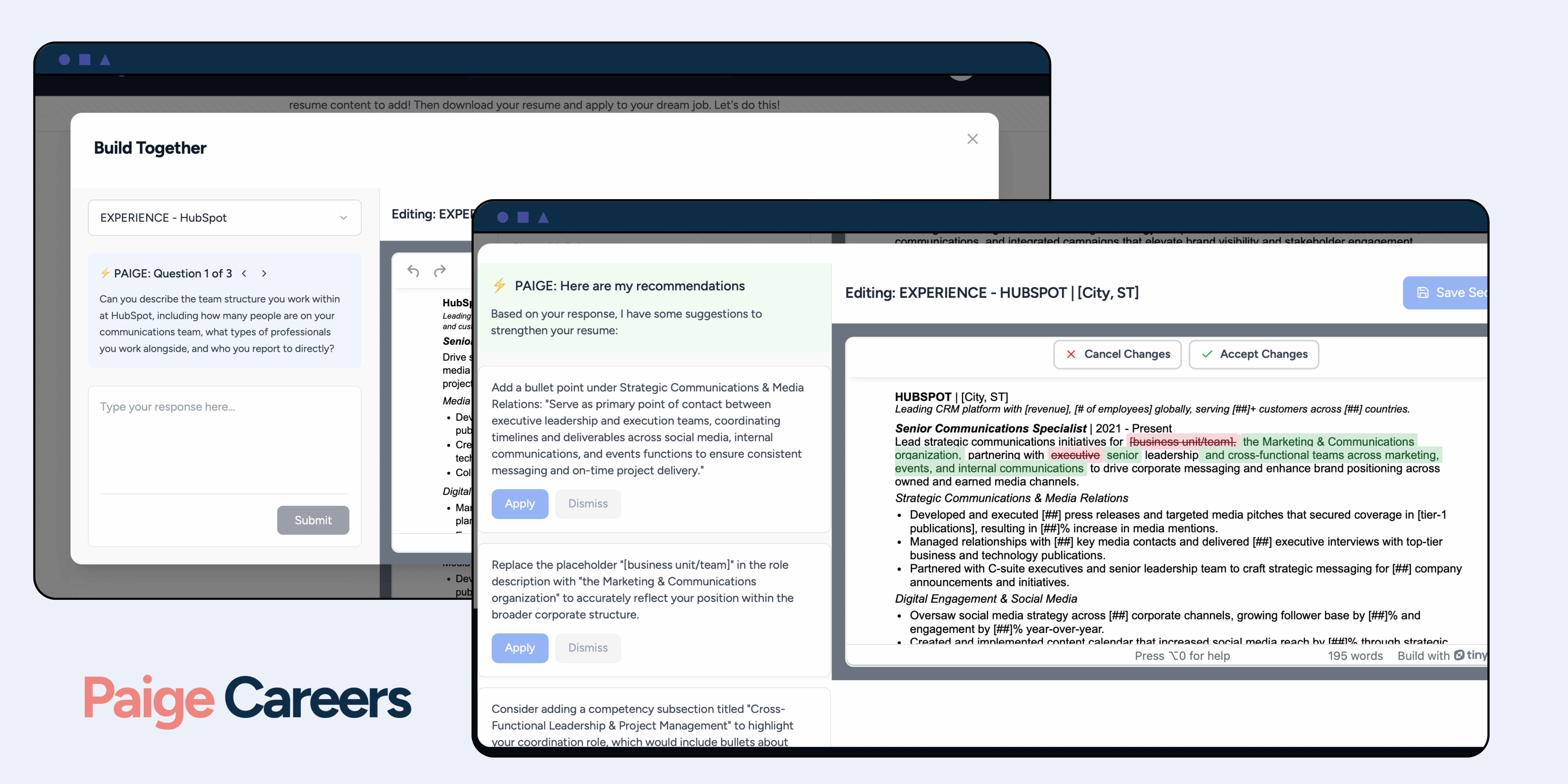
Paige Resume Builder mirrors a one-on-one consultation with a professional resume writer. It lets you take a deep dive into a specific section of your resume—for example, your most recent position—providing specific, civilian-focused resume coaching. Through conversational AI, Paige asks strategic questions about your military role that extract the information civilian employers actually care about. For example, it may ask you targeted questions about your team size, your operational scope, your specific accomplishments, and your leadership impact to help you unearth key aspects of your experience. And then Paige makes specific, actionable recommendations that you can make to your resume. With a click of a button, you can apply those changes to your working draft.
The kinds of questions you are asked in the Paige Resume Builder are the types you might expect in an interview, or by a hiring manager who feels they're missing something when going through your resume. This means that the Paige Resume Builder is not only a bullet point generator, filling in key holes and strengthening your resume content—it is an interview prep tool that helps you anticipate the types of conversations you'll expect when you meet a live person.
Military Transitions Paige Can Support
Examples across service branches and ranks
An Army Infantry Platoon Sergeant or Marine Corps Platoon Commander who led teams in combat environments can use Paige to translate tactical leadership into operations management—showcasing crisis decision-making, team performance under pressure, and mission accomplishment for roles like Operations Manager, Program Director, or Supply Chain Manager in logistics, manufacturing, or emergency management sectors.
- →Combat leadership → Crisis management and operations leadership
- →Tactical planning → Strategic program management
- →Mission execution → Project delivery and performance management
Intelligence specialists across all branches with experience in threat assessment, data analysis, and briefing senior leaders can use Paige to reframe collection management as research methodology, intelligence production as risk analysis, and briefing skills as executive communication—making transitions to corporate security, risk management, consulting, or business intelligence highly successful.
- →Intelligence collection → Research and data analysis
- →Threat assessment → Risk analysis and mitigation
- →Senior leader briefings → Executive communication and reporting
Senior NCOs (E-6 through E-9) who've led large teams, managed training programs, and ensured operational readiness can use Paige to translate their experience as team leadership, talent development, and performance management—language that resonates with companies seeking supervisors, team leads, and operations managers who can build high-performing teams.
- →Team leadership → Supervisory and management experience
- →Training programs → Talent development and onboarding
- →Operational readiness → Performance management and quality control
Junior and mid-grade officers (O-1 through O-5) who've commanded units, managed programs, and interfaced with senior stakeholders can use Paige to reposition their experience as strategic planning, program management, and cross-functional leadership—opening doors to management and director-level positions in corporate, nonprofit, and consulting environments.
- →Unit command → Strategic leadership and program management
- →Program oversight → Cross-functional project leadership
- →Stakeholder interface → Executive collaboration and communication
Logistics professionals across all branches who've managed supply operations, coordinated transportation, and maintained equipment readiness can use Paige to translate their experience into supply chain management, inventory control, vendor relations, and process optimization—making them highly competitive for civilian logistics and operations roles.
- →Supply operations → Supply chain management and logistics
- →Transportation coordination → Vendor relations and distribution
- →Equipment readiness → Process optimization and quality control
Military pilots and aviation maintenance professionals can use Paige to translate flight operations into program management, crew coordination into team leadership, and safety compliance into risk management—positioning them for roles in civilian aviation, aerospace, or complex project management environments.
- →Flight operations → Program management and operations
- →Crew coordination → Team leadership and collaboration
- →Safety compliance → Risk management and quality assurance
Military medical personnel (corpsmen, medics, nurses, physicians) can use Paige to translate combat casualty care into emergency medicine, field operations into austere environment expertise, and military treatment facilities into high-volume healthcare settings—preparing them for civilian healthcare transitions.
- →Combat casualty care → Emergency medicine and trauma care
- →Field operations → Austere environment and crisis response
- →Military treatment facilities → High-volume healthcare operations
Special operators and members of elite units can use Paige to translate unconventional operations into crisis management, small unit leadership into autonomous team performance, and mission planning into strategic program design—positioning them for high-level security, consulting, or executive leadership roles while respecting classification requirements.
- →Unconventional operations → Crisis management and problem-solving
- →Small unit leadership → Autonomous team performance and decision-making
- →Mission planning → Strategic program design and execution
Common Questions About Military-to-Civilian Resume Writing
Q: How long should my military resume be for civilian applications?
A: Ideally 2 pages, 3 maximum, even if you're a senior officer or Command Sergeant Major with 25 years of service. Most civilian hiring managers won't read beyond page 2; the majority of their time is focused on the first page. Paige helps you prioritize your most relevant accomplishments and eliminate everything else.
Q: Should I include my rank on my resume?
A: Only in specific contexts. If you're applying to defense contractors or companies that regularly hire veterans, you can include it. For most civilian employers, translate your rank into scope instead: "Senior Operations Leader (equivalent to Director-level)" or "Team Lead supervising 12 personnel" works better than "Staff Sergeant, E-6." Paige automatically helps you reframe seniority in business terms.
Q: How do I list my security clearance?
A: If you hold an active clearance (Secret, Top Secret, TS/SCI), include it in a "Certifications & Clearances" section—it's a major asset for many civilian employers, especially defense contractors and government consulting firms. If your clearance is expired or inactive, you can note "Former Top Secret clearance" to show you've been through the process, but don't present it as active.
Q: What about my military education and training?
A: Absolutely include formal military education (War College, Command and Staff College, service academies) and civilian-recognized certifications (PMP, Six Sigma, technical licenses). Skip branch-specific schools unless they're directly relevant to the civilian role. Paige helps you identify which training translates and which to leave off.
Q: Should I include my awards and decorations?
A: Selectively. High-level awards (Bronze Star, Meritorious Service Medal, combat decorations) demonstrate exceptional performance and can be mentioned briefly. Skip the routine ones (Good Conduct Medal, unit awards). Most importantly, translate what the award means: "Awarded Bronze Star for leadership during combat operations" is more powerful than just listing the award name.
Q: Can I include budget information from my military work?
A: Only if it's unclassified and approved for public disclosure. If you're unsure, use alternative metrics like equipment value, operational scale, team size, or personnel supported. Paige helps you identify appropriate metrics when budget figures aren't available.
Q: What should I do about information that may be classified?
A: When in doubt, leave it out. If you're uncertain whether information is classified or approved for public disclosure, don't include it on your resume until you've confirmed it's unclassified. Consult your unit's security manager or Special Security Officer (SSO), your Transition Assistance Program (TAP) counselor, your command's public affairs office, or your branch's personnel security office. Never assume that because you've seen information discussed publicly that it's automatically declassified.
Q: How do I show I can work in a civilian environment when I've only known military structure?
A: By highlighting adaptability and results in your accomplishments. Did you work with civilian contractors? Interface with local nationals or partner forces? Lead diverse teams? Navigate changing requirements? These details demonstrate that you can work effectively outside rigid military structure. Having a streamlined, strategically focused civilian resume is itself a demonstration of adaptability.
Q: What if I'm still on active duty and can't list a separation date?
A: That's completely fine. Note "Present" as your end date and include "Separating [Month/Year]" or "ETS [Month/Year]" in your header or summary section. Civilian employers understand military timelines and will appreciate knowing when you'll be available.
Why Veterans Choose Paige for Career Transitions
Paige Provides More Than A New Resume; It Offers Strategic Career Positioning
When you're figuring out how to transition from military to civilian careers, your resume is your first—and often only—chance to make an impression. Generic resume builders can't handle the complexity of military experience and civilian resume translation. And hiring a professional resume writer for every iteration gets expensive fast.
Paige gives you military resume help that combines AI efficiency with professional resume writing expertise:
- Unlimited revisions as you refine your target roles
- Real-time translation of military experience to civilian impact
- Strategic positioning for the roles you actually want
- Format optimization for ATS systems and human readers
- Professional-quality output in a fraction of the time
This is professional resume writing for veterans that's accessible, affordable, and designed for your success.
Ready to Make Your Military Experience Work in the Civilian World?
Your military to civilian resume doesn't have to be a barrier to your next career move. With the right translation, your military experience becomes a competitive advantage—demonstrating leadership under pressure, expertise in complex operations, and proven ability to deliver results in high-stakes environments.
Paige was built for exactly this moment. Start building your civilian resume today and see how strategic translation transforms your career story.
Get Started with Paige →Paige Careers was founded by Certified Professional Resume Writer Margaret Gerety, who has coached over 300 professionals—including veterans, career changers, and executives—through successful career transitions.