Freelance to In-House Resume: How Consultants and Contractors Can Successfully Transition to Full-Time Roles
Most freelance professionals are far more qualified for in-house leadership roles than their resumes show. The problem isn't experience—it's perception.
Table of Contents
If you're a freelancer, independent consultant, or contractor ready to transition back to full-time employment, you already know your freelance resume won't land you the in-house role you want. Your consultant to full-time employee resume needs to tell a different story—one that positions your independence as leadership experience, not a liability. Whether you've been freelancing for 2 years or 10, the challenge is the same: how do you show employers you can work within a team after years of working for teams?
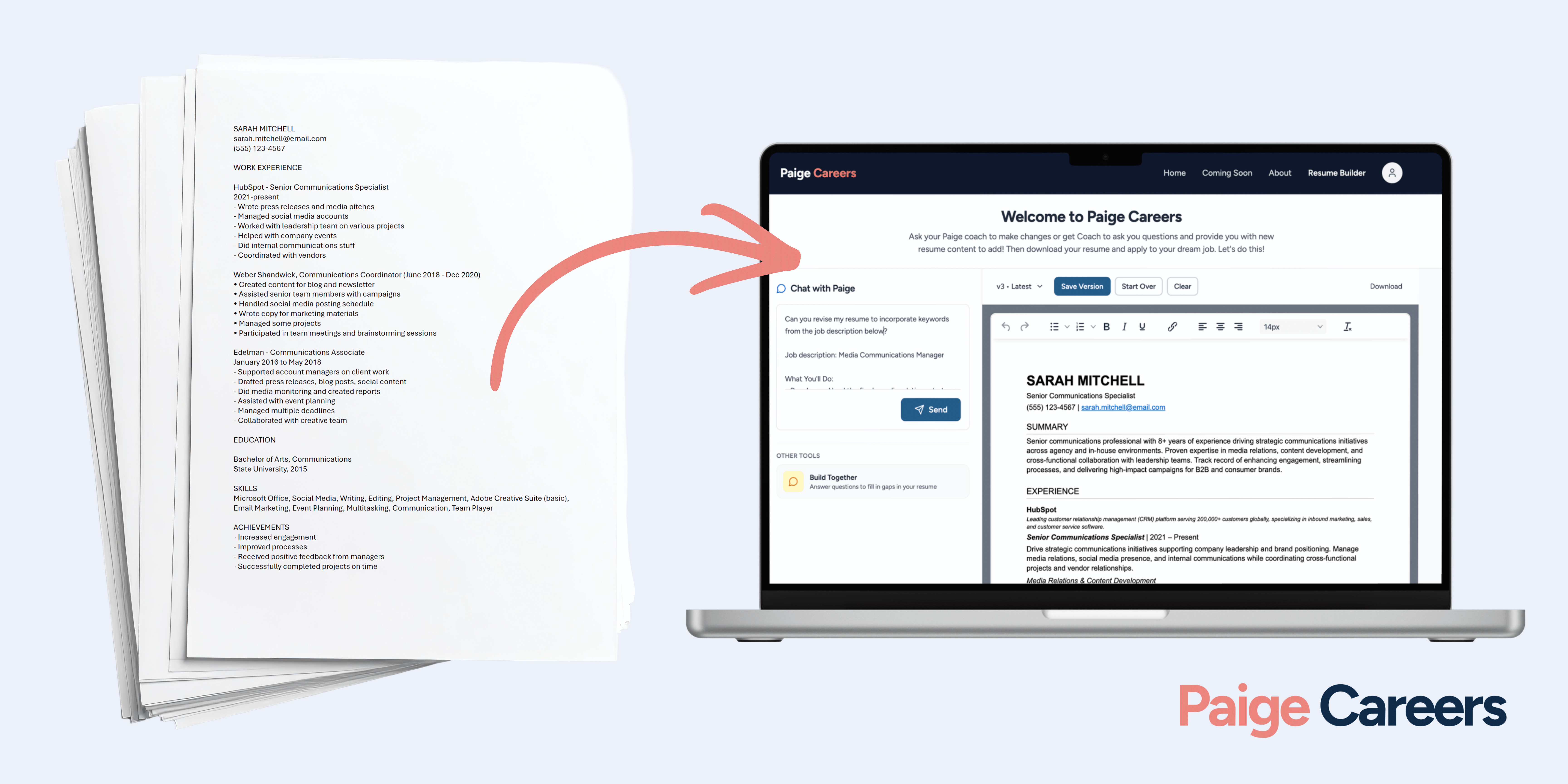
That's exactly where Paige comes in. As an AI resume builder designed by a Harvard-educated, Certified Professional Resume Writer with over 300 clients across consulting, nonprofit, and corporate sectors, Paige doesn't just reformat your resume. It helps you strategically reposition your freelance experience as in-house leadership potential that opens doors.
Why Your Freelance Resume Isn't Working for In-House Roles
Freelance vs. In-House Resume
Understanding the critical differences that make or break your career transition
| Requirement | Freelance Resume | In-House Resume |
|---|---|---|
| Team Integration | ❌"Independent Consultant" signals solo work without team collaboration | ✅Evidence of cross-functional collaboration and team leadership |
| Primary Focus | ❌Deliverables and project outputs | ✅Stakeholder relationships, consensus-building, and collaborative process |
| Earlier Experience | ❌Prior in-house roles buried at bottom or omitted entirely | ✅Earlier corporate success strategically positioned to prove in-house capability |
| Seniority & Level | ❌15 client projects listed with unclear scope or strategic level | ✅Clear indication of leadership level, scope, and strategic responsibility |
| Stakeholder Management | ❌Generic "worked with clients" without demonstrating executive presence | ✅Direct C-suite engagement and high-EQ stakeholder navigation across competing priorities |
| Transition Narrative | ❌No explanation for returning to full-time work (signals flight risk) | ✅Clear "why now" narrative showing intentional career progression |
Ready to Make the Transition?
Paige automatically converts your freelance resume into in-house language that gets results
Get Started with Paige →The Perception Problem Freelancers Face
Your freelance to in-house transition hits a wall before you even get the interview. Here's why:
"Independent Consultant" translates to "doesn't play well with others."
Whether fair or not, hiring managers often read "freelancer" as someone who couldn't handle corporate structure or preferred to avoid office politics. Your resume needs to actively counter this perception by demonstrating your collaborative leadership and team integration skills.
You're showing what you did for clients, not how you worked with them.
Freelance resumes often list deliverables—"developed marketing strategy," "created content calendar," "managed ad campaigns"—without showing the interpersonal dynamics that made the work successful. In-house employers need to see evidence that you can navigate stakeholder relationships, manage up, collaborate across departments, and build consensus. That's the real question they're asking: Can you reintegrate into a team environment?
Your earlier in-house experience is buried or missing.
Most freelancers started their careers in full-time roles—and that experience is exactly what proves you can succeed in an in-house environment. But if your last corporate job was 8 years ago and you've buried it at the bottom of your resume, recruiters never see the evidence they need. Your resume should strategically highlight that you've done this before—and successfully.
Your freelance structure hides your seniority.
When you list yourself as "Founder, [Your Name] Consulting" with 15 different client projects underneath, it's unclear what level of work you were doing. Were you executing junior-level tasks? Leading strategy? Managing teams? In-house recruiters can't tell—and they won't take the time to figure it out.
You're underselling your stakeholder management skills.
Here's what most freelancers don't realize: you've been working directly with senior leaders at every client organization. You've navigated C-suite expectations, managed competing stakeholder priorities, and delivered under intense scrutiny—all without the protection of an internal team or established relationships. That's sophisticated stakeholder management and executive presence, but your resume probably frames it as "worked with clients" instead of the high-EQ leadership skill it actually is.
Your resume lacks the "why now" narrative.
In-house recruiters are skeptical of freelancers returning to full-time work. They assume you're just looking for stability between contracts or that you'll leave the moment things get difficult. Your resume needs to actively address this: Why are you making this transition? What about in-house work appeals to you at this career stage? Without that narrative, employers will assume the worst.
The freelance resume format problem isn't cosmetic. It's strategic. You need freelance-to-corporate resume translation—not just editing.
What Makes Freelance-to-In-House Resume Writing Different
It's Not Just About Consolidating Projects—It's About Repositioning Your Professional Identity
When rewriting your freelance resume for in-house roles, you're not just organizing client engagements. You're fundamentally repositioning how employers perceive your work style, your motivations, and your ability to contribute within a traditional organizational structure.
Here's what translating freelance experience for in-house audiences actually requires:
1. Demonstrating Team Integration and Collaborative Leadership
Your freelance to full-time resume needs to prove you can work with people, not just for them. In-house employers need to see evidence of collaboration, consensus-building, and your ability to navigate internal dynamics.
Here's what that looks like:
- ●Cross-functional collaboration → "Partnered with internal marketing, product, and sales teams across 5 departments to align campaign strategy, facilitating 12+ stakeholder meetings and delivering unified go-to-market approach" (not "developed marketing campaigns for client")
- ●Team leadership without authority → "Led working group of 8 client team members across operations and IT to implement new CRM system, driving adoption from 40% to 95% within 3 months" (not "implemented CRM system")
- ●Consensus-building → "Facilitated agreement among 6 senior stakeholders with competing priorities, resulting in approved strategic roadmap and $2M budget allocation" (not "provided strategic consulting")
- ●Integration into existing teams → "Embedded with 15-person product team for 9-month engagement, collaborating daily with designers, engineers, and product managers to ship 3 major features" (not "worked on product development project")
- ●Taking direction while leading → "Reported to VP of Operations while leading cross-functional project team of 10, balancing executive vision with on-the-ground execution" (not "managed project for client")
The key is showing you weren't just parachuting in with solutions—you were rolling up your sleeves, building relationships, and working within organizational structures to drive results.
2. Showcasing Your Executive Presence and Stakeholder Management
Here's the advantage most freelancers don't recognize: as an independent consultant, you've been working directly with senior decision-makers at every engagement. You didn't have the buffer of a manager or team—you were the face of the work, managing executive expectations and delivering results under direct scrutiny.
That's sophisticated stakeholder management and executive presence—exactly what in-house employers value for senior roles. But you have to frame it properly:
❌ Freelance language:
"Provided consulting services to various clients in financial services sector."
✅ In-house language:
"Consulted directly with C-suite executives at 8 financial services firms, including 2 Fortune 500 companies, delivering strategic recommendations that influenced $50M+ in investment decisions." Or "Managed senior stakeholder expectations throughout 6-12 month engagements, presenting findings to boards and executive teams."
See the difference? The revised iterations show you operate comfortably at the executive level, manage high-stakes relationships, and deliver under pressure—all while working independently. These are exactly the skills that translate to senior in-house roles.
3. Consolidating Your Freelance Experience Strategically
One of the biggest formatting challenges for freelance resumes is how to present multiple client engagements without creating a choppy, confusing narrative. The solution isn't to list every client separately—it's to consolidate your freelance period under one headline and organize your work by functional expertise.
Here's the structure that works:
Independent Consultant, [Your Name] Consulting | [City, State] | [Date Range]
Then organize your bullet points by competency area rather than by client:
Strategic Planning & Business Development
- • Led market entry strategy for 3 SaaS companies entering healthcare vertical, resulting in 2 successful product launches and $8M in new revenue.
- • Developed 5-year strategic plans for mid-market professional services firms, including competitive analysis and organizational restructuring recommendations.
Change Management & Organizational Development
- • Guided 200-person nonprofit through leadership transition and restructuring, reducing operational costs by 18% while maintaining program quality.
- • Designed and facilitated 15+ executive workshops on change management best practices for clients ranging from 50 to 500 employees.
This approach lets you show the breadth of your expertise while making it clear you weren't just bouncing between unrelated projects—you were building deep functional expertise across multiple engagements.
4. Leveraging Your Earlier In-House Experience
If you had a successful corporate career before going freelance, that experience is gold—it proves you can thrive in an in-house environment. Don't bury it.
Even if your last full-time role was 8-10 years ago, include enough detail to show:
- • Your level of responsibility (team size, budget, strategic scope)
- • Your track record of internal collaboration and results
- • Why you were successful in that environment
For example:
Senior Marketing Manager, | [Date Range]
Built and led 8-person marketing team, growing department from individual contributor role to full functional unit.
- • Managed $2M annual marketing budget across digital advertising, content production, and events.
- • Oversaw relationships with 10+ agency partners, negotiating contracts that reduced costs by 15% while improving deliverable quality.
- • Collaborated across sales, product, and customer success to drive 40% increase in qualified leads year-over-year.
This shows you didn't leave corporate because you couldn't hack it—you left from a position of strength, gained valuable diverse experience as a freelancer, and now you're ready to bring that expanded perspective back to an in-house role.
5. Addressing the "Why Now" Question
Your resume needs to subtly answer the question every hiring manager is asking: Why are you coming back to full-time work now?
This isn't about a paragraph-long explanation—it's about strategic positioning throughout your resume:
In your professional summary: Frame your freelance experience as intentional skill-building, not desperation. "Marketing strategist with 12 years of experience, including 5 years leading in-house teams and 4 years consulting with Fortune 500 clients. Seeking to leverage diverse strategic expertise in senior in-house leadership role within mission-driven organization."
In your freelance description: Add a one-line context setter: "Transitioned to independent consulting after [buy-out of former company] or [to maintain flexibility during husband's deployment overseas]."
In your accomplishments: Show sustained client relationships and long-term thinking: "Served as retained strategic advisor to 3 clients for 2+ years each" signals commitment and relationship-building, not transactional project work.
How Paige Helps Freelancers Transition to In-House Roles
AI-Powered Resume Translation Built on Professional Resume Writing Expertise
How Paige Works
Transform your freelance resume into an in-house powerhouse in four simple steps
Upload Your Resume
Start by uploading your freelance resume—Paige automatically reorganizes client work and translates it into in-house language
Refine with Paige
Chat with Paige to highlight collaborative leadership, stakeholder management, and team integration skills that in-house employers value
Paige Resume Builder
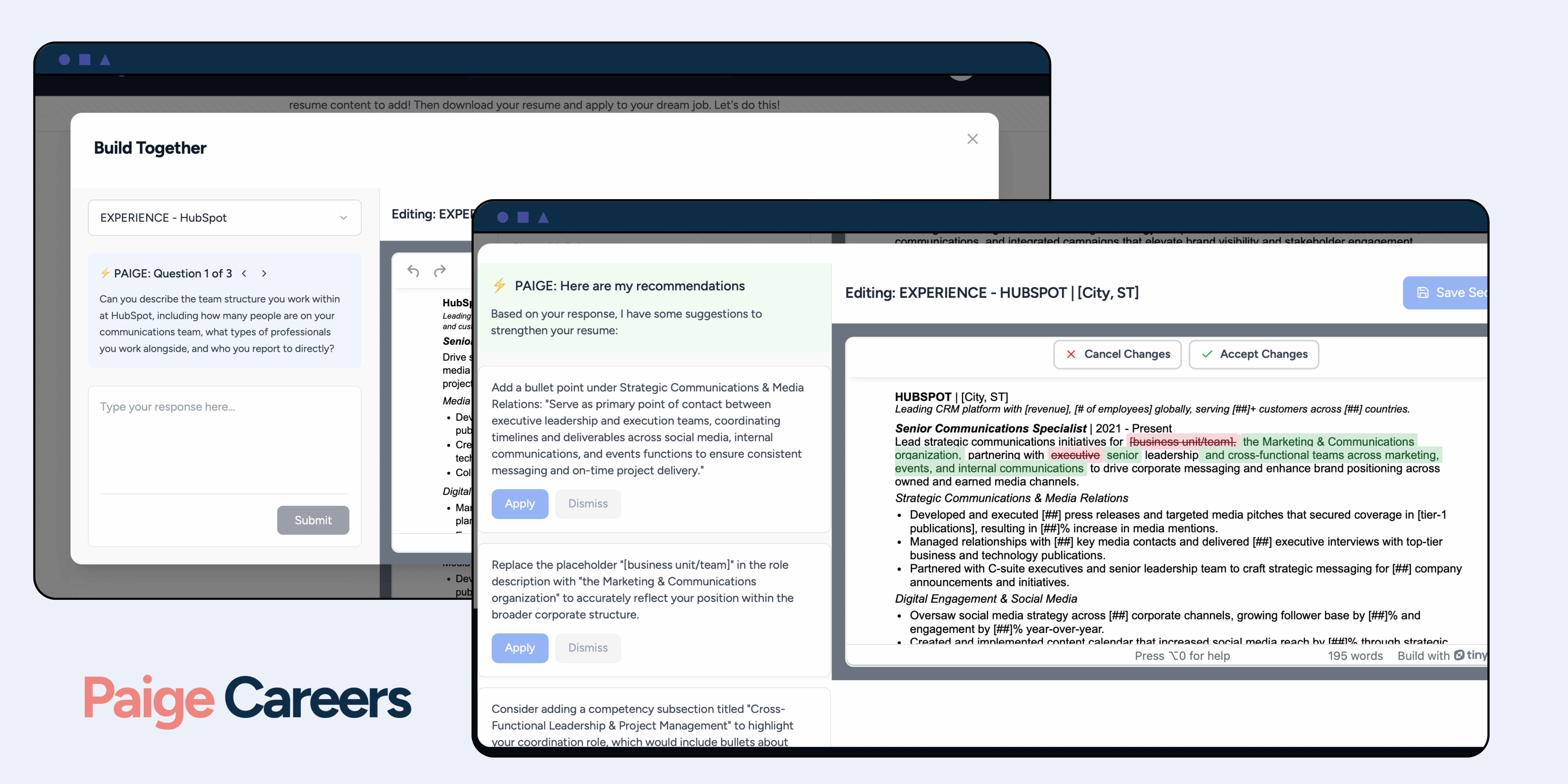
Use the Paige Resume Builder for key sections—strategic questioning extracts evidence of collaboration, consensus-building, and organizational integration
Download & Repeat
Download your in-house-ready resume, then use Versions to customize for each role—unlimited revisions as you target different companies
Paige is a resume builder for freelancers that can help you navigate the consultant-to-employee career transition. Unlike generic resume templates or AI tools that don't understand the freelance-to-in-house challenge, Paige was built by a Certified Professional Resume Writer who has guided hundreds of consultants, contractors, and freelancers through this exact transition.
Here's how Paige works as your freelance career transition tool:
Automatic Freelance-to-In-House Translation
After you upload your current resume, Paige automatically reorganizes your freelance work and rewrites it in in-house language. It identifies the competencies corporate employers value—stakeholder management, cross-functional collaboration, team leadership, change management—and organizes your accomplishments under them so employers can quickly see how you've demonstrated these skills across your engagements.
For example, instead of a chronological list of client projects, Paige might reorganize your experience like this:
Cross-Functional Team Leadership
- ●Embedded with 20-person product team at Fortune 500 consumer goods client for 18-month engagement, collaborating with engineering, design, and marketing to launch 4 major product features.
- ●Led 12-person working group across 3 departments at healthcare client, driving consensus on new patient experience strategy
Senior Stakeholder Management
- ●Consulted directly with C-suite executives at 6 companies, presenting strategic recommendations to boards and executive leadership teams.
- ●Managed complex stakeholder relationships across competing priorities, facilitating alignment on $15M strategic initiative.
This reorganization makes your collaborative skills and stakeholder management expertise immediately visible—exactly what in-house hiring managers are looking for.
Don't have specific metrics for your freelance work? Paige identifies where quantifiable results would strengthen your resume and prompts you to add them. It also helps you articulate the strategic value of your work, not just the deliverables.
Want even more targeted translation? On the home page, simply ask Paige to "modify my experience to match an in-house [specific job description]" and you'll get hyper-specific language changes and strategic recommendations tailored to that exact position. It's like having a professional resume writer who understands both your freelance background and your target company culture.
This is the resume translation tool for freelancers you've been looking for.
Strategic Positioning of Your Earlier In-House Experience
Paige knows that your pre-freelance corporate experience is crucial to proving you can succeed in an in-house role. It helps you strategically position that earlier experience—even if it's 8-10 years old—to show your track record of internal collaboration, team leadership, and corporate success.
Paige doesn't just bury your old roles at the bottom. It helps you create a narrative arc: you were successful in-house, you gained valuable diverse experience freelancing, and now you're bringing expanded expertise back to a full-time role.
Paige Resume Builder: Strategic Questioning and Resume Coaching at Scale
Paige Resume Builder mirrors a one-on-one consultation with a professional resume writer. Through conversational AI, Paige asks strategic questions about your freelance work that extract the information in-house employers actually care about.
For example, Paige might ask:
- • "Tell me about a time you had to build consensus among stakeholders with competing priorities."
- • "How did you integrate into your client's existing team structure?"
- • "What was your relationship with the senior leaders at this client? How often did you interact with them?"
- • "How did you navigate challenges when your recommendations conflicted with what the client wanted to do?"
- • "What internal teams did you work most closely with, and how did you build those relationships?"
These questions help you unearth the collaborative, stakeholder-focused aspects of your experience—the parts that prove you can work within an organization, not just for one.
And then Paige makes specific, actionable recommendations that you can apply to your resume with one click.
The kinds of questions you're asked in the Paige Resume Builder are also the types you'll face in interviews, where hiring managers will probe whether you can reintegrate into a team environment. This means the Paige Resume Builder isn't just a bullet point generator—it's interview prep that helps you articulate your collaborative leadership skills with confidence.
Freelance Transitions Paige Can Support
Examples across consultant types and experience levels
A freelance marketing consultant who's worked with 10+ clients across e-commerce, SaaS, and professional services can use Paige to consolidate fragmented client work into cohesive strategic marketing leadership—showcasing brand strategy, cross-functional collaboration, and senior stakeholder management for roles like Marketing Director or VP of Marketing at growing companies.
- →Fragmented client projects → Cohesive strategic marketing leadership
- →Client deliverables → Cross-functional collaboration and team integration
- →Independent consulting → Senior stakeholder management at executive level
HR consultants who've supported multiple organizations through change management, talent strategy, and organizational development can use Paige to reframe their independent work as strategic HR partnership—highlighting their ability to work embedded within leadership teams, facilitate difficult conversations, and drive cultural initiatives. Perfect for HRBP or Director of People Operations roles.
- →Independent HR consulting → Strategic HR partnership and embedded leadership
- →Client engagements → Change management and organizational development expertise
- →Consultant role → Ability to facilitate and drive cultural initiatives
Designers and creatives who've managed client relationships and delivered across multiple brands can use Paige to reposition their freelance experience as creative leadership within organizational constraints—showcasing their ability to collaborate with marketing teams, manage feedback from stakeholders, and balance creative vision with business objectives.
- →Client design work → Creative leadership within organizational constraints
- →Freelance projects → Collaboration with cross-functional teams
- →Independent creative → Ability to balance vision with business objectives
Independent strategy consultants who've worked with senior executives at multiple companies can use Paige to translate their external advisory work into internal strategic leadership—emphasizing their ability to navigate organizational politics, build business cases that drive decision-making, and work collaboratively with cross-functional teams to execute strategic initiatives.
- →External advisory work → Internal strategic leadership
- →Client strategy consulting → Organizational politics navigation and business case development
- →Independent consulting → Cross-functional team collaboration and execution
Fractional executives who've served in interim leadership roles at multiple companies can use Paige to consolidate their diverse leadership experience into a cohesive executive track record—showing sustained organizational impact, ability to lead and develop teams, and strategic leadership that translates to full-time VP or C-suite roles.
- →Fractional executive roles → Cohesive executive track record
- →Interim leadership → Sustained organizational impact and team development
- →Multiple company engagements → Strategic leadership at executive level
Freelance project managers who've led initiatives across different industries and organizational structures can use Paige to demonstrate their ability to work within established PMO frameworks while bringing external best practices—highlighting their stakeholder management skills, team collaboration, and ability to drive projects to completion within corporate governance structures.
- →Freelance project management → PMO framework integration
- →Multiple industry projects → External best practices and corporate governance
- →Independent PM work → Stakeholder management and team collaboration
Common Questions About Freelance-to-In-House Resume Writing
Q: How do I show I'm not a flight risk after years of freelancing?
A: By emphasizing sustained client relationships, long-term projects, and your earlier in-house track record. If you had clients who retained you for 2+ years, highlight that—it signals commitment and relationship-building. Make sure your professional summary addresses your transition directly: you're bringing valuable diverse experience to a role where you can drive sustained organizational impact. Paige helps you craft this narrative strategically throughout your resume.
Q: Should I consolidate my freelance work or list clients separately?
A: It depends on your overall career narrative. Consolidate if you have strong earlier in-house experience that needs prominent positioning—organize all freelance projects under one position and group accomplishments by functional area. List clients separately if your freelance work has been robust and impressive, particularly if you've served in fractional executive roles or worked with high-profile organizations. In either approach, focus on strategic skills and results rather than creating an exhaustive client roster. Paige helps you determine the best structure based on your unique experience and target roles.
Q: How long should my freelance resume be for in-house applications?
A: 2 to 3 pages maximum, even if you've been freelancing for 10+ years. In-house recruiters won't read beyond page 2, so you need to prioritize your most relevant accomplishments—especially those that demonstrate collaboration, stakeholder management, and sustained impact. Paige helps you consolidate and prioritize ruthlessly so your resume is punchy and focused.
Q: Should I include my earlier in-house experience even if it's 8-10 years old?
A: Absolutely. That experience is proof you can succeed in a corporate environment—which is exactly what hiring managers are wondering about. You don't need to include every bullet point from a decade ago, but you should show your level of responsibility, your internal collaborative success, and your track record of results. Keep it to 3-4 strong bullet points per older role.
Q: How do I address gaps between freelance projects?
A: By using year ranges (not month/year) for your freelance experience and by organizing your work by functional expertise rather than chronologically by client. This naturally smooths over gaps and keeps the focus on your strategic skills rather than exact timelines. For example: "Independent Consultant, [Your Name] Consulting | 2018 - 2025" frames your entire freelance period as one cohesive experience.
Q: How do I show I can take direction after being my own boss?
A: By highlighting moments in your freelance work where you reported to someone, integrated into existing team structures, or navigated competing stakeholder input. For example: "Reported to VP of Marketing while embedded with internal team" or "Collaborated closely with Head of Product to align strategy with company vision" shows you can work within a hierarchy and take direction from senior leaders. The Paige Resume Builder specifically prompts you to surface these examples from your freelance work.
Why Freelancers Choose Paige for Career Transitions
Paige Provides More Than A New Resume; It Offers Strategic Career Repositioning
When you're figuring out how to transition from freelance to full-time employment, your resume is your first—and often only—chance to overcome skepticism. Generic resume builders can't handle the complexity of freelance-to-in-house translation. And hiring a professional resume writer for every iteration gets expensive fast.
Paige gives you freelance resume help that combines AI efficiency with professional resume writing expertise:
- Unlimited revisions as you refine your target roles
- Real-time translation of freelance experience to in-house leadership
- Strategic positioning that addresses hiring manager concerns
- Format optimization for ATS systems and human readers
- Professional-quality output in a fraction of the time
This is professional resume writing for freelancers that's accessible, affordable, and designed for your success.
Ready to Make Your Freelance Experience Work for In-House Roles?
Your freelance to in-house resume doesn't have to be a barrier to your next career move. With the right translation, your independent experience becomes a competitive advantage—demonstrating executive presence, stakeholder management at the highest levels, and proven ability to drive results across diverse organizational contexts.
Paige was built for exactly this moment. Start building your in-house resume today and see how strategic translation transforms your career story.
Paige Careers was founded by Certified Professional Resume Writer Margaret Gerety, who has coached over 300 professionals—including consultants, freelancers, career changers, and executives—through successful career transitions.