Law Firm to In-House Resume: How Firm Lawyers Can Successfully Transition to Corporate Legal Roles
Most attorneys at law firms are far more qualified for in-house positions than their resumes show. The problem isn't experience—it's translation.
Table of Contents
If you're a law firm lawyer considering a transition to in-house counsel, you already know your law firm resume won't work for corporate legal departments. Your law firm to in-house resume needs to speak a different language—one that general counsels and hiring managers in corporate legal departments can understand and value. Whether you're a junior associate, senior associate, of counsel, or partner, the challenge is the same: how do you convert law firm matter lists and billable hours into the strategic business partnership language that in-house roles require...without losing the power of your legal expertise?
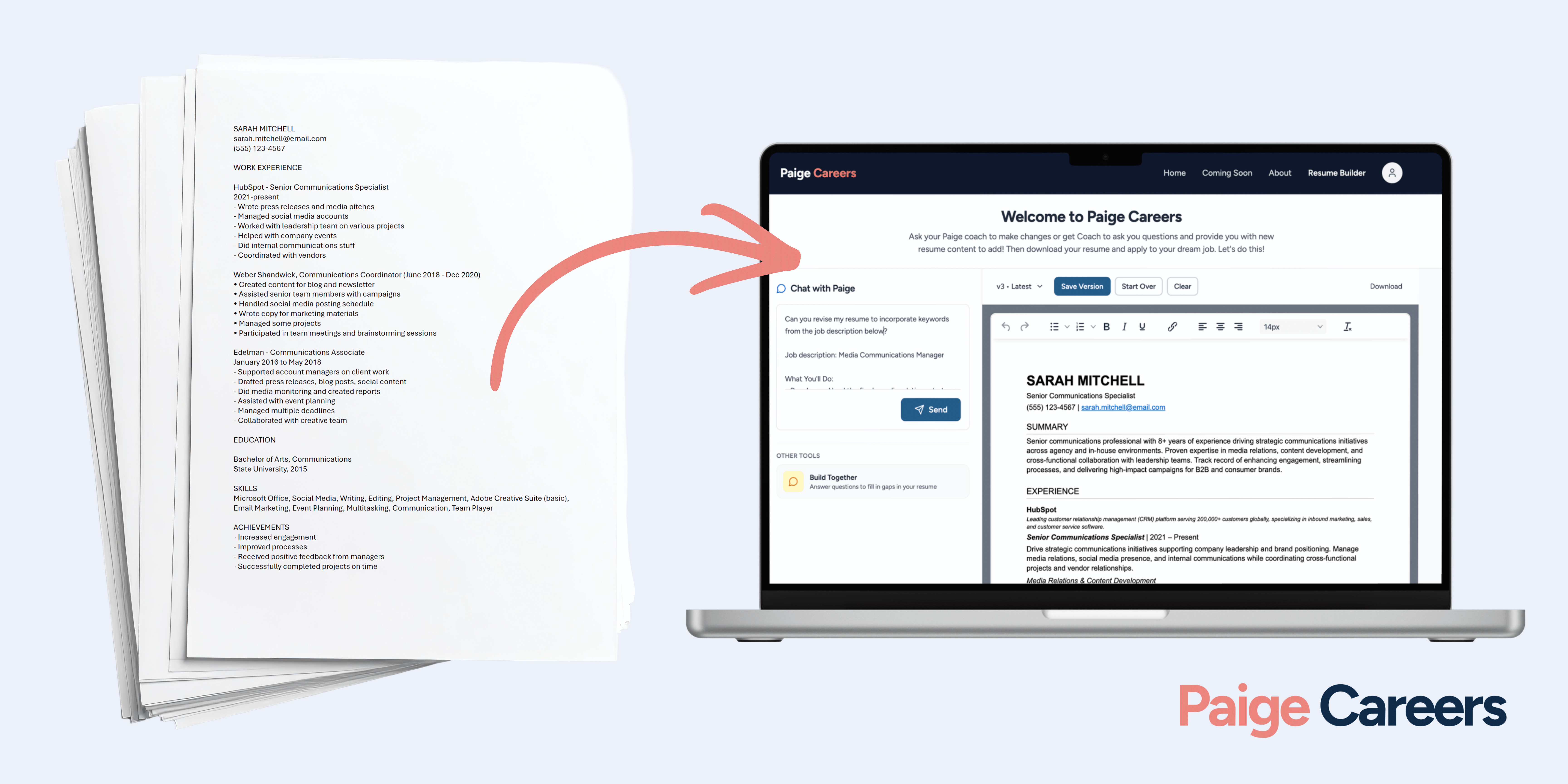
That's exactly where Paige comes in. As an AI resume builder for lawyers designed by a Harvard-educated, Certified Professional Resume Writer with over 300 clients across legal, corporate, and nonprofit sectors, Paige doesn't just reformat your resume. It helps you strategically translate your law firm experience into in-house results that open doors.
Why Your Law Firm Resume Isn't Working for In-House Positions
Law Firm vs. In-House Resume
Understanding the critical differences that make or break your firm-to-corporate transition
| Requirement | Law Firm Resume | In-House Resume |
|---|---|---|
| Overall Structure | ❌4-5 pages dense with matter details, representative cases, and billable achievements | ✅2-3 pages strategically focused on business impact, leadership, and transferable skills |
| Content Focus | ❌Chronological matter lists: "Represented..." "Advised..." "Drafted..." | ✅Business outcomes and cross-functional impact with quantifiable results |
| Language & Framing | ❌Legal process and technical expertise: litigation defense, deal execution, regulatory compliance | ✅Business value and strategic partnership: risk mitigation, cost management, practical advisory |
| Achievement Style | ❌Matter-based bullets focused on legal outcomes and technical complexity | ✅Impact-driven bullets showing business results, stakeholder value, and organizational influence |
| People & Teams | ❌Invisible collaborators; reads like solo practitioner work | ✅Explicit team leadership, cross-functional partnerships, and stakeholder management at scale |
| Professional Summary | ❌Practice area specialist: "Securities litigation attorney..." or matter list begins immediately | ✅Business-oriented professional summary positioning you as adaptable legal partner with commercial judgment |
Ready to Make the Translation?
Paige automatically converts your law firm experience into in-house language that opens doors
Get Started with Paige →The Translation Problem Law Firm Lawyers Face
Your law firm to in-house transition hits a wall the moment an in-house recruiter opens your resume. Here's why:
Your law firm resume reads like a matter list, not a career story.
That chronological list of cases and transactions (e.g., "Represented client in..." "Advised on..." "Drafted agreements for...") often leaves out key information about your strategic thinking, business acumen, adaptability under pressure, cross-functional leadership, and ability to serve as a trusted advisor to high-level leaders. In-house counsel need to see how you solve business problems, not just how many deals you closed.
You're only listing clients and matters instead of showing business impact.
Law firm resumes typically read: "Represented Fortune 500 technology companies in securities litigation" or "Advised private equity clients on M&A transactions ranging from $50M to $2B." While giving this context is key, in-house departments also need to see what business outcomes you drove: risk mitigation, cost savings, process improvement, cross-departmental collaboration, strategic positioning. If you can't translate legal work into business value, they assume you can't think like a business partner.
Your people and teams are invisible.
Law firm resumes read as if you work alone: "Drafted purchase agreement," "Conducted due diligence," "Managed discovery." But in reality, you coordinated with partners, supervised junior associates, worked with opposing counsel, managed client relationships across multiple business units, and collaborated with accountants, bankers, and other advisors. In-house roles are fundamentally about cross-functional collaboration—if you don't show you've been doing this all along, hiring managers assume you can't. They need to see the people, teams, and stakeholder complexity behind every matter.
Your expertise is siloed by practice area, not business function.
Law firm resumes organize by litigation vs. transactional, or by specific practice groups. But in-house roles require breadth and integration. A corporate counsel role might need someone who can handle employment disputes, negotiate vendor contracts, advise on regulatory compliance, AND support the product team on IP issues—all while understanding how each decision impacts the business strategy. If your resume shows you only know how to do securities litigation, you look too narrow.
Your resume screams "external advisor," not "business partner."
Law firm culture positions attorneys as outside experts who provide analysis and recommendations. In-house culture positions attorneys as internal stakeholders who collaborate across functions, understand commercial priorities, and make judgment calls that balance legal risk with business opportunity. That's a fundamentally different role—and most law firm resumes don't show you can make that shift.
You're not showing the soft skills that make you a valuable member of an in-house team.
Law firm resumes emphasize technical legal skills, case outcomes, and deal complexity. In-house resumes emphasize stakeholder management, cross-functional leadership, business judgment, practical problem-solving, and the ability to communicate complex legal concepts to non-lawyers. These are different competencies—and if you're not explicitly showing them, hiring managers will assume you don't have them.
Your professional summary (if you have one) positions you as a specialist, not a generalist.
Many law firm lawyers lead with their niche expertise: "Securities litigation attorney with extensive experience defending financial institutions" or "M&A partner focused on private equity transactions in the healthcare sector." While specialization has value, in-house departments often need versatile lawyers who can pivot across multiple legal areas and business needs. If your summary doesn't show adaptability and business orientation, you're limiting your opportunities.
The law firm resume format problem isn't cosmetic. It's strategic. You need law firm to in-house resume translation—not just editing.
What Makes Law Firm to In-House Resume Writing Different
It's Not Just About Removing Case Citations—It's About Repositioning Your Value Proposition
When rewriting your law firm resume for in-house roles, you're not just condensing content. You're fundamentally repositioning your professional identity from external expert to internal business partner.
Here's what translating law firm experience for in-house audiences actually requires:
1. Showcasing business impact, not just legal outcomes
Your law firm to in-house resume needs metrics that matter in corporate legal departments: cost savings, process efficiency, risk mitigation, business enablement, cross-functional collaboration. Here's what that looks like:
- ●Matter volume → business scalability: "Managed portfolio of 40+ commercial contracts annually, developing template agreements that reduced negotiation time by 50%" (not "Negotiated and drafted various commercial agreements")
- ●Litigation defense → risk management: "Reduced company's employment litigation exposure by 60% through proactive policy review and manager training programs" (not "Defended employer in 15 employment discrimination cases")
- ●Regulatory work → compliance infrastructure: "Built and implemented GDPR compliance framework across 8-country European operation, enabling $200M market expansion" (not "Advised on data privacy regulatory requirements")
- ●Transaction experience → deal support: "Supported 20+ acquisitions totaling $500M by leading due diligence, identifying material risks, and negotiating key terms under aggressive timelines" (not "Represented buyer in various M&A transactions")
- ●Team leadership & coordination → project management: "Directed 8-person deal team (4 associates, 2 paralegals, 2 contract analysts) through simultaneous closings of 3 acquisitions, coordinating with client's M&A, tax, and treasury departments plus 6 outside advisors to complete $300M in transactions within 60-day window" (not "Worked on multiple M&A transactions for private equity client")
- ●Client advisory → stakeholder partnership: "Served as primary legal advisor to C-suite and board on governance matters, providing practical guidance that balanced legal risk with business objectives" (not "Provided legal counsel to senior management")
2. Translating law firm skills into in-house competencies
In your law firm role, you've likely managed complex matters, worked with sophisticated clients, and handled high-stakes legal issues. In-house employers value these experiences—but only if you frame them in terms that demonstrate your ability to function as a business partner, not just a legal technician.
Here's the reality: law firm work often involves managing multiple concurrent deadlines, navigating partner demands, and delivering technically excellent legal work under pressure. You might have juggled 15 active matters while maintaining a 2,000+ billable hour target. Or coordinated with teams across five offices on a major transaction. This is sophisticated legal project management, but in-house readers won't value it unless you translate the language and show business relevance.
❌ Law firm language:
"Managed litigation matters for financial services clients, including discovery coordination, motion practice, and trial preparation across multiple jurisdictions."
✅ In-house language:
"Led litigation strategy for financial services matters with potential exposure of $50M+, managing outside counsel spend of $2M annually while reducing average time-to-resolution by 30% through strategic settlement negotiations."
Notice how the second version shows cost consciousness, strategic thinking, and results—exactly what in-house departments are looking for.
3. Making project management and cross-functional collaboration visible
Every significant law firm matter is actually a complex project involving multiple stakeholders, competing timelines, and cross-functional coordination. But most law firm resumes hide this reality, making you sound like a solo practitioner rather than a collaborative leader.
In-house roles require constant cross-functional work—you're the legal partner to HR, Finance, Sales, Product, Marketing, and Operations. If your resume doesn't show you already do this, you won't look ready for in-house work.
Here's what making collaboration visible looks like:
❌ Solo practitioner language: "Managed securities litigation matter through trial."
✅ Team leadership language: "Led litigation team of 5 attorneys and 2 paralegals defending securities class action with $200M exposure, coordinating with client's CFO, General Counsel, and Board Audit Committee while managing relationships with forensic accountants and expert witnesses across 18-month case lifecycle."
❌ Invisible stakeholders: "Advised on $500M acquisition."
✅ Cross-functional collaboration: "Served as lead attorney on $500M acquisition, supervising team of 3 associates while coordinating with client's corporate development, finance, and HR teams, managing 4 outside vendors (investment bankers, accountants, environmental consultants), and negotiating directly with seller's C-suite and board representatives."
❌ Generic advisory work: "Counseled clients on employment matters."
✅ Stakeholder management at scale: "Advised HR leadership team of 12 across 6 business units on employment strategy, partnering with business leaders to implement policy changes affecting 2,000+ employees."
These kinds of changes aren't inflating your experience—they are making visible the project management and collaboration that was always there. Paige helps you identify these hidden elements through strategic questioning and adds them automatically to your resume.
4. Demonstrating you can be a generalist, not just a specialist
Most in-house roles—especially at mid-sized companies—require legal breadth. Even if you're hired for a specific expertise area, you'll be expected to handle adjacent issues and collaborate across legal functions.
If you're a litigator, show that you can handle non-litigation work. If you're a transactional attorney, demonstrate you understand compliance and risk management. If you specialize in one industry, highlight transferable skills that apply across sectors.
For example:
❌ Siloed specialist:
"Securities litigation associate with 8 years of experience defending financial institutions in complex securities fraud class actions and regulatory investigations."
✅ Adaptable business lawyer:
"Senior litigator with 8 years of experience supporting commercial litigation, securities matters, and regulatory advisor work across banking, asset management, and fintech sectors. Defended financial institutions in complex securities fraud class actions and regulatory investigations, managing matters with $500M+ in exposure. Served as business advisor to clients, drafting proactive risk mitigation strategies, including development of disclosure policies, internal investigation protocols, and employee training programs that reduce litigation exposure."
The second version shows you understand how different legal functions connect to business needs—that's the mindset in-house departments want.
5. Showing you can communicate with non-lawyers
One of the most critical in-house skills is the ability to translate complex legal concepts for business stakeholders who may have no legal training. Law firm resumes often use dense legal terminology that signals you primarily communicate with other lawyers.
In-house resumes should demonstrate:
- •Plain language communication skills
- •Ability to present legal issues to C-suite executives and boards
- •Experience training non-legal teams on compliance matters
- •Track record of making legal concepts accessible and actionable
❌ Lawyer-to-lawyer language:
"Conducted comprehensive Daubert analysis of expert testimony in products liability MDL, resulting in successful motion to exclude plaintiff's causation expert."
✅ Business-oriented language:
"Developed complex litigation strategy that eliminated $100M in potential damages by successfully excluding plaintiff's key expert testimony."
How Paige Helps Law Firm Lawyers Transition to In-House Roles
AI-Powered Resume Translation Built on Legal Career Expertise
How Paige Works
Transform your law firm resume into an in-house powerhouse in four simple steps
Upload Your Resume
Start with your law firm resume—Paige identifies transferable skills and eliminates matter list formatting that doesn't work in-house
Refine with Paige
Chat with Paige to translate law firm language into business partnership terminology and reframe litigation/deal work to highlight cross-functional impact
Paige Resume Builder
Use the Paige Resume Builder for key sections—strategic questioning extracts business context, team leadership, and practical advisory from your matters
Download & Repeat
Download your in-house-ready resume, then use Versions to customize for each role—unlimited revisions as you target different legal departments
Paige is a resume builder for lawyers that can help tactically navigate law firm-to-in-house career transitions. Unlike generic resume templates or AI tools that don't understand the firm-to-in-house challenge, Paige was built by a Certified Professional Resume Writer and former attorney who has guided hundreds of legal professionals through this exact transition.
Here's how Paige works as your in-house career transition tool:
Automatic Law Firm to In-House Translation
After you upload your law firm resume, Paige automatically rewrites your experience in in-house language. It identifies the competencies corporate legal departments value—business judgment, cross-functional collaboration, risk management, practical problem-solving, vendor management—and organizes your experience to showcase these skills.
For example, instead of a chronological list of matters, Paige might reorganize your experience like this:
Strategic Legal Advisory
- ●Counseled senior client leadership on complex regulatory issues, translating technical compliance requirements into actionable business strategies.
- ●Advised cross-functional teams on product launches, enabling $50M revenue opportunity and managing IP and regulatory risk.
Risk Management & Litigation
- ●Led team addressing 10-person wage and hour class action, partnering with client's HR, finance, and operations leaders to develop settlement strategy that reduced exposure by 70% while implementing policy changes across 15 locations.
- ●Managed portfolio of 25+ commercial disputes, supervising 2 associates and coordinating with internal teams across 5 divisions.
Contract & Vendor Management
- ●Negotiated enterprise agreements with 10+ technology vendors, achieving $500K annual savings while improving service terms.
- ●Developed standardized contract templates and playbooks that reduced legal review time by 40%.
This reorganization makes your business orientation immediately visible—exactly what in-house hiring managers are looking for.
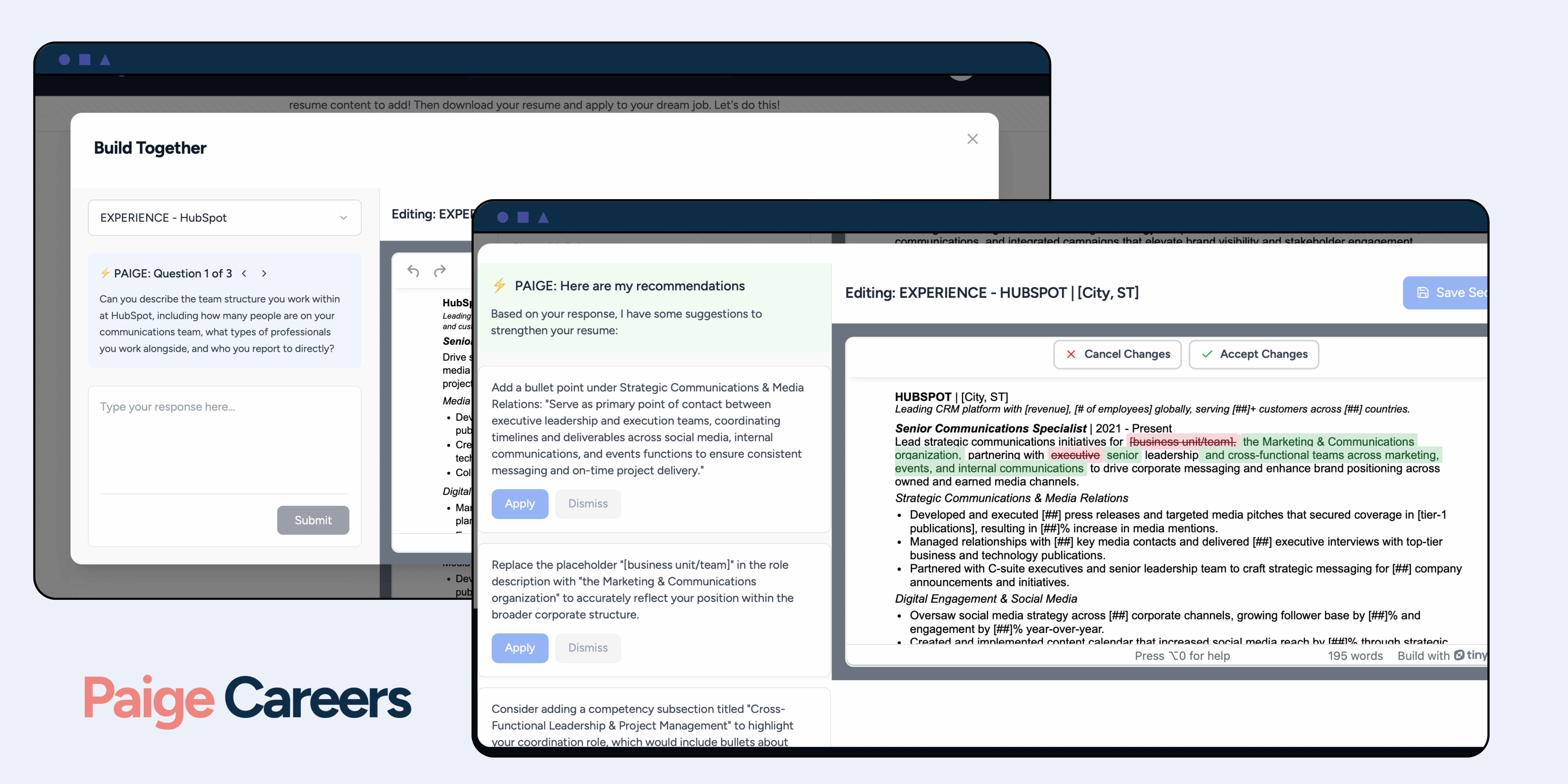
Don't have identifiable metrics in the materials you give Paige? Paige puts in placeholders where it thinks these would make the most impact, and reminds you to insert real data and results.
Want even more targeted translation? On the home page, simply ask Paige to "modify my experience to match an in-house [specific job description]" and you'll get hyper-specific language changes and strategic recommendations tailored to that exact position. It's like having a legal career coach who understands both your law firm background and your target in-house role.
This is the resume translation tool for law firm lawyers you've been looking for.
Optimized Length and Format
Paige knows that your 4-5 page law firm resume needs to become a focused 2-3 page document. It prioritizes your most relevant accomplishments, eliminates redundancy, and structures your experience for maximum impact—all while keeping your voice authentic.
Paige Resume Builder: Strategic Questioning and Resume Coaching at Scale
Paige Resume Builder mirrors a one-on-one consultation with a legal career advisor. It lets you take a deep dive into a specific section of your resume—for example, your current associate position—providing specific, in-house resume coaching. Through conversational AI, Paige asks strategic questions about your law firm role that extract the information in-house employers actually care about. For example, it may ask you targeted questions about the business context of your work, your cross-functional collaborations, and your practical problem-solving to help you unearth key aspects of your experience. And then Paige makes specific, actionable recommendations that you can make to your resume. With a click of a button, you can apply those changes to your working draft.
The kinds of questions you are asked in the Paige Resume Builder are the types you might expect in an interview with a general counsel or hiring manager who wants to understand how you think about legal work in a business context. This means that the Paige Resume Builder is not only a bullet point generator, filling in key holes and strengthening your resume content—it is an interview prep tool that helps you anticipate the types of conversations you'll expect when you meet a live person.
Law Firm Transitions Paige Can Support
Examples across practice areas and experience levels
A 3rd-year litigation associate who's handled employment disputes, commercial litigation, and internal investigations can use Paige to translate courtroom experience into risk management, compliance advisory, and practical business counseling—positioning themselves for Associate Counsel or Corporate Counsel roles at mid-sized companies.
- →Employment litigation → Employment risk management and policy development
- →Commercial disputes → Contract negotiation and vendor management
- →Internal investigations → Compliance advisory and training
A 6th-year transactional associate with M&A and commercial contracts experience can use Paige to reposition deal experience as strategic business partnership: leading cross-functional teams, managing sophisticated negotiations, and providing practical commercial advice—opening doors to Senior Counsel roles at growth companies or established corporations.
- →M&A transactions → Strategic deal support and due diligence leadership
- →Commercial contracts → Vendor management and contract optimization
- →Client advisory → Business partnership and strategic counsel
Associates with regulatory, white collar, or compliance advisory experience can use Paige to reframe regulatory expertise as compliance program development, risk assessment, and policy implementation—making their transition to Compliance Counsel or Director of Compliance roles far more successful.
- →Regulatory advisory → Compliance program development
- →White collar defense → Risk assessment and internal controls
- →Client counseling → Policy implementation and training
Of counsel attorneys who've managed client relationships, supervised junior lawyers, and handled diverse legal matters can use Paige to translate that breadth into executive legal leadership: building legal functions from scratch, managing outside counsel, advising boards, and serving as a business partner to C-suite executives—positioning them for GC or CLO roles at startups and mid-sized companies.
- →Client relationship management → Executive advisory and board governance
- →Supervising associates → Team building and legal department leadership
- →Diverse practice areas → Integrated legal and business strategy
IP litigation associates and senior associates can use Paige to showcase their technical expertise while demonstrating business orientation: patent portfolio strategy, trademark protection, licensing negotiations, and IP risk management—language that resonates with technology companies and innovative manufacturers seeking in-house IP counsel.
- →IP litigation → Patent portfolio strategy and IP risk management
- →Trademark disputes → Brand protection and trademark portfolio development
- →Technical expertise → Business-oriented IP counsel and licensing
Senior corporate associates with securities, governance, and M&A experience can use Paige to translate technical expertise into strategic advisory: board governance, SEC compliance, executive compensation, and corporate development—positioning them for Assistant General Counsel roles at publicly traded companies.
- →Securities work → SEC compliance and disclosure strategy
- →Corporate governance → Board advisory and governance best practices
- →M&A transactions → Corporate development and strategic transactions
Partners with established practices and client management experience can use Paige to reposition their leadership as executive-level legal strategy: building and managing teams, controlling legal spend, mitigating enterprise risk, and serving as trusted advisor to senior leadership and boards—opening doors to GC and CLO roles at larger organizations.
- →Practice management → Legal department leadership and team building
- →Client development → Executive advisory and board governance
- →Business development → Strategic legal partnership and risk management
Partners with both transactional and regulatory experience can use Paige to showcase the integrated legal and compliance leadership that many companies now seek: combining corporate governance, regulatory compliance, risk management, and strategic advisory—positioning them for Chief Legal & Compliance Officer roles that oversee both functions.
- →Transactional + regulatory expertise → Integrated legal and compliance leadership
- →Client advisory → Enterprise risk management and strategic counsel
- →Practice leadership → Executive legal and compliance strategy
Common Questions About Law Firm to In-House Resume Writing
Q: How long should my law firm resume be for in-house applications?
A: Ideally 2 pages, but 3 maximum in the case of extensive speaking engagements, publications, or community leadership. Most in-house hiring managers won't read beyond page 2; the majority of their time is focused on the first page. Paige helps you prioritize your most relevant accomplishments and eliminate everything else.
Q: Should I list every matter I've worked on?
A: No. This is not a resume you're creating for a lateral move. You do not need a list of representative matters or cases, or a "book of business." In-house departments want to understand your case or deal experience, but they also need to see business judgment, strategic thinking, teamwork, and relevant subject matter expertise. Paige helps you identify which matters best demonstrate in-house-relevant skills.
Q: How do I describe my matters without violating client confidentiality?
A: Use industry and deal/matter characteristics instead of client names (e.g., "Led securities litigation defense for Fortune 500 financial services company" or "$2B merger of publicly traded healthcare providers"). For publicly disclosed matters you can be more specific. Focus on your role, the complexity, and the business context rather than privileged details. Use ranges for deal values. In-house hiring managers understand these constraints—they're lawyers too. Paige helps you strike this balance by focusing on matter characteristics, team dynamics, and business outcomes.
Q: What should I do with my internal law firm leadership roles—recruiting, committee work, mentoring, etc.?
A: Include them! Committee memberships, recruiting coordination, summer associate mentoring, affinity group leadership, and pro bono work demonstrate leadership beyond billable work, ability to manage people and projects, and cross-functional collaboration. For partners and of counsel attorneys, firm management experience is especially valuable—executive committees, practice group management, associate development. These roles directly translate to the people management and organizational leadership that in-house departments need. Paige helps you determine which internal leadership activities strengthen your in-house positioning and where to feature them most effectively.
Q: How do I show I can handle the business side of legal work when my firm experience is purely legal?
A: By reframing the business context that was always present in your law firm work. Every matter had a business objective—a transaction that needed to close, a dispute that needed to settle, a regulatory risk that needed to be managed. Show you understand those business drivers and how your legal work enabled business outcomes. Also highlight any experience with budget management, outside counsel or vendor management, client relationship ownership, cross-functional team coordination, or practical business advisory. Don't forget about committee memberships, hiring and recruiting work, and mentoring activities.
Q: Should I update my LinkedIn profile for my in-house search?
A: Yes! Many law firm lawyers neglect LinkedIn because their firms maintain their bios, but in-house recruiters heavily rely on LinkedIn for candidate sourcing. Your LinkedIn should be written in the same business-oriented, in-house language as your resume: emphasize cross-functional collaboration, business impact, and strategic advisory rather than matter lists and technical legal work. Use industry descriptors and deal characteristics to maintain client confidentiality while showing expertise. Model Rule 7.1 prohibits false or misleading communications, but being active and strategic on LinkedIn while maintaining confidentiality is entirely consistent with professional conduct rules.
Q: How do I address the perception that I can't handle the pace and ambiguity of in-house work?
A: By highlighting examples where you've made judgment calls with incomplete information, managed competing priorities, or delivered practical solutions under time pressure. Combat the worry that law firm lawyers are too academic or too cautious by showing you're pragmatic, decisive, and comfortable with business risk. Also, the quality of your resume itself sends a signal—a streamlined, business-focused resume demonstrates you can prioritize, communicate concisely, and understand what your audience cares about.
Why Law Firm Lawyers Choose Paige for In-House Transitions
Paige Provides More Than a New Resume; It Offers Strategic Career Repositioning
When you're figuring out how to transition from law firm to in-house, your resume is your first—and often only—chance to make an impression. Generic resume builders can't handle the complexity of translating law firm experience into in-house value. And hiring a professional resume writer for every iteration gets expensive fast.
Paige gives you law firm to in-house resume help that combines AI efficiency with legal career expertise:
- Unlimited revisions as you refine your target roles
- Real-time translation of law firm experience to in-house impact
- Strategic positioning for the roles you actually want
- Format optimization for ATS systems and human readers
- Professional-quality output in a fraction of the time
This is professional resume writing for lawyers that's accessible, affordable, and designed for your success.
Ready to Make Your Law Firm Experience Work In-House?
Your law firm to in-house resume doesn't have to be a barrier to your next career move. With the right translation, your law firm experience becomes a competitive advantage—demonstrating sophisticated legal expertise, high-stakes problem-solving, and proven ability to deliver under pressure.
Paige was built for exactly this moment. Start building your in-house resume today and see how strategic translation transforms your career story.
Get Started with Paige →Paige Careers was founded by Certified Professional Resume Writer Margaret Gerety, a former WilmerHale attorney who has coached over 300 professionals—including junior associates, senior lawyers, and executives—through successful career transitions.