Resume for Recent Graduates: How New College Grads Can Land Their First Professional Role
Most recent graduates are far more qualified for professional roles than their resumes show. The problem isn't experience—it's translation.
Table of Contents
If you're a recent graduate or college senior preparing for your first job out of college, you already know your student resume won't compete in the professional job market. Your entry level resume needs to speak a different language—one that hiring managers can immediately recognize as valuable, even without years of work history. Whether you're a business major, STEM graduate, liberal arts student, or career changer with a fresh degree, the challenge is the same: how do you write a resume with no work experience that proves you're ready to deliver from day one?
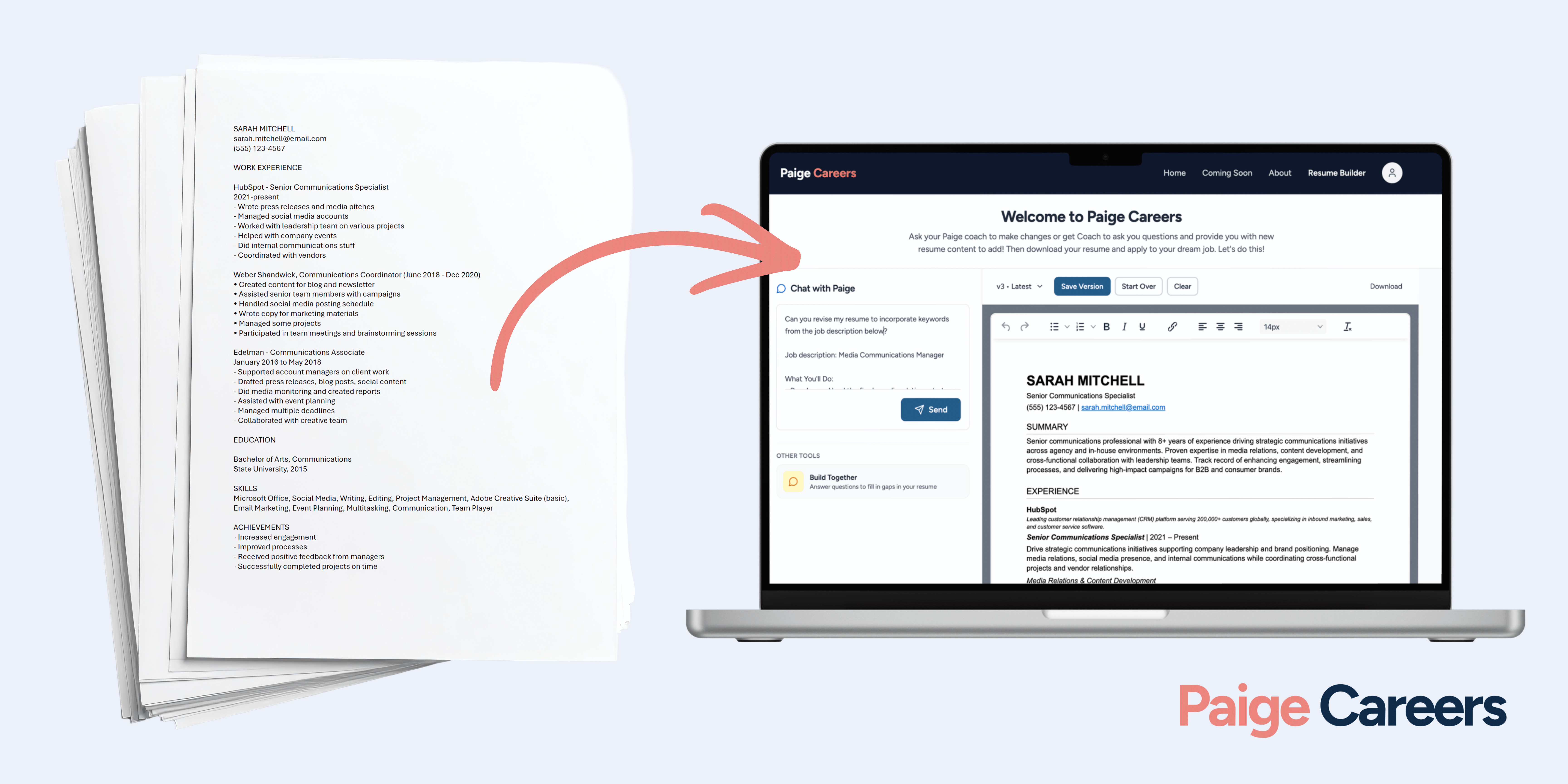
That's exactly where Paige comes in. As an AI resume builder for recent graduates designed by a Harvard-educated, Certified Professional Resume Writer with over 300 clients across industries and career stages, Paige doesn't just fill in a template. It helps you strategically translate academic experience to professional resume content that opens doors.
Why Your Student Resume Isn't Working for Professional Jobs
Student vs. Professional Resume
Understanding the critical differences that make or break your college-to-career transition
| Requirement | Student Resume | Professional Resume |
|---|---|---|
| Overall Structure | ❌Large white spaces, gaps, minimal content that looks empty | ✅Full, strategic content demonstrating capability and potential |
| Experience Inclusion | ❌Only formal internships and jobs; excludes leadership, projects, athletics | ✅All relevant experiences positioned to show transferable skills |
| Language & Framing | ❌Academic terminology; sounds like coursework, not workplace skills | ✅Professional terminology showing transferable workplace competencies |
| Achievement Style | ❌Duty-based bullets: "Responsible for..." or "Helped with..." | ✅Impact and results with quantifiable metrics and outcomes |
| Value Recognition | ❌Undersells retail, internships, and student roles as "just a job" | ✅Properly positions all experience to highlight professional skills |
| Opening Statement | ❌Generic "Objective" statement or no summary at all | ✅Targeted professional summary positioning skills and value |
Ready to Make the Translation?
Paige automatically converts your student experiences into professional language that gets results
Get Started with Paige →The Translation Problem Recent Graduates Face
Your college-to-career transition hits a wall the moment a recruiter opens your resume. Here's why:
Your resume looks empty.
Many new graduates create resumes with large white spaces and only an education section plus maybe one internship. Recruiters scanning your resume see gaps, not potential. The issue isn't that you don't have relevant experience—it's that you haven't framed what you do have in professional terms.
You don't know what counts as "real" experience.
Recent college graduates often assume that only formal internships or part-time jobs belong on a resume. So they leave out leadership roles in student organizations, significant academic projects, volunteer work, and campus activities—all of which demonstrate valuable professional skills when positioned correctly. And if you were a varsity athlete, student journalist, theater performer, or held leadership in Greek life, you're sitting on gold: sustained participation in major campus organizations shows time management, teamwork, discipline, dedication, and performance under pressure—exactly what employers want in entry-level candidates. But most new graduates either leave these experiences off entirely or list them as a single line under "Activities" without showing their professional value.
Your accomplishments sound academic, not professional.
You list "Completed capstone project analyzing marketing strategies" or "Served as treasurer for student organization." But hiring managers need to see transferable skills: project management, budget oversight, data analysis, team leadership, stakeholder communication. The substance is there—the framing isn't.
You're not showing impact or results.
Entry-level candidates often write duty-based bullets: "Responsible for social media" or "Helped with event planning." But even without years of experience, you can quantify impact: "Grew Instagram following by 200% in 6 months" or "Coordinated 3 campus events serving 500+ students with zero budget overruns."
You're underselling part-time jobs and internships.
That retail job where you handled difficult customers, managed inventory, and trained new staff? That's customer service, operations management, and team development. That summer internship where you "assisted with research"? You likely conducted data analysis, synthesized findings, and presented recommendations. Don't minimize—translate.
Your resume has no professional summary.
Professional resumes start with a targeted summary that immediately tells hiring managers what you bring to the table. Student resumes often skip this entirely or include an outdated "Objective" statement. Without a strong summary positioning your skills and potential, recruiters have to work too hard to figure out if you're a fit.
The entry level resume problem isn't that you lack experience. It's that you haven't positioned your academic, extracurricular, and early professional experiences as proof of workplace competence.
What Makes Resume Writing Different for Recent Graduates
It's Not About Inventing Experience—It's About Repositioning What You Have
When writing your first professional resume, you're not fabricating credentials. You're fundamentally reframing your college experience in terms that matter to employers.
Here's what turning academic experience into professional resume content actually requires:
1. Showcasing quantifiable impact from any experience
Your college graduate resume needs metrics that matter in business: team size, budget managed, people served, efficiency gains, growth percentages, project scope. Here's what that looks like:
- ●Academic projects → "Led 5-person team to develop comprehensive market analysis for local nonprofit, resulting in 3 actionable recommendations adopted by organization leadership" (not "Completed group project for Marketing 401")
- ●Student organization leadership → "Managed $15,000 annual budget for 200-member student organization, reducing expenses by 20% while increasing event attendance 35%" (not "Served as treasurer for campus club")
- ●Internship experience → "Analyzed 6 months of customer feedback data (1,200+ responses) to identify 3 key product improvement opportunities presented to senior leadership" (not "Assisted with customer research")
- ●Part-time work → "Trained and mentored 8 new employees while maintaining 98% customer satisfaction rating during peak holiday season" (not "Worked retail during college")
- ●Campus activities → "Coordinated 4 career development workshops serving 150+ students, securing sponsorship from 3 local employers" (not "Helped plan career events")
- ●Volunteer work → "Developed social media strategy for community organization, growing engagement by 300% over 4 months and attracting 25 new volunteers" (not "Did social media for volunteer organization")
2. Translating academic and extracurricular leadership into professional competencies
As a recent college graduate, you've likely managed project teams, navigated stakeholder relationships, solved complex problems, and delivered results under tight deadlines. Employers value these skills—but only if you frame them in business terms that clearly demonstrate your professional readiness.
Here's the reality: college isn't just about coursework. You've coordinated group projects with conflicting schedules, managed organizational budgets, presented research findings, led campus initiatives, and balanced competing priorities—whether that's varsity sports commitments requiring 20+ hours weekly, competing across the country as part of your debate club, or performing in student-led productions. This is transferable skills development at scale, but hiring managers won't recognize it unless you translate the language.
❌ Academic language:
"Served as project lead for senior capstone analyzing consumer behavior patterns in e-commerce."
✅ Professional language:
"Led 4-person research team analyzing 10,000+ consumer data points to identify 5 key purchasing behavior trends, delivering executive summary and recommendations to faculty and industry partner."
3. Taking ownership and demonstrating initiative
College environments often emphasize collaborative work and shared credit. Your resume might default to passive language: "Participated in research project" or "Assisted with event coordination" or "Member of team that..."
Employers need to see what you specifically contributed and what initiative you took.
Paige helps you identify your exact role and claim it with strong action verbs—while still showing your ability to work collaboratively. The result? You sound both capable and team-oriented.
❌ "Participated in group project that analyzed social media marketing strategies."
✅ "Spearheaded data collection and analysis for team project evaluating social media ROI across 20 brands, presenting findings to 40+ peers and faculty."
Notice how the second version shows your leadership and specific contribution while making it clear you worked as part of a team. That's the balance employers are looking for.
4. Eliminating academic jargon and adding business context
Every student-to-professional transition requires translating academic terminology into workplace language. If someone outside your university wouldn't immediately understand it, it needs translation.
This is especially true for course projects and student organizations. "Senior Seminar in Organizational Behavior" tells a recruiter nothing. Instead: "Organizational Behavior Capstone: conducted qualitative research with 15 small business owners to analyze employee retention strategies, synthesizing findings into actionable framework."
Similarly, don't assume role titles in student organizations are self-explanatory. "Vice President of External Affairs, Business Student Association" should include context: "led corporate partnership strategy, securing $12,000 in sponsorships from 4 local businesses and coordinating networking events for 200+ members."
How Paige Helps Recent Graduates Launch Professional Careers
AI-Powered Resume Translation Built on Professional Resume Writing Expertise
How Paige Works
Transform your student resume into a professional resume in four simple steps
Upload Your Documents
Start with your student resume, or simply share your experience—Paige identifies transferable skills and eliminates academic language pitfalls
Refine with Paige
Chat with Paige to translate academic and extracurricular experiences into professional terminology and reframe coursework to highlight workplace competencies
Paige Resume Builder
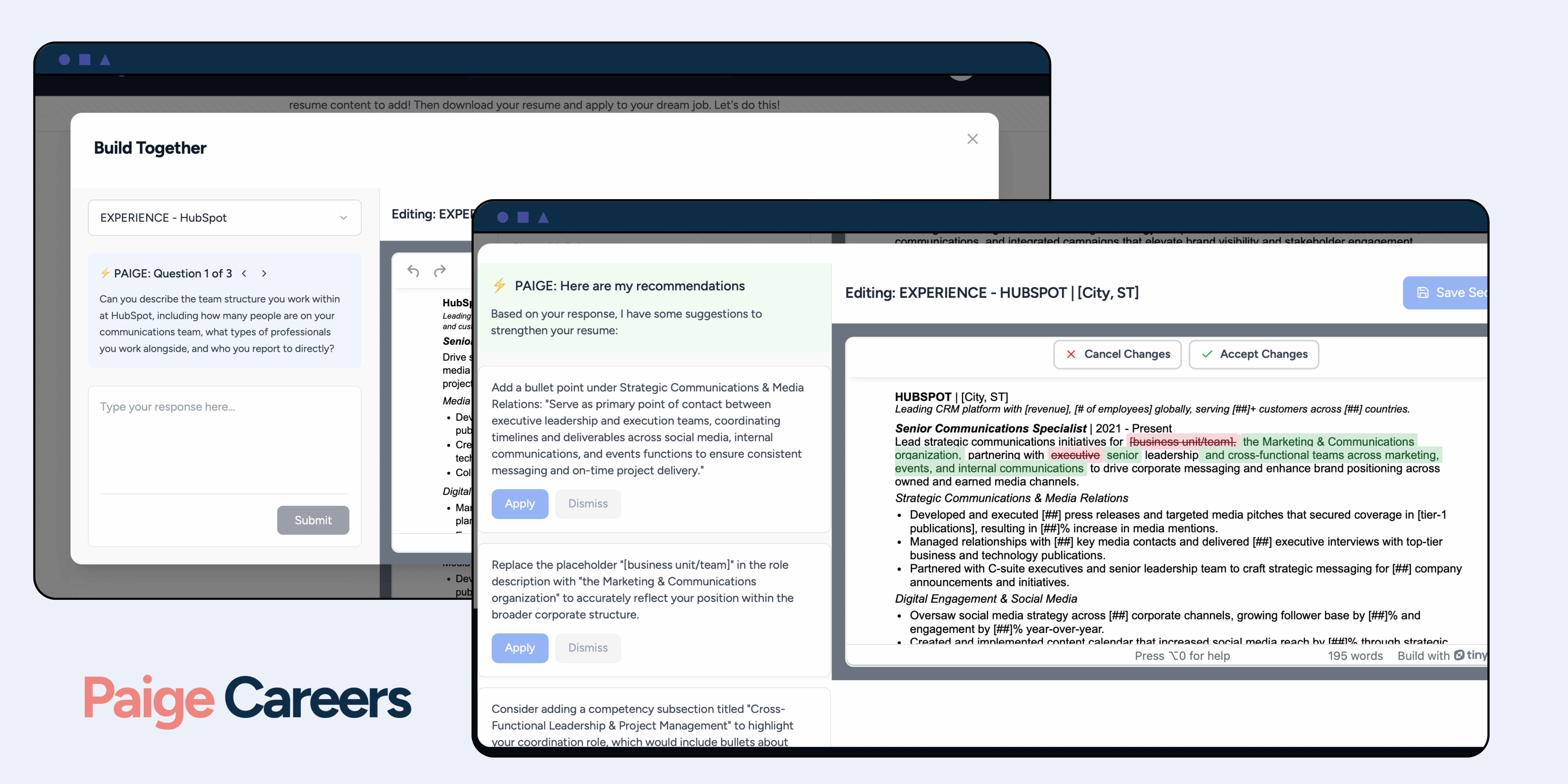
Use the Paige Resume Builder for key sections—strategic questioning extracts professional impact from internships, projects, and leadership roles
Download & Repeat
Download your professional-ready resume, then use Versions to customize for each application—unlimited revisions as you target different roles
Paige is a resume builder for college graduates that helps tactically navigate the college-to-career transition. Unlike generic resume templates or AI tools that just fill in blanks, Paige was built by a Certified Professional Resume Writer who has guided recent graduates and entry-level professionals through launching their careers.
Here's how Paige works as your entry-level resume tool:
Automatic Academic-to-Professional Translation
After you upload your student resume or any documents (internship descriptions, course syllabi, project summaries), Paige automatically identifies academic language and rewrites it in professional terms. It recognizes the kinds of competencies employers value—project management, data analysis, stakeholder communication, problem-solving—and helps you frame your academic and extracurricular experiences to showcase these skills.
For example, instead of listing experiences chronologically with duty-based bullets, Paige might reorganize your content like this:
Project Management & Team Leadership
- ●Led 5-person capstone team analyzing market entry strategies for tech startup, delivering 40-page strategic plan adopted by company leadership
- ●Coordinated 6-month fundraising campaign for student organization, exceeding $10,000 goal by 25% through corporate partnerships and campus events
Data Analysis & Research
- ●Analyzed 3 years of enrollment data (5,000+ records) to identify retention patterns, presenting findings and recommendations to university administration
- ●Conducted primary research with 30+ industry professionals to inform thesis on sustainable supply chain practices
This reorganization makes your transferable skills immediately visible—exactly what hiring managers are looking for.
Don't have specific metrics? Paige inserts placeholders where quantifiable impact would strengthen your resume and reminds you to add real data and results.
Want even more targeted positioning? On the home page, simply paste a job description and ask Paige to "modify my resume to match this [specific role]" and you'll get hyper-specific language changes and strategic recommendations. It's like having a professional resume writer who understands both your background and your target industry.
This is the resume builder for recent graduates you've been looking for.
Optimized Length and Format
Paige knows that your entry level resume needs to be substantial enough to demonstrate competence without padding or fluff. It helps you identify which experiences matter most, eliminate irrelevant coursework, and structure your content for maximum impact—all while keeping your voice authentic. Aren't sure if it should be 1 or 2 pages, or where your education should go given your level of experience? Ask Paige in the chat box and it will make suggestions according to your specific resume and experience level!
Paige Resume Builder: Strategic Questioning and Resume Coaching at Scale
Paige Resume Builder mirrors a one-on-one consultation with a professional resume writer. It lets you take a deep dive into a specific experience—your internship, a major project, a leadership role—providing specific coaching on how to write a resume with no work experience that still demonstrates professional value.
Through conversational AI, Paige asks strategic questions that help you uncover the professional substance in your experiences:
- •What was the scope and scale of this project or role?
- •What specific challenges did you solve?
- •What were the measurable outcomes?
- •What skills did you develop or demonstrate?
- •Who did you work with and what was your specific contribution?
Then Paige makes specific, actionable recommendations that you can apply to your working draft with a click.
The kinds of questions asked in the Paige Resume Builder are the types you'll encounter in interviews—making it not only a bullet point generator, but an interview prep tool that helps you articulate your value clearly.
Transitions Paige Can Support for Recent Graduates
Examples across majors and career paths
Business majors with strong analytical coursework, internship experience, and leadership in student organizations can use Paige to translate academic projects into business initiatives, case competitions into consulting experience, and student leadership into management competencies—positioning for analyst roles at consulting firms, financial services companies, and corporate strategy teams.
- →Financial modeling coursework → Quantitative analysis skills
- →Student organization budget management → Financial planning experience
- →Case competition participation → Strategic problem-solving
Engineering, computer science, and science graduates with lab experience, research projects, and technical coursework can use Paige to translate academic research into R&D experience, course projects into technical portfolio pieces, and teaching assistant roles into technical communication skills—opening doors to roles at tech companies, research labs, and engineering firms.
- →Senior design project → Product development experience
- →Research assistant role → Technical research skills
- →Hackathon participation → Rapid prototyping and collaboration
Communications, English, political science, and humanities graduates with writing portfolios, campus media experience, and event coordination can use Paige to translate campus journalism into content creation, student government into stakeholder management, and research papers into analytical writing skills—positioning for roles in marketing, public relations, corporate communications, and content strategy.
- →Campus newspaper editor → Content management and editorial leadership
- →Thesis research → Primary research and analytical writing
- →Event planning for student org → Project management and logistics
Sociology, psychology, anthropology, and social work graduates with volunteer experience, community engagement, and research backgrounds can use Paige to translate fieldwork into program management, volunteer coordination into team leadership, and academic research into program evaluation—opening opportunities at nonprofits, foundations, and social enterprises.
- →Community service projects → Program coordination
- →Research methods coursework → Data collection and analysis
- →Peer mentoring → Training and development
Students with 1-3 internships but limited other work experience can use Paige to maximize the professional value of those experiences, translating summer projects into sustained contributions, intern-level tasks into professional competencies, and temporary roles into proof of workplace readiness—positioning for full-time offers or roles at similar companies.
- →"Intern responsibilities" → Professional project contributions
- →"Assisted team" → Specific deliverables and impact
- →"Summer work" → Sustained professional experience
Common Questions About Resume Writing for Recent Graduates
Q: Should I include my GPA on my resume?
A: Include your GPA if it's 3.5 or higher, or if you're applying to competitive industries like consulting, finance, or graduate programs where GPA is often expected. If your overall GPA is lower but your major GPA is strong (3.5+), you can list "Major GPA: 3.7/4.0" instead. If your GPA is below 3.5, leave it off entirely and focus on relevant experience, projects, and skills.
Q: How do I handle having limited or no work experience?
A: You have more experience than you think—it's just not traditional employment. Include: Internships (even unpaid or virtual); Relevant coursework and major projects (especially capstones, research projects, or team projects with real-world applications); Student organization leadership (positions held, initiatives led, budgets managed); Significant club or team participation; Part-time jobs (any job demonstrates work ethic, reliability, and transferable skills); Volunteer work (especially sustained commitments or leadership roles); Campus activities (organizing events, peer mentoring, research assistance). Paige helps you frame and position each of these experiences professionally.
Q: Should I include college coursework on my resume?
A: Only if it's directly relevant to the job you're applying for AND you lack substantial work experience to fill the space. For example, include "Relevant Coursework: Data Structures, Machine Learning, Database Management" for a software engineering role. Skip listing general education requirements or introductory courses. Once you have internships, projects, or other experiences to showcase, remove coursework entirely.
Q: How long should an entry-level resume be?
A: 1 page for most recent graduates. Only extend to 2 pages if you have substantial relevant experience (multiple internships, significant research projects, extensive leadership roles). Hiring managers spend an average of 6-7 seconds on an initial resume scan. Make every line count.
Q: Should I include student organizations and extracurricular activities?
A: Yes, if they demonstrate leadership, relevant skills, or sustained commitment. Include: Leadership positions (President, VP, Committee Chair, Captain); Significant initiatives (events you organized, fundraising you led, projects you managed); Relevant skills demonstrated (budget management, event planning, team leadership). Skip basic membership without active contribution and high school activities (unless you're a first-year student with very limited college experience).
Q: What about part-time jobs during college—even if they're not in my field?
A: Absolutely include them. Any employment demonstrates work ethic and reliability, transferable skills (customer service, time management, teamwork, problem-solving), and professional references. Paige helps you extract the professional value from any job—retail, food service, tutoring, administrative work—by focusing on the skills you developed rather than the industry.
Why Recent Graduates Choose Paige to Launch Their Careers
Paige Provides More Than a Resume Template; It Offers Strategic Career Positioning
When you're figuring out how to write your first professional resume, you're competing against candidates with more years of experience. Generic resume builders just give you empty fields to fill in. Professional resume writers charge $300 and upwards for a single resume—and revisions or extra conversations can cost you more.
Paige gives you entry-level resume help that combines AI efficiency with professional resume writing expertise:
- Unlimited revisions as you apply to different roles and industries
- Real-time translation of academic and extracurricular experience to professional impact
- Strategic positioning for the specific roles you're targeting
- Format optimization for ATS systems and human readers
- Professional-quality output in a fraction of the time (and cost) of hiring a resume writer
This is professional resume writing for recent graduates that's accessible, affordable, and designed for your success.
Ready to Turn Your College Experience into Career Opportunity?
Your resume as a recent graduate doesn't have to be a barrier to launching your career. With the right translation, your academic projects become business initiatives, your student leadership becomes management experience, and your potential becomes immediately visible to employers.
Paige was built for exactly this moment. Start building your professional resume today and see how strategic positioning transforms your job search.
Get Started with Paige →Paige Careers was founded by Certified Professional Resume Writer Margaret Gerety, who has coached over 300 professionals—including recent graduates, career changers, and executives—through successful career transitions.