Nonprofit to Private Sector Resume: How Nonprofit Professionals Can Successfully Transition to Corporate Careers
Most nonprofit professionals are far more qualified for private-sector leadership roles than their resumes show. The problem isn't experience—it's translation.
Table of Contents
If you're a nonprofit professional considering a transition from nonprofit to corporate, you already know your mission-driven resume won't land in the private sector job market. Your nonprofit to private sector resume needs to speak a different language—one that hiring managers in corporate environments can understand and value. Whether you're a program manager, development director, executive director, or nonprofit coordinator, the challenge is the same: how do you convert mission-focused language to business language the private sector understands…without losing the power of your experience?
That's exactly where Paige comes in. As an AI resume builder for nonprofit professionals designed by a Harvard-educated, Certified Professional Resume Writer with over 300 clients across nonprofit, federal, and private sectors, Paige doesn't just reformat your resume. It helps you strategically translate your nonprofit experience into private-sector results that open doors.
Why Your Nonprofit Resume Isn't Working for Corporate Jobs
Nonprofit vs. Corporate Resume
Understanding the critical differences that make or break your career transition
| Requirement | Nonprofit Resume | Corporate Resume |
|---|---|---|
| Length | ❌Often 3-5 pages with detailed program descriptions | ✅2-3 pages maximum |
| Primary Focus | ❌Mission, values, and community impact | ✅Business results and measurable ROI |
| Required Details | ❌Program participants, grant cycles, volunteer coordination | ✅Revenue generated, budget scale, and team size |
| Voice & Ownership | ❌"We" language emphasizing collective mission without clear individual role | ✅Strong action verbs showing individual leadership and collaboration |
| Language Style | ❌Mission-driven terminology and sector-specific jargon | ✅Business language and corporate terminology |
| Job Context | ❌Focus on day-to-day activities, event planning, reporting | ✅Strategic overview and business purpose of role |
Ready to Make the Translation?
Paige automatically converts your nonprofit resume into corporate language that gets results
Get Started with Paige →The Translation Problem Nonprofit Professionals Face
Your nonprofit to corporate transition hits a wall the moment a corporate recruiter opens your resume. Here's why:
Your accomplishments sound too mission-focused.
That beautiful language about "empowering communities," "advancing social justice," or "serving vulnerable populations"? It signals passion—but corporate hiring managers are looking for business impact. They want to know: Did you increase revenue? Improve efficiency? Manage stakeholders? Scale operations? Without that translation, your deep expertise gets dismissed as "nice to have" rather than "mission-critical."
You're undervaluing your budget and team management.
Managing a $2M nonprofit budget with zero room for error can be harder than managing a $10M corporate budget with a cushion. Leading 50 volunteers can be more complex than managing 10 salaried employees. But your nonprofit resume for private sector jobs probably doesn't frame it that way. Instead, nonprofit professionals often downplay their resource constraints and operational complexity—exactly the things that demonstrate exceptional management skills.
Your fundraising experience is invisible as business development.
You've cultivated relationships with major donors, written compelling proposals, closed six-figure gifts, and built sustainable revenue pipelines. That's sales, business development, and client relationship management—but your resume probably calls it "donor stewardship" or "grant writing." Corporate recruiters don't make that connection themselves.
You aren't claiming your leadership.
Nonprofit culture emphasizes collective mission and team accomplishment, which often means your individual contribution can get lost. Private-sector employers need to know what you specifically led, built, or achieved. If you can't articulate your individual contribution and ownership, they assume you were support staff, not leadership. That doesn't mean you shouldn't highlight the teams and partners you work with. In fact, corporate employers highly value cross-functional collaboration—your ability to coordinate across departments, manage diverse stakeholder groups, and build consensus among people with competing priorities. Nonprofit professionals excel at this. You've likely coordinated with program staff, development teams, board committees, external partners, volunteers, and community stakeholders, sometimes all on the same initiative. Use strong action verbs (led, directed, coordinated, facilitated, managed) paired with specific team structures and stakeholder groups show both your leadership and your collaborative approach—exactly what corporate hiring managers want to see.
Your strategic leadership is buried under operational detail.
You've probably built programs from scratch, navigated complex stakeholder environments (donors, board members, community partners, government agencies), managed through funding volatility, and made high-stakes decisions with limited resources. That's executive-level strategic thinking. But nonprofit resumes often focus on day-to-day activities—event planning, volunteer scheduling, grant reporting—that make you look tactical, not strategic.
Your job titles sound junior—even when you're senior.
"Program Coordinator" could mean you're running a $5M international initiative with 20 staff members across 4 countries. "Development Associate" could mean you personally closed $3M in major gifts last year. But corporate hiring managers see "Coordinator" and "Associate" and assume entry-level. Your nonprofit to for-profit resume needs to reframe seniority in business terms: team size, budget scope, revenue responsibility, strategic decision-making.
The nonprofit resume format problem isn't cosmetic. It's strategic.
You need nonprofit resume translation—not just editing.
Most nonprofit professionals are far more qualified for corporate roles than their resumes show. Your experience is real. Your impact is undeniable. You just need to speak the language corporate hiring managers understand.
What Makes Nonprofit-to-Corporate Resume Writing Different
It's Not Just About Changing Language—It's About Rewriting Your Value Proposition
When rewriting your nonprofit resume for corporate jobs, you're not just swapping words. You're fundamentally repositioning your professional identity from mission-driven to results-driven—while maintaining the authenticity of your experience.
Here's what translating nonprofit experience for private sector audiences actually requires:
1. Showcasing quantifiable business impact
Your nonprofit to corporate resume needs metrics that matter in business: revenue generation, cost efficiency, client/stakeholder satisfaction, market growth, operational scale, team performance. Here's what that looks like:
Fundraising → Revenue generation
❌ "Managed donor relationships and grant writing"
✅ "Generated $4.5M in annual revenue through major gift cultivation, corporate partnerships, and grant proposals, exceeding annual target by 23%"
Program management → Operational leadership
❌ "Coordinated youth education programs serving 200 participants"
✅ "Directed $1.2M education initiative across 5 sites, managing 12 staff and 30+ volunteers to deliver services to 200+ clients"
Budget management → Financial leadership
❌ "Managed program budget"
✅ "Oversaw $3M operating budget with zero deficit over 4 years, implementing cost-saving measures that reduced overhead by 18% while increasing program capacity by 25%"
Volunteer management → Talent development
❌ "Recruited and supervised volunteers"
✅ "Built and led volunteer workforce of 75+ individuals and spearheaded new training program that improved retention by 40%"
Stakeholder engagement → Client relationship management
❌ "Maintained relationships with community partners"
✅ "Managed portfolio of 50+ strategic partnerships including corporate sponsors, government agencies, and community organizations, securing $2M+ in combined funding"
2. Translating donor relations as business development and sales
Your nonprofit fundraising experience is sophisticated relationship-based sales, but corporate recruiters won't see it unless you frame it that way.
Think about what fundraising actually involves: prospecting, qualification, cultivation, proposal development, negotiation, closing, retention, and relationship management. That's the exact skillset companies need in business development, account management, and client services roles.
Here's the translation in action:
❌ Nonprofit language:
"Stewarded relationships with major donors and foundation partners to support organizational mission."
✅ Corporate language:
"Managed and cultivated portfolio of 40+ high-value relationships, with 85% retention rate and 35% growth in average gift size over 3 years."
Notice how the second version uses business metrics (portfolio size, retention rate, growth percentage) and action verbs (managed, cultivated) that corporate hiring managers recognize as revenue leadership.
3. Reframing program management as strategic operations
Nonprofit program managers run complex operations involving multiple stakeholders, tight budgets, and competing priorities. That's strategic operations leadership, but it needs to be framed in business terms.
❌ Nonprofit language:
"Managed afterschool program serving underserved youth in partnership with local schools."
✅ Corporate language:
"Directed operations education initiative serving 300+ clients annually across 8 locations, managing $800K budget, 15-person staff, and partnerships with 12 institutional stakeholders."
The corporate version shows:
- ●Scale (300 clients, 8 locations, 12 partners)
- ●Financial responsibility ($800K budget)
- ●Team leadership (15 staff)
That's the language of operations leadership.
4. Taking ownership: The "mission-driven" vs. "I-driven" problem
Nonprofit culture emphasizes collective mission and shared accomplishment. Your resume likely frames everything through the lens of organizational goals rather than your personal contribution and leadership. Private-sector employers need to see what you specifically built, led, and delivered.
Paige helps you identify your exact role and claim it with strong active verbs—while still acknowledging the collaborative nature of nonprofit work. The result? You sound both authoritative and team-oriented.
For example:
❌ "Worked with team to expand services and grow revenue."
✅ "Led organizational expansion into 3 new markets, building stakeholder partnerships and securing $2.5M in new funding, growing annual revenue by 45% in 2 years."
Notice how the second version shows your leadership role while acknowledging the complexity of the work. That's the balance corporate employers are looking for.
5. Eliminating mission language & adding business context
Every nonprofit career change requires a hard look at sector-specific language, mission-driven framing, and assumptions about what hiring managers understand. If someone outside the nonprofit sector wouldn't immediately grasp the scope or significance, it needs translation.
This is especially true for specialized program areas. "Youth Development Coordinator, Teen Justice Initiative" tells a corporate reader very little. Instead: "Program Manager, justice-involved youth services, directing 8-person team delivering case management and workforce development to 150+ clients annually."
Similarly, if you worked in a specialized nonprofit space—like refugee resettlement, affordable housing development, or environmental advocacy—don't assume the sector explains itself. Add brief context: "within international humanitarian organization serving 10,000+ displaced families annually" or "community development nonprofit focused on building 200+ affordable housing units across Metro DC."
How Paige Helps Nonprofit Professionals Transition to Corporate Careers
AI-Powered Resume Translation Built on Professional Resume Writing Expertise
How Paige Works
Transform your nonprofit resume into a corporate powerhouse in four simple steps
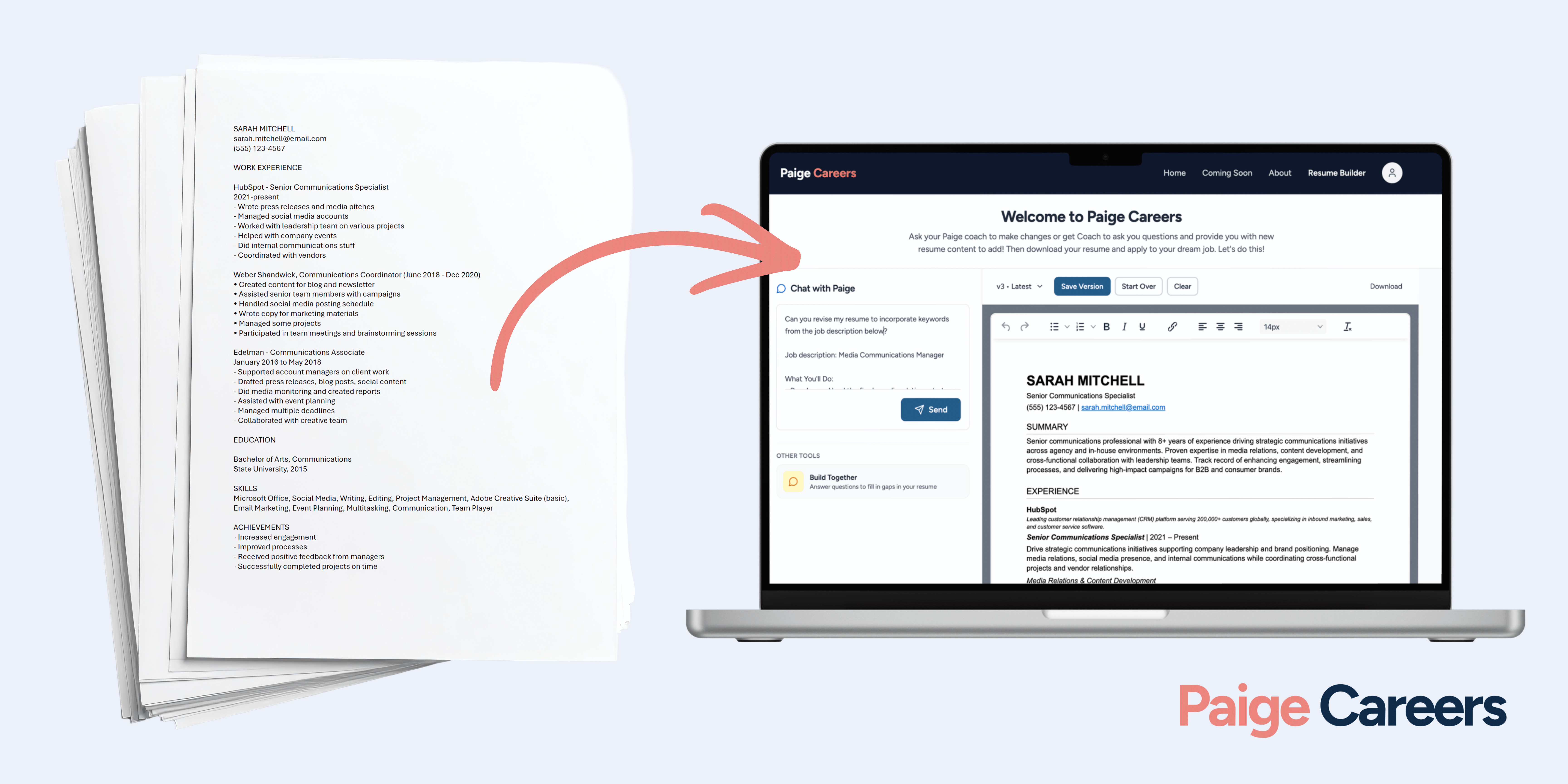
Upload Your Documents
Start by uploading your nonprofit resume or any career documents—Paige automatically optimizes format and clears mission-focused clutter
Refine with Paige
Chat with Paige to refine content, translate nonprofit language, and ask questions about positioning for your target roles
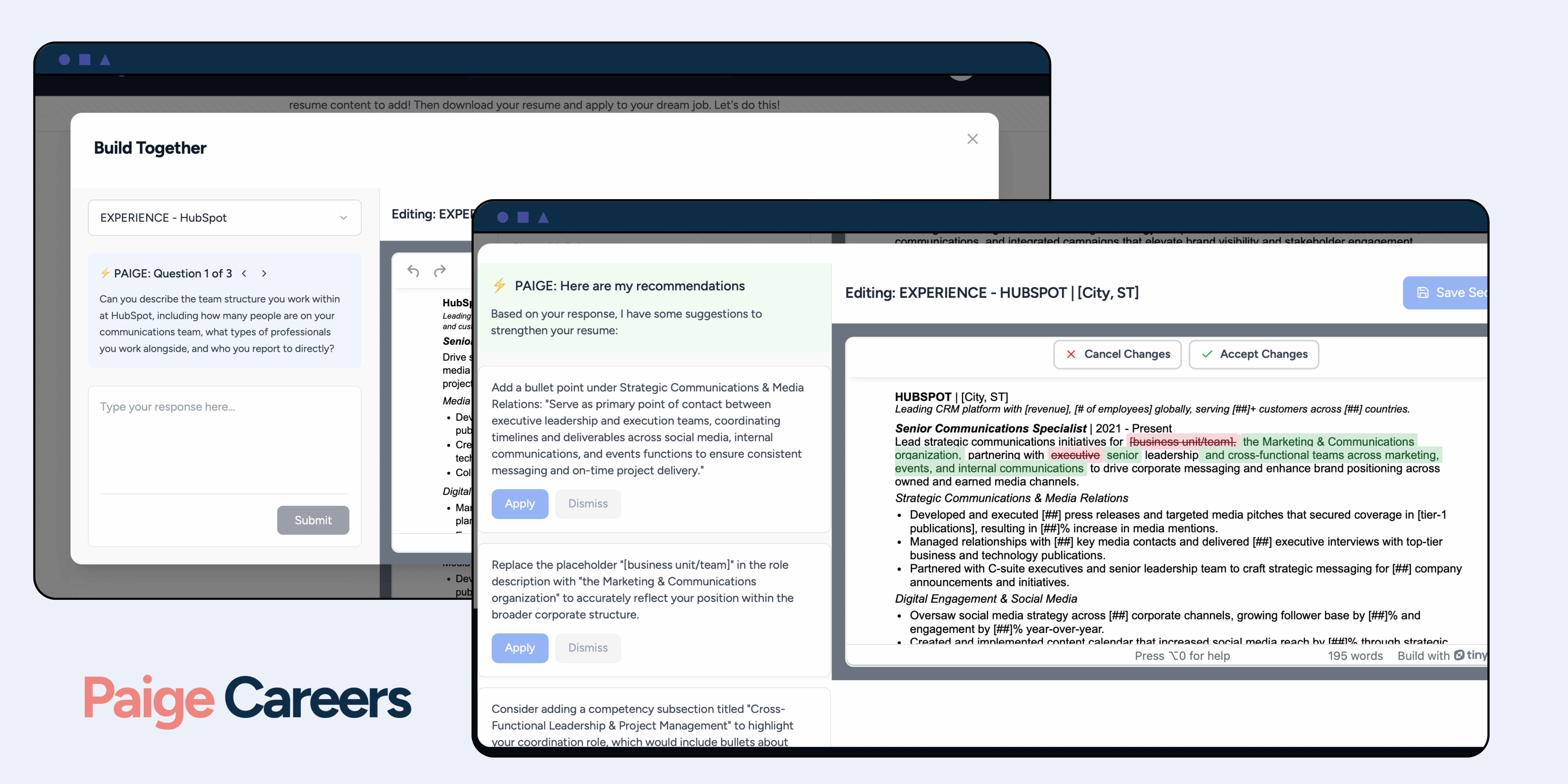
Paige Resume Builder
Use the Paige Resume Builder for key sections—strategic questioning extracts corporate impact from your nonprofit experience
Download & Repeat
Download your polished resume, then use Versions to customize for each job—unlimited revisions as your search evolves
Paige is a resume builder for nonprofit professionals designed to help you tactically navigate nonprofit-to-corporate career transitions. Unlike generic resume templates or AI tools that don't understand the nonprofit-to-corporate challenge, Paige was built by a Certified Professional Resume Writer who has guided hundreds of nonprofit and mission-driven professionals through this exact transition.
Here's how Paige works as your nonprofit career transition tool:
Automatic Nonprofit-to-Corporate Translation
After you upload your old resume, Paige automatically rewrites your work in corporate terms. It identifies the kinds of competencies the private sector values—stakeholder management, operational efficiency, strategic planning, team leadership—and reorganizes your bullet points under them so employers can quickly see how you've demonstrated these skills.
For example, instead of a chronological list of program activities, Paige might organize your experience like this:
Revenue & Business Development
- ●Generated $5M in funding from major donors, corporate sponsors, and foundation grants over 3 years, exceeding annual targets by 18%.
- ●Built pipeline of 100+ qualified prospects through strategic outreach, cultivating 25 into active donors worth $2M+ collectively.
Strategic Operations & Program Leadership
- ●Directed $2.5M teen outreach program across 6 locations, managing 20-person team and delivering services to 500+ clients annually.
- ●Reduced annual operational costs by 22% through vendor renegotiation and process improvements.
Stakeholder & Partnership Management
- ●Managed relationships with 40+ strategic partners, including corporate sponsors, government agencies, and community organizations.
- ●Presented quarterly program updates and strategic recommendations to 15-member board of directors, securing approval for $5M budget and new strategic initiatives.
This reorganization makes your transferable skills immediately visible—exactly what corporate hiring managers are looking for.
Don't have identifiable metrics in the materials you give Paige? Paige puts in placeholders where it thinks these would make the most impact, and reminds you to insert real data and results.
Want even more targeted translation? On the home page, simply ask Paige to "modify my role to match a corporate [specific job description]" and you'll get hyper-specific language changes and strategic recommendations tailored to that exact position. It's like having a professional resume writer who understands both your nonprofit background and your target industry.
This is the resume translation tool for nonprofit workers you've been looking for.
Optimized Length and Format
Paige knows that your mission-focused, detail-heavy nonprofit resume needs to become a 2-3 page business document. It prioritizes your most relevant accomplishments, eliminates mission language that doesn't translate to business value, and structures your experience for maximum corporate impact—all while keeping your voice authentic.
Paige Resume Builder: Strategic Questioning and Resume Coaching at Scale
Paige Resume Builder mirrors a one-on-one consultation with a professional resume writer. It lets you take a deep dive into a specific section of your resume—for example, your current role—providing specific, nonprofit to corporate resume coaching. Through conversational AI, Paige asks strategic questions about your nonprofit role that extract the information corporate employers actually care about. For example, it may ask you targeted questions about your budget, your team, your revenue responsibility, and your measurable impact to help you unearth key aspects of your experience. And then Paige makes specific, actionable recommendations that you can apply to your resume. With a click of a button, you can apply those changes to your working draft.
The kinds of questions you are asked in the Paige Resume Builder are the types you might expect in an interview, or by a hiring manager who feels they're missing something when reviewing your resume. This means that the Paige Resume Builder is not only a bullet point generator, filling in key holes and strengthening your resume content—it is an interview prep tool that helps you anticipate the types of conversations you'll have when you meet a live person.
Nonprofit Transitions Paige Can Support
Examples across nonprofit roles and career levels
A program manager running multi-site initiatives with million-dollar budgets can use Paige to translate program oversight into strategic operations leadership—showcasing stakeholder management, process improvement, and cross-functional team leadership for roles like Senior Operations Manager or Program Director at corporations.
- →Program oversight → Strategic operations leadership
- →Stakeholder management → Cross-functional team leadership
- →Multi-site coordination → Business process optimization
Development directors with proven track records in major gift cultivation and revenue generation can use Paige to reposition fundraising as business development—translating donor prospecting into lead generation, relationship management into account management, and grant writing into proposal development for roles in sales, partnerships, or business development.
- →Donor prospecting → Lead generation
- →Relationship management → Account management
- →Grant writing → Proposal development
Communications directors with strong messaging, brand management, and audience engagement skills can use Paige to translate their experience into corporate marketing language—reframing storytelling as brand strategy, donor communications as customer engagement, and advocacy campaigns as integrated marketing initiatives for roles in marketing, communications, or public relations.
- →Storytelling → Brand strategy
- →Donor communications → Customer engagement
- →Advocacy campaigns → Integrated marketing initiatives
Grant writers with expertise in research, writing compelling proposals, and securing funding can use Paige to translate their skills into corporate proposal development, RFP response, or business development support—language that resonates with companies seeking professionals who can articulate value and close deals.
- →Grant writing → Corporate proposal development
- →Funding research → RFP response
- →Proposal development → Business development support
Coordinators managing complex projects, volunteer teams, and multiple stakeholders can use Paige to reframe their coordination experience as project management—translating event planning into project delivery, volunteer management into team leadership, and stakeholder coordination into cross-functional collaboration for corporate project management roles.
- →Event planning → Project delivery
- →Volunteer management → Team leadership
- →Stakeholder coordination → Cross-functional collaboration
Common Questions About Nonprofit-to-Corporate Resume Writing
Q: Should I remove my passion for social impact from my resume?
A: You don't need to hide your values, but you do need to lead with business value. The private sector increasingly values professionals who bring mission-driven perspective to corporate roles—especially in CSR, ESG, sustainability, and social impact functions. But your resume needs to demonstrate business competencies first (revenue generation, operational excellence, stakeholder management) before highlighting your mission alignment. Your social impact background is a differentiator, not your primary qualification.
Q: How long should my nonprofit resume be for corporate applications?
A: Ideally, 2 pages, even if you're an Executive Director with 20+ years of experience. Sometimes going to 3 pages makes sense if you have significant publications or speaking engagements. Corporate hiring managers aren't likely to read carefully beyond page 2. Paige helps you prioritize your most transferable accomplishments and eliminate mission-focused detail that doesn't advance your corporate candidacy.
Q: Should I keep my volunteer work on my corporate resume?
A: Yes, if it's significant and shows leadership or other relevant business skills. If you volunteer as a board treasurer for a nonprofit—managing a $500K budget and providing financial oversight—that's relevant. If you volunteer at your local food bank once a month, it's probably not adding strategic value to a corporate resume.
Q: How do I show I can work in a faster-paced corporate environment when nonprofits are known for being scrappy?
A: By reframing "scrappy" as "resourceful and efficient." Nonprofits operate with minimal resources, tight budgets, and high accountability—that breeds exceptional problem-solving, adaptability, creativity, and efficiency. Highlight examples where you: delivered results despite limited resources, found creative solutions to budget constraints, moved quickly to capitalize on opportunities, managed multiple priorities with competing deadlines, or adapted strategy when circumstances changed. These stories demonstrate that you thrive in dynamic environments—regardless of sector.
Why Nonprofit Professionals Choose Paige for Career Transitions
Paige Provides More Than a New Resume; It Offers Strategic Career Repositioning
When you're figuring out how to transition from nonprofit to corporate, your resume is your first—and often only—chance to make an impression. Generic resume builders can't handle the complexity of nonprofit experience on private sector resumes. And hiring a professional resume writer for every iteration gets expensive fast.
Paige gives you nonprofit resume help that combines AI efficiency with professional resume writing expertise:
- Unlimited revisions as you refine your target roles
- Real-time translation of nonprofit experience to corporate impact
- Strategic positioning for the roles you actually want
- Format optimization for ATS systems and human readers
- Professional-quality output in a fraction of the time
This is professional resume writing for nonprofit professionals that's accessible, affordable, and designed for your success.
Ready to Make Your Nonprofit Experience Work in the Corporate World?
Your nonprofit to corporate resume doesn't have to be a barrier to your next career move. With the right translation, your nonprofit experience becomes a competitive advantage—demonstrating leadership under resource constraints, stakeholder management across diverse groups, and proven ability to deliver measurable impact.
Paige was built for exactly this moment. Start building your corporate resume today and see how strategic translation transforms your career story.
Paige Careers was founded by Certified Professional Resume Writer Margaret Gerety, who has coached over 300 professionals through successful career transitions.