
When people ask me whether cover letters matter in 2026, I pause before responding. Yes, they feel like a tacked-on requirement meant to weed out job seekers who are “spraying and praying” and don’t read the application instructions (or can’t be bothered to take the last step of drafting a cover letter).
And, yes, for the most part, the cover letters I review don’t add much to the applicant’s story: they tend to look like slightly reworded resumes written in prose about how qualified you are, padded out to fill a page.
But here's what I tell my clients: You have to care about your cover letter. Because, when someone does read it, they READ it.
They read it for tone. They read it for fit. They read it for whether you understand what the organization actually does. In those moments, a perfunctory cover letter doesn't just fail to help. It actively hurts.
And in an era of AI-generated slop, the cover letter is becoming something more: a gateway. When every resume looks polished and every applicant has run their materials through the same model, the cover letter is often the only piece of an application that proves a human being is behind it. It is, in many cases, the first real writing sample a hiring manager sees. The cover letters that stand out are the ones where the writer actually sounds like a person, with a specific reason for being in the room. In a flood of AI-generated applications, those are the ones that decide whether your resume gets read at all.
That shift, from formality to gateway, helps explain something strange that is happening in the market.
The data over the past decade tells a story most people haven't noticed.
Are Cover Letters Making a Comeback? What the Data Shows
Look at what hiring managers have said about cover letters across 4 major surveys over 10 years.
In 2015, a Jobvite survey reported by The Muse found that 55% of hiring managers considered cover letters unimportant. The 2016 Jobvite Recruiter Nation report, cited by TopResume, pushed that further: 74% of recruiters said cover letters didn't factor into their decisions. The death-of-the-cover-letter narrative was everywhere.
Then the numbers flipped.
In 2019, ResumeLab surveyed 200 hiring decision-makers. 83% agreed that knowing how to write a cover letter is crucial. In 2023, Resume Genius surveyed 625 US hiring managers and found that 94% of hiring managers say cover letters influence interview decisions, 83% read the majority of cover letters they receive, 73% read them even at companies that don't require them, and 45% read the cover letter before the resume.
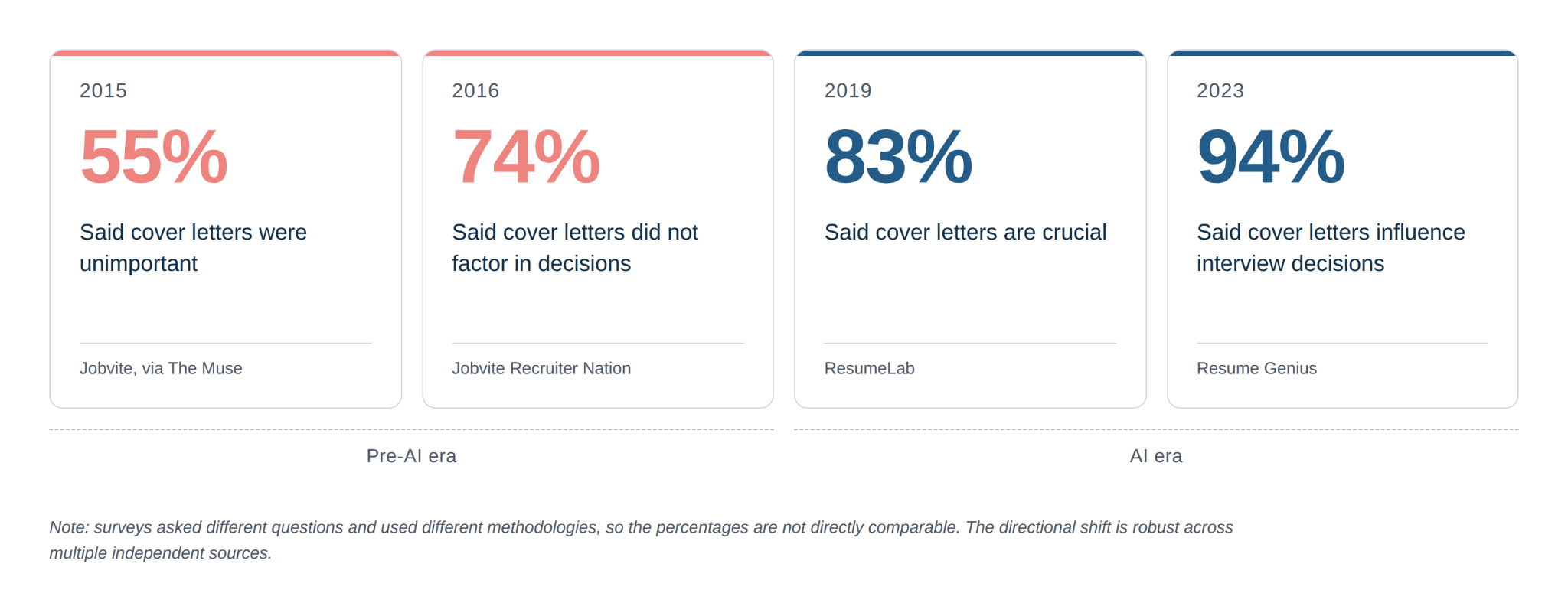
That is not nothing. The questions across these surveys are not perfectly comparable, and methodologies vary, so I don't want to claim a clean trend line. But the directional story is real and corroborated across multiple independent sources. Something has changed.
Here is a hypothesis worth taking seriously: AI is the reason.
The AI Paradox: Why AI Makes a Strong Cover Letter More Important, Not Less
You would expect cover letters to matter less in 2026, not more. Application volume has exploded. Hiring managers are drowning. The intuitive prediction is that the cover letter, already on its way out, would be the first casualty.
Two things have happened that cut the other way.
First, AI has flattened the resume. Submitting a clean and well-organized achievement-oriented resume used to be a meaningful signal of competence and interest. Now, anyone with a Claude or ChatGPT subscription can produce a polished resume in less than 20 minutes. ATS optimization is a solved problem. The “professional-looking” resume has lost most of its differentiating power.
Second, AI doesn't write great cover letters. It writes passable ones, which is a different thing. AI cover letters tend to read smoothly, make generic claims, and give no specificity of the person applying or their reasons for applying. Readers can tell. The Interview Guys reviewed recent research showing that 80% of hiring managers view AI-generated application content negatively, and 74% say they can spot it.
Put those forces together and you get a strange new equilibrium. The resume, traditionally the gatekeeper, is now the floor. Almost everyone clears it. The cover letter, traditionally the formality, is now the differentiator. The signal a strong cover letter sends, that this person can think, that this person can write, that this person actually wants this specific role, is more valuable in 2026 than it was in 2015 because almost nothing else in the application can deliver it.
This is the same logic playing out in college admissions, something I have been paying more attention to as my own family approaches that stage. As test-prep boosts SAT/ACT scores and grade inflation make standardized signals noisier, the personal essay has become more important, not less. The piece of the application that resists optimization is the piece that ends up carrying the most weight.
When Cover Letters Matter Most: 4 Situations Where They Can Determine the Outcome.
ResumeLab's 2019 survey asked hiring managers what cover letters are actually FOR. The top answers:
- 63% said explaining motivation to join the company.
- 50% said describing career objectives.
- 50% said explaining career changes.
- 49% said explaining employment gaps.
- 47% said highlighting professional achievements.
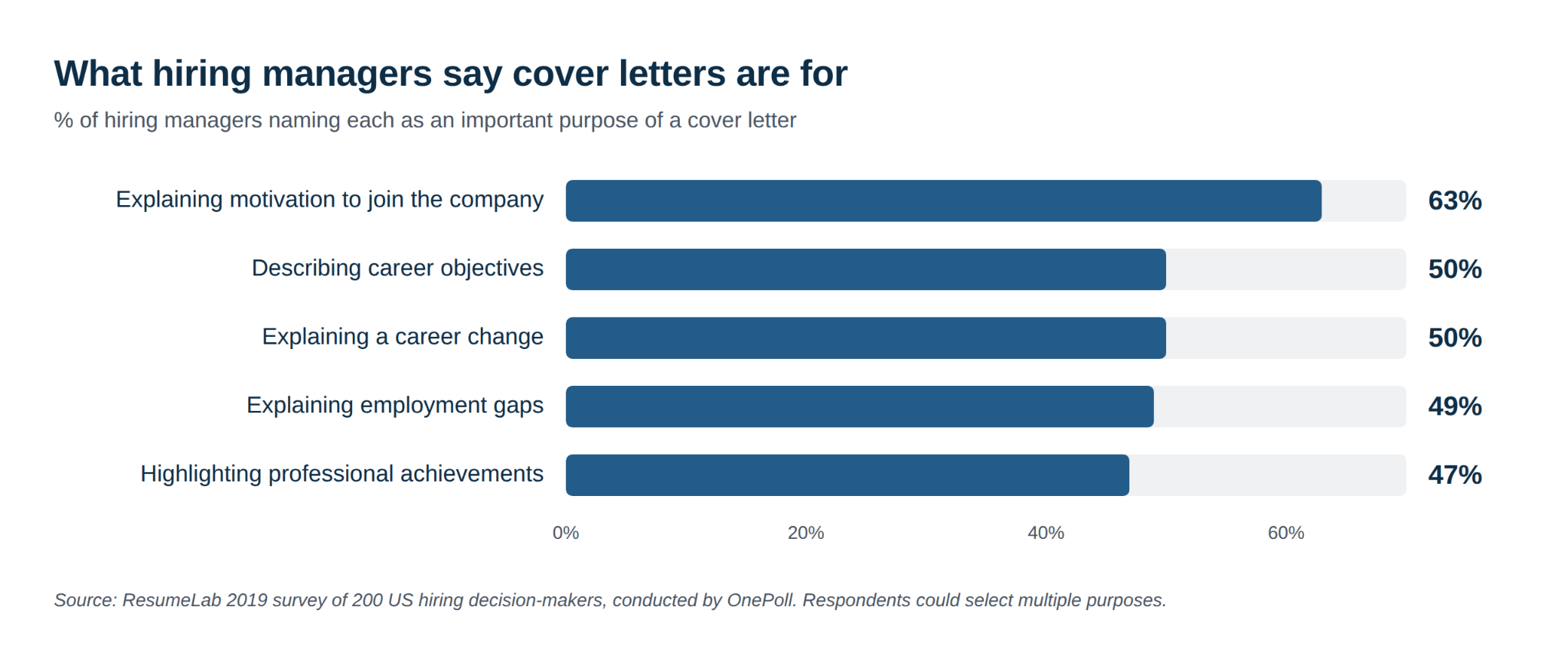
Notice the pattern. Cover letters do the work resumes can't: motivation, narrative, context. That maps directly onto the situations where they matter most:
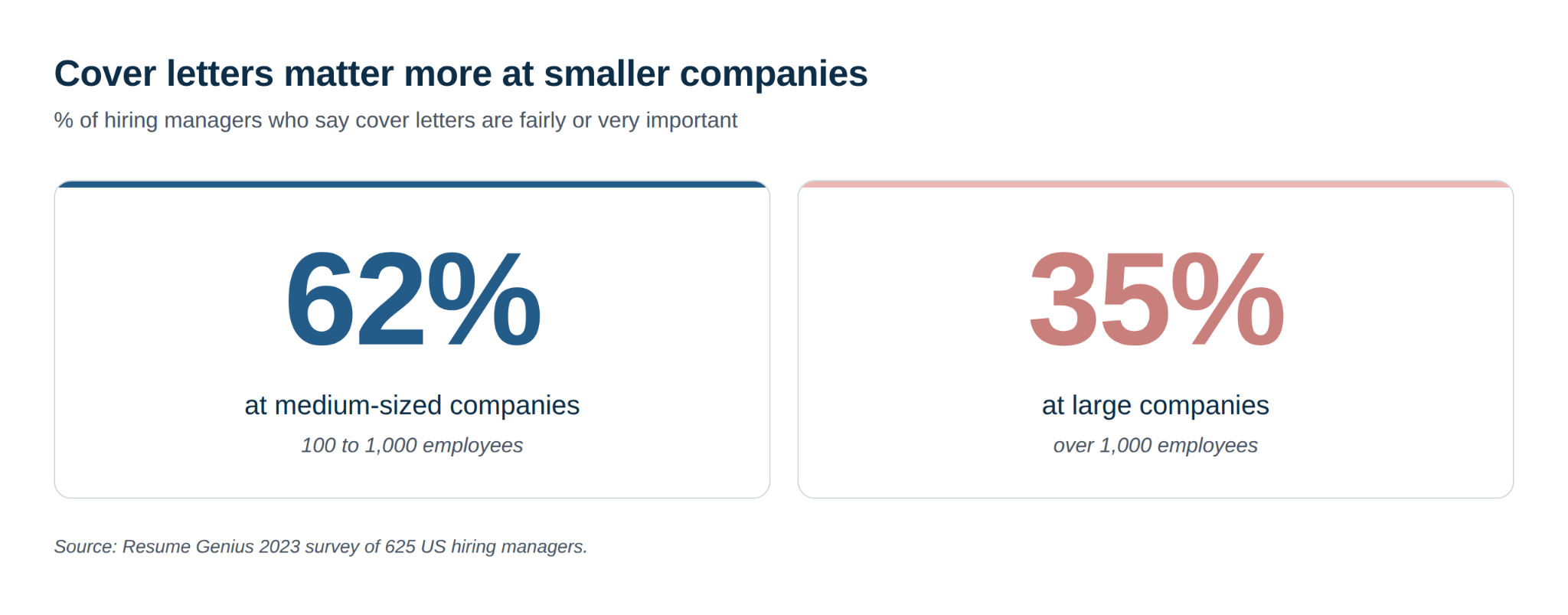
Smaller teams, after the initial cut. When a hiring manager has narrowed 200 resumes down to 15 candidates, the resume has done its job. The question shifts. Who are these people? What do they sound like? Who would I actually want in the next room? Resume Genius found that 62% of hiring managers at medium-sized companies (100 to 1,000 employees) classified cover letters as fairly or very important, compared to 35% at large companies. Smaller organizations, where every hire reshapes the team, lean on this signal hard.
Mission-driven and nonprofit organizations. These employers care intensely about why you want to be there. They get plenty of qualified applicants, especially in 2026 with significant reduction we’ve seen in the federal workforce (nearly half a million according to Federal News Network). What they screen for, almost more than skill, is alignment. A resume can't tell them why you care. A cover letter can. The 63% "explaining motivation" finding from ResumeLab is highest precisely because mission-driven organizations are over-represented in the kinds of roles where cover letters get carefully read.
Career changes and breaks. This is where the cover letter does its most distinctive work. Resumes are linear by design. They show what you've done in chronological order. Career changes need a narrative the resume can't provide: why you're moving, what you're bringing, why this role is the logical next step.
It is also the place to address extended breaks: relocation, time spent upleveling your skills, caregiving for an elderly parent or a new child. Gaps can sometimes be addressed on the resume itself, but I often tell clients to use the first-person voice the cover letter affords to name the elephant in the room directly, especially if they have noticed the issue derailing interviews.
The principle applies more broadly: if you can predict a question that will come up every time, and especially one whose answer doesn't light you up, address it in your written materials. Take it off the table. Interview time is precious. You don't want to spend the first 10 minutes explaining why you took 18 months off when you could be talking about the work that energizes you.
Later rounds of interviews. By the second or third round in the interview process, you’re starting to meet with more senior members of the organization and future teammates. The pool of candidates has narrowed significantly, so the interview panel has more time to read the full application. They know you’re qualified; you’ve passed through all of the regular hurdles. So what they want to know is: who you are, how you write, and why you’re in front of them. While I don’t have data to support this context, I know for sure that you won’t be able to ask to “swap out” your cover letter if you get to these later stages of interviewing. So make sure the cover letter you apply with not only clears the first application hurdles but is also something you’re proud to have in your employee folder.
The Cover Letter is a Writing Sample
Here is something I tell every 1:1 client.
Your cover letter is a writing sample. In many cases, it is the only writing sample the hiring manager will ever see from you. It needs to sound like you wrote it, not a bot (as mentioned above, recent research shows that 80% of hiring managers view AI-generated application content negatively, and 74% say they can spot one).
This is why I do not write cover letters for prospective clients unless I have worked with them before and have samples of their writing in front of me. The risk of getting the voice wrong is too high. A cover letter that doesn't sound like the person submitting it isn't a service. It is a liability. The interviewer reads it, calls the candidate, and discovers a mismatch in the first 30 seconds.
If you are tempted to outsource your cover letter to AI, this is the operative point. AI doesn't know your voice (unless you train it, which of course, is very doable!). If all you feed it is your resume and the job description, it will generate a generic professional voice that approximates yours and a boring story about why you’re applying. The reader can tell.
How to Write a Cover Letter That Actually Gets Read
Most cover letter advice tells you what to put on the page: contact info, date, polite greeting. That is not the problem. The problem is what people write once they get past the formalities.
Here is what works.
Don't restate the resume. They have it. They are looking at it. The cover letter is your chance to do something the resume can't, which is sound like a person and explain why this role, specifically, makes sense in your career trajectory.
Show you understand what they actually do. Most cover letters only describe the writer. The strongest ones also describe the organization briefly and accurately, explaining what the writer has done and why working at that organization aligns with their future plans. This is rare. It is also the single biggest signal of fit.
Connect 1 specific experience to 1 specific need. Resumes list. Cover letters connect. Pick the experience that maps most directly to what this role requires, and write 2 to 3 sentences explaining the connection. Not the whole story. Just the link.
Sound like yourself. The fastest way to write a forgettable cover letter is to imitate the tone of every other cover letter you've ever read. Use your own words. Use contractions. Vary sentence length. Read it out loud. If it sounds like a person, you're close.
Use the format that fits you. The conventional cover letter is 3 paragraphs of prose. Nothing about that is mandatory. If you are a bullet-point thinker, use bullet points. If you are a storyteller, tell a story. If you reach for headers when you organize your thoughts, use headers. The cover letter is a writing sample, and the format itself is part of the sample. Pick the one that shows you at your best.
Stay short. Most surveys converge on 250 to 400 words as the right length, filling half a page to one full page. Resume Genius found that hiring managers who read cover letters prefer about 400 words on average. The cover letters I write almost always take a full page, unless the applicant is applying to a significant leadership role (see below). More than that, and the reader is gone before the second paragraph.
Close with what you'd bring, not what you hope to gain. End on something specific you would contribute, not on how excited you are or how grateful you'd be.
Cover Letter Best Practices for Executive and Senior Leadership Roles
Everything above applies at every level. But for ED searches, C-suite roles, and senior leadership positions, the cover letter does more work, and the bar is higher.
At those levels, the cover letter is no longer just a screening document. It is part of how the search committee evaluates whether you understand the role you are applying for. A 250-word "I'm interested" letter from a candidate for an Executive Director position reads as a tell that the candidate doesn't grasp what is being asked.
Senior cover letters need to do 3 things the entry-level version doesn't.
Show you’ve done your homework. Mention current or past employees you’ve talked to about the role, if applicable, including specific people who might have highlighted the role and urged you to apply. Then demonstrate that you have researched the organization and understand where it is right now. What is working. What isn't. What the next phase requires. This signals strategic thinking and deep work, which is what they are hiring for. Generic enthusiasm is a red flag at the executive level.
Lay out your first 90 days, briefly. Unless they ask for it, you don’t need to lay out a full plan. Write a short paragraph to show you have thought about how you would actually start in the role. Where would you focus first? Who would you want to meet? What would you want to learn before making any decisions? Senior hires get judged on judgment, and judgment shows up in how someone enters a role.
Articulate your leadership style. Not adjectives. Examples. How do you build teams? How do you handle disagreement? Where have you secured buy-in from key stakeholders? What kind of culture do you create? Search committees vet for fit at a much deeper level than at junior roles. They want to know who they would be inheriting.
A senior cover letter should run longer than 400 words. That is fine. The constraint at this level isn't length (again, unless you’ve been instructed otherwise!). It is substance per word. Every sentence has to do work.
The Final Cost-Benefit Argument: Write That Cover Letter!
Here is the case for taking the cover letter seriously, even when you suspect no one will read it.
The cost is low. A genuinely good cover letter takes about an hour to create once you've done the prep work for the role. The marginal effort over a phoned-in version is small.
The upside is asymmetric. Many readers won't notice. Many will. And those readers are often the final decision-makers in the hiring process.
There is also a compounding benefit. When you treat every cover letter as if a thoughtful reader will see it, you get better at articulating, in plain language, why you want a particular role and what you would bring to it. That clarity carries into your interviews. It carries into your LinkedIn About section. It carries into how you describe yourself to peers, mentors, and future employers.
The cover letter is not just a hurdle. It is a forcing function for clarity. Most people skip the work. The ones who don't, stand out.
And in the AI era, when so much of the application has been smoothed into uniformity, a cover letter that sounds like an actual human being thinking carefully about a specific role is doing more for you than it has in a decade.
If you’re not sure where to start, Paige Careers can help you build the resume that gets your application in the room — so your cover letter has a chance to do its job.
Frequently Asked Questions
Do cover letters matter in 2026?
Yes, it seems more than they did in 2015! As AI has made polished resumes easier to produce, the cover letter has become one of the few remaining ways to stand out. A 2023 Resume Genius survey found that 94% of hiring managers say cover letters influence their interview decisions.
Should I write a cover letter if it's optional?
Yes. The only time skipping a cover letter makes sense is when the posting explicitly says not to.
How long should a cover letter be?
Most hiring managers prefer around 250 to 400 words — roughly half a page to one full page. For executive and senior leadership roles, longer is generally expected, but every sentence needs to earn its place.
Can I use AI to write my cover letter?
You can use AI to assist, but not to write it for you. Research shows 80% of hiring managers view AI-generated application content negatively, and 74% say they can spot it. The cover letter's entire value is that it sounds like a specific human being — AI undermines that by default.
Do I need a cover letter for a career change?
Yes — this is actually where a cover letter does its most important work. Resumes are linear and can't explain why you're making a move. The cover letter is the one place in your application to tell that story on your own terms.
Do hiring managers actually read cover letters?
More than you'd think. The 2023 Resume Genius survey found 83% of hiring managers read the majority of cover letters they receive, and 45% read the cover letter before the resume. The ones who do read it, read it carefully.
Margaret Gerety is a Certified Professional Resume Writer and founder of Paige Careers, an AI-powered resume builder, and Margaret Gerety Advisors, a 1:1 resume and LinkedIn coaching practice for mid-to-senior professionals.