
A senior leader in my professional network is about to step into a C-suite role at a fast-growing healthcare startup. He came to me to refresh his materials before the move. His current LinkedIn profile shows 3 or 4 sentences of a bio, his education, and his last firm. With his (admittedly nice) headshot, that is the whole thing.
This is the kind of professional LinkedIn was built for. He is stepping into a role where his visibility matters. And he is articulating the low-grade anxiety I hear from almost every client I work with. They know their profile is out of date. They do not know if they are doing LinkedIn “right.” They scroll through their feed and quietly wonder why peers, people they know are no more accomplished than they are, somehow sound more impressive online. They suspect they should be posting, but don’t know what to post about.
That mix of feelings is universal, and it is mostly misplaced.
Frankly, most professionals do not post on LinkedIn. They lurk. They use it as a rolodex to look up someone’s profile before a big meeting. They read their feed. They see posts pitching the creator path, the promise that if you just adopted the right hooks and the right cadence, you too could be one of those impressive-sounding people.
That advice is real, and for some people it works. But it is built for a small subset of users, mostly people in B2B sales and independent coaching, whose business model depends on being visible online. For most professionals, there is a different model.
Below I’ve outlined 3 distinct levels of LinkedIn engagement that I think works for the “regular” worker (by this I generally mean you have an employer and/or employees). Here is what those levels actually look like, who each one is right for, and how to do them well without driving yourself crazy or feeling like an imposter.
Why Your LinkedIn Feed Feels Overwhelming (And Why It's Not Your Fault)
Before getting to the framework, it is worth understanding why LinkedIn feels overwhelming.
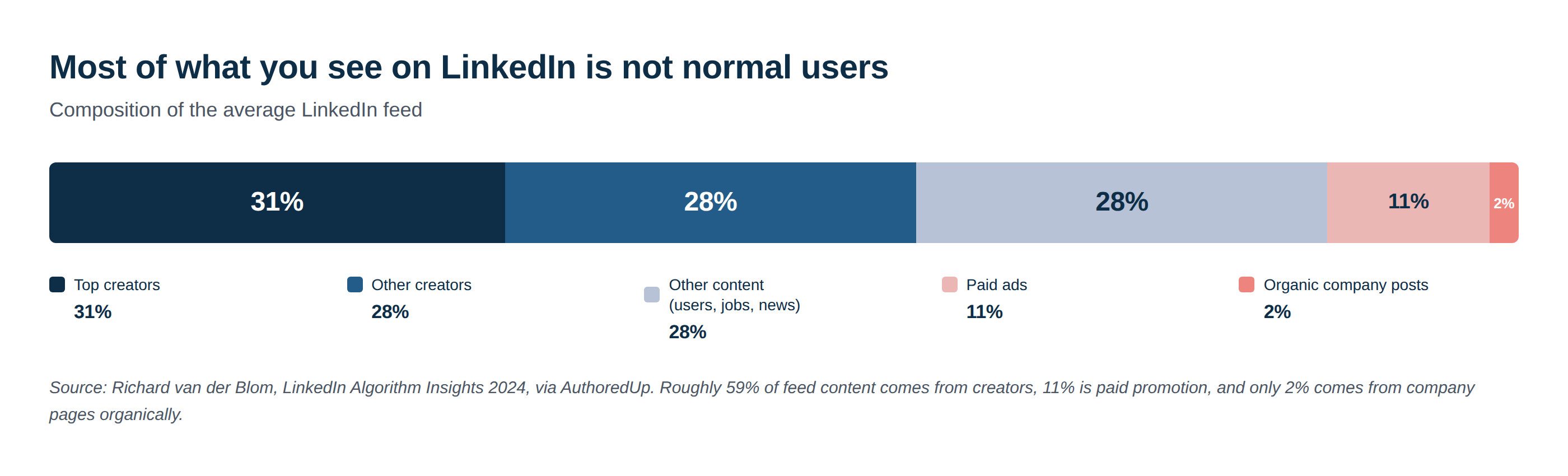
Recent research on LinkedIn’s algorithm and content distribution shows just how skewed the feed has become toward people who are paid, formally or informally, to be visible. Roughly 59% of LinkedIn’s feed is now creator content, with top creators alone accounting for 31%. Another 11% is paid ads. Content from “regular users” looking to engage their network sits at just 28% (and even more interesting, organic company posts make up just 2%). Much of what you see is, in one way or another, marketing.
That share has grown sharply. 60% of content creators surveyed in late 2024 said they planned to expand their LinkedIn presence in the next 12 months, and 49% had already increased their LinkedIn activity over the prior year. The platform has become the destination for creators and B2B marketers because 59% of B2B buyers now consume creator content on LinkedIn more than on any other platform.
Meanwhile, the average user’s reach is collapsing. The same algorithm research found that organic reach is down for 98% of LinkedIn users compared to the previous year. You are seeing more polished content, more often, from fewer people, while your own posts (when you make them) get less traction than ever.
The comparison most professionals are making in their heads (I am not posting, but everyone else seems to be) is a comparison to the wrong group. You are comparing yourself to a tiny minority of people whose actual job is to post. They are not your peers on LinkedIn. They are the marketers.
Once you separate those people out, the question changes. It stops being “why am I not posting more?” and becomes: “what is the right level of engagement for someone like me, in my stage of career?” That is the actual question. Here is how I think about it.
LinkedIn Profile Optimization: The Foundation Before Anything Else
Before any of this matters, your LinkedIn profile needs to reflect what you have actually done and are doing.
The healthcare-startup executive I mentioned earlier is not unusual at his level. Many mid-level to senior professionals build careers from relationships, reputation, and direct outreach. They do not need LinkedIn until suddenly they do, usually when a new role thrusts them into the public eye. Many have a profile that has not been touched since the year they made partner or made it into the C-suite the first time.
If that is where you are, your work starts with the profile, full stop. Just imagine: you spend all of this time crafting the perfect post. People see you’re posting and wonder what you’ve been up to. They click through to a profile that undersells you at best, and raises questions at worst. Now all of a sudden, the story is your outdated profile, not the theme of the post.
So get the foundation right first. Your headline, About section, experience sections (for at least the last 15 years), education, volunteering, certifications, and top skills. Then think about building your connections up to that magic 500+ number so you have an actual audience, a platform. Then think about posting.
A related warning, drawn from a current client of mine who has been sitting on her final LinkedIn profile for a month: if you know LinkedIn matters for your next move, do the profile work before the role starts. Not after. The transition consumes everything. There is no downtime in the first 90 days, and an excellent draft sitting in a folder helps nobody. It especially doesn’t help my client who is trying to hire on LinkedIn for her new and growing team.
(Need to get your LinkedIn profile fixed fast? Check out my on-demand webinar, LinkedIn Profile Quick Tips or book a 1:1 LinkedIn review session with me here.)
The 3 Levels of LinkedIn Engagement
Once your profile is in good shape, the question becomes: how “engaged” do you actually need to be?
I use a 3-level framework with clients. The base of the pyramid is broad. The top is narrow. Most people belong somewhere in the middle.
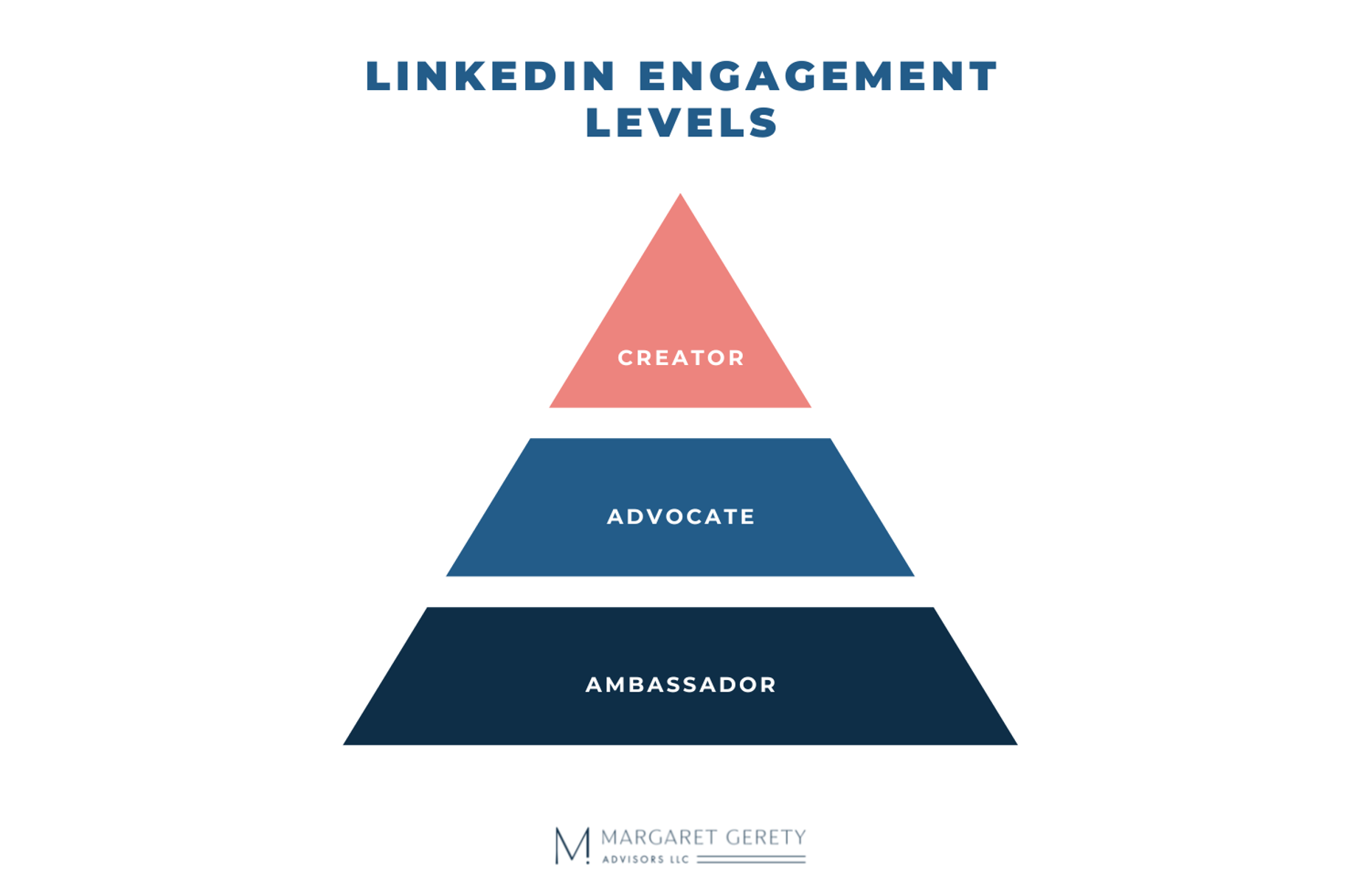
Ambassador is the bottom layer. As an ambassador, you are representing your company and your team. This is the level you cannot opt out of. Your profile is already doing this work for you, whether you participate or not.
Advocate is more active than “ambassador” but more passive than “creator.” You are amplifying the work of others: your colleagues, peers, company, and industry. You are not typically generating original content, but you are wholeheartedly passing along news, information, and thought leadership to your network.
Creator is at the top. You are sharing original thinking and insights. You’re providing your point of view in rich, thoughtful ways. This is the level most LinkedIn advice obsesses over. It is also the smallest layer of the pyramid for a reason - not everyone has the time, aptitude, interest, or need for becoming a creator.
Where you belong depends on your career stage, your role, and your appetite for the work. Most professionals are at the Ambassador level; it’s simply the baseline. Many, especially more senior professionals, will either become comfortable with posting on LinkedIn or be lightly pressured by their companies to shift to the Advocate level. Creator is genuinely optional, for professionals who have something to say and want to spend the time crafting LinkedIn-style posts that say it.
Ambassador Level: The Baseline For LinkedIn Engagement
If you are at a certain career stage, you are an Ambassador whether you like it or not. The question is whether you are a good one.
Your profile is part of the company’s storefront. When someone Googles you (and they will), LinkedIn is the first or second result for roughly 8 out of 9 professionals I have worked with. When potential investors, future hires, journalists, partners, or board members do their homework, they are reading your profile.*
Doing Ambassador work well is hygiene, not heroics:
- A current headline that names your actual role and what you do
- An About section that reads like a person, not a press release
- An Experience section that captures the substance of your work, not just job titles
- A current headshot, taken within the last 3 years
- A banner that signals your brand or your company, not the LinkedIn default
That is it. If you do this and nothing else, your LinkedIn is doing meaningful work for your career. You do not have to post. The profile itself is the post.
* It’s worth noting that some industries (law, certain financial professions, certain government work) have strict rules about what you can and cannot post. Some companies have marketing and communication guidelines, complete with company banners to use. Be sure to check these out before updating your profile and/or posting on the platform, or elsewhere.
Advocate: The Easiest Lift to Increase Engagement on LinkedIn
The next layer up is where most professionals should be operating. And most companies are desperate to get their employees there.
Remember the data that said organic company posts make up just 2% of what users see in their feed? That means that companies are desperate for you, their employee, to share their posts, or the posts of other company leaders and employees. This helps put your company’s name, services, and product wins in your network’s feed. This kind of advocacy isn’t about writing your own content; it’s about amplifying what others’ have already crafted and published.
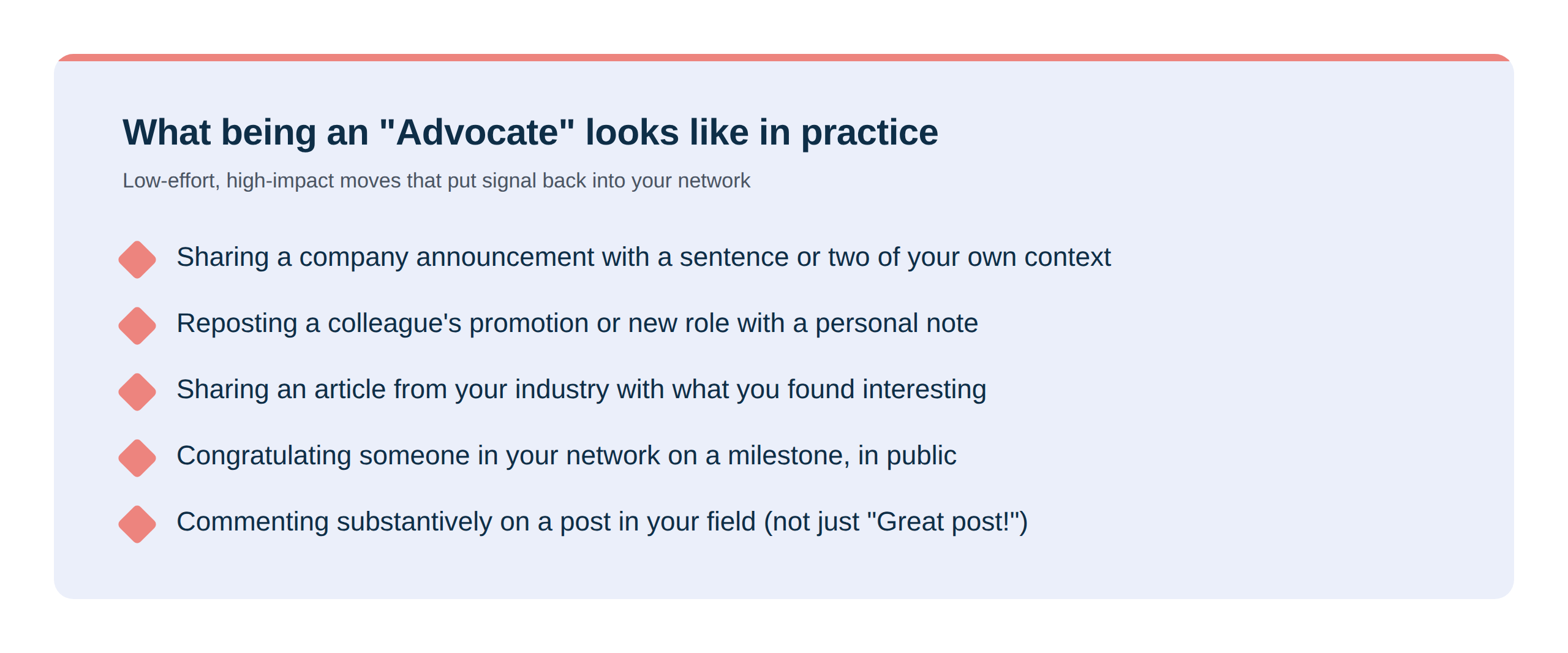
This is genuinely low-effort, high-impact work. It can take as little as 5 minutes and can be done as infrequently as once or twice a month. It makes you and your organization visible to your network without requiring you to have original ideas on demand. And it strengthens relationships, because the people you are advocating for will take notice that you care and are proud of their work.
One specific tactic worth highlighting: the repost with commentary. When someone in your network shares something good, do not just hit “repost.” Hit “repost with your thoughts” and add 2 sentences. Don’t know what to write? Well, tell folks why this post matters, who it might be useful for, or even give a hot take or original thought you have to deepen or further the conversation. That single behavior puts you somewhere between Advocate and Creator, with almost none of the Creator effort.
Creator Level: How to Build Thought Leadership on LinkedIn (If and When It's Right for You)
If you do want to climb to the top of the pyramid, here is how to get there as painlessly as possible.
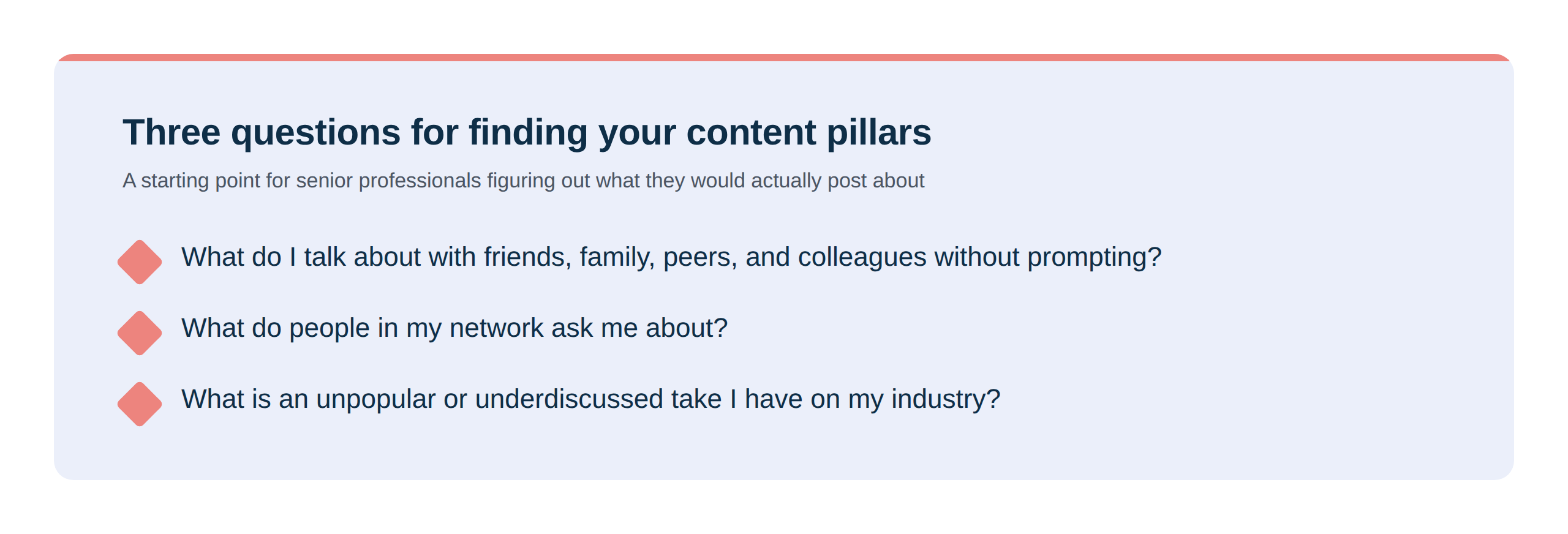
Do not try to be an “influencer.” Do not try to post every day. Don’t become obsessed with formulas for hooks, stops, and engagement bait. Instead, pick 2 or 3 content pillars and write short posts on them.
A content pillar is a topic you genuinely know something about. The simple test: it is something you would talk about over a work dinner without checking notes. For a private equity investor, it might be how to evaluate management teams, what makes a turnaround actually work, and lessons from a specific failed deal. For a former educator turned nonprofit program manager, it might be creating programs that meet diverse student needs or the future of primary education in the age of AI.
Once you have your pillars, the formula is simple: think something, say something. When you have a real observation about your domain, write it down. A paragraph is enough. Two paragraphs is a feast.
A few principles for helping your post reach more people once you decide to post and care about engagement numbers:
Play around with format. As people’s attention spans wax and wane, consider the actual formatting of your words. Given LinkedIn is pretty limited in rich-text editing, try using shorter sentences, or (dare I suggest) a light touch of emojis.
80% educational, 20% promotional. If everything you post is about your company or your services, you are an advertisement, not a creator. Share what you know first. Sell second.
Use images. Posts with images get roughly 98% more comments than text-only posts. When you’re reposting or including links from outside pieces, those images will often autopopulate on their own. If not, grab a screenshot from the article and upload it. Another easy win: photos of you doing your thing (people love to see photos of their connections, and this also helps build your “thought leadership” persona).
Do not post and ghost. Even I am guilty of this one. I spend all this time crafting the perfect post, and once I’ve shipped it off to the world, I want to go for a walk and stretch my legs. But when you post and step away immediately, you risk losing any momentum with your post’s engagement. You’ve lit the fire, but if you don’t tend to it when it’s a baby fire, the fire will go out. When someone comments, you want to be able to reply quickly with a thank you, counterpoint, or additional point. Comments are where the real network-building happens, and the algorithm rewards engagement in the first hour after posting in particular. In fact, posts with active comment threads (where a discussion is happening in the replies) get 2.4x more reach than posts with only direct comments.
And here is the underrated point: this kind of content actually works. 75% of executives say thoughtful professional content on LinkedIn has led them to explore a company or service they were not previously considering. The people who do show up at the Creator level get heard. They get a reputation boost. The space is less crowded at this level than the conventional wisdom suggests, precisely because so few professionals make the time to flex this muscle.
Avoiding the “I’m so honored” posts. A lot of people ask me how to avoid the obligatory and painful posts that start with “I was so honored to,” or “I am excited to announce.” First of all, sometimes these are just necessary, but it’s a good reminder that they can be a crutch, and if you push yourself, you can do better.
First, if you actually take the points above to heart, you should already be starting with more robust content and a sharper thesis than, “Oh, I went to this conference, or received this promotion, so I should talk about it.” Start with the idea, a quote, a story, or an anecdote. Flex your storytelling muscles.
Second, remember that your readers will only see the first 1-2 lines of your post before they need to click to read more. This is called a “hook.” And while I am loathe to suggest using one (I promised you didn’t need to worry about this marketing speak!), it is a good reminder that you do need to make your post sound interesting at the very outset. That’s why the words “I was honored to attend…” both sound boring and are a waste of space.
Use AI judiciously. AI can be critical in helping you at creator mode. Absolutely brainstorm with it. But your voice needs to come through, and the above points needs to be fully embraced. For example, in my experience, AI sucks at creating a hook and optimizing those first 2 lines of your post. And, honestly, it often misses my entire point. I am constantly redirecting it, cutting half of the content, and starting over. But it’s very helpful at getting you over writers block.
LinkedIn Strategy for Job Seekers: Why Activity is a Signal
There is one situation where the level of activity matters more than I have suggested above: when you are actively looking for a job.
LinkedIn has built an entire system of “signals” around job search activity, and those signals affect how findable and credible you appear to recruiters. Inside LinkedIn Recruiter, the dominant tool used by corporate and agency recruiters, every candidate gets a “Likelihood of interest” rating. It is based on your response patterns to InMails, your company-page interactions, whether your current employer has had recent layoffs, and whether you’ve turned on Open to Work (nota bene: if you turn the “Open to Work” frame on, set it to visible to recruiters only, not the public green banner, to avoid looking desperate or signaling to your current employer that you’re in the market for a new job!). Recruiters can see, at a glance, whether you appear to be paying attention.
What this means in practice: if you are in a job search, the bar for activity is meaningfully higher than it is otherwise. You do not need to start posting daily. You do need to:
- Update your profile regularly so the algorithm registers fresh activity
- Respond to InMails, even the irrelevant ones, even briefly
- Follow companies you are interested in
- Engage with content in your target industry so recruiters can see you are paying attention
This is Advocate-level work in the framework above. But during a search, it stops being optional.
The same principle applies in a softer form even when you are not formally looking. People will not reach out to you if they do not believe you check your account. Board invitations, speaking requests, inbound from journalists, introductions from former colleagues — all of it flows through the same channel. The lights have to be on or no one will come knocking.
Final Take: You Don’t Have to be a Creator. You Do Have to be Present.
Here is the summary, for anyone who hates posting:
If you are a professional with a LinkedIn profile, the platform is working for you. Your job is to make sure it is doing the right work.
- Ambassador-level presence is non-negotiable. Make sure your profile reflects who you actually are.
- Advocate-level engagement is the highest-leverage activity most professionals are ignoring. One or two thoughtful reposts and comments a week strengthen your network without demanding original content.
- Creator-level posting is optional but can pay dividends. It pays off when it is purposeful, authentic, and consistent. It is also a real commitment. Proceed with caution!
- If you are job searching, you need to do more. Activity becomes a signal recruiters look for, and silence becomes a signal that costs you opportunities.
You do not have to be a LinkedIn influencer. You do have to show up.
If you are stepping into a new or more senior role and your LinkedIn does not yet tell the right story, that is the kind of work I do with 1:1 clients at Margaret Gerety Advisors. Get in touch for a conversation about getting your profile ready before the role starts.