
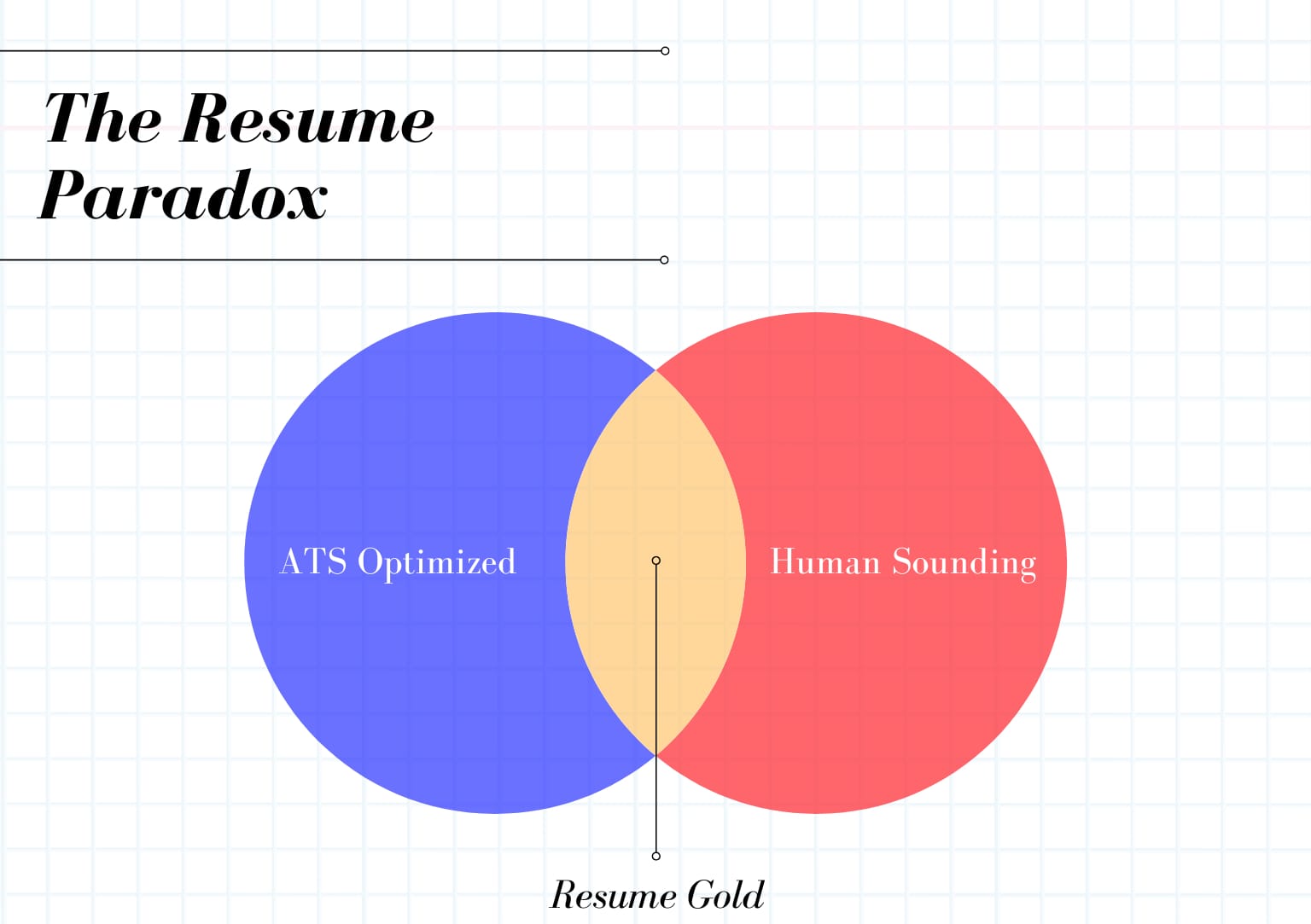
The paradox: optimize too hard for the machine (ATS or "Applicant Tracking Systems"), and the human reader sees a generic, lazy applicant. Write naturally for the reader, and the machine may not surface the resume in the first place. Forbes reports that 75% of applicants are booted out by algorithms before their resumes reach a human.
With AI getting more sophisticated in its vetting processes, and AI detectors getting better at identifying non-human writing, we're left to wonder: what's a job applicant to do?
Forbes reports that 75% of applicants are booted out by algorithms before their resumes reach a human.
With AI getting more sophisticated in its vetting processes, and AI detectors getting better at identifying non-human writing, we're left to wonder: what's a job applicant to do?
Why "Just Optimize for ATS" Is Bad Advice For New Graduates
For new graduates, aggressive keyword stuffing creates its own trap. Pile in the right terms without specific, grounded, and varied content behind them, and the resume starts to read like a checklist rather than a person. AI screening tools are increasingly trained to detect exactly that pattern and to deprioritize it.
The goal isn't optimization in isolation. It's landing in the overlap. Specific and relevant enough that the machine registers relevance. Human enough that the reader actually wants to meet the person behind the page.
The machine penalizes generic. The human reader penalizes thin. Resume Gold requires being both findable and real — and the AI crawler is the second place that balance gets tested.
The 3 Writing Patterns AI Crawlers Flag (And How to Avoid Them)
AI screening tools don't just scan for keywords. They analyze how the resume is written — tone, sentence structure, vocabulary consistency — and increasingly flag content that reads as machine-generated. This matters for new graduates especially, because the temptation to lean on AI writing tools is highest when you feel like you don't have enough to say. Here's what those crawlers are actually looking for.
1. Overly formal phrasing. Phrases like "cross-cutting strategies" and "leveraged synergies" sound overly polished, especially for a new grad, and actually say very little. Swap formal constructions for language you'd actually use to describe your work to a colleague. If you wouldn't say it out loud, it probably shouldn't be on the page.
2. Mechanical precision. There's a difference between specific and clinical. "Implemented evidence-based interventions across 3 programmatic workstreams" is technically precise, and completely lifeless. The same information written as "redesigned 3 program tracks based on field data, with 2 now used as national models" does real work. Precision without texture reads as a bot.
3. Predictable language and syntax. If every bullet is equally polished and uses the same vocabulary register throughout, that uniformity flags it. Human writing has texture: some lines are punchy, some are detailed, some are plainspoken. Lean into that variation rather than smoothing it out.
Avoiding these patterns is a craft problem. And like any craft problem, it starts with having real material to work from.
The Work New Graduates Have to do First
In order to clear the ATS gate and still present an interesting, original, and relevant resume, an new grads must do the hard work of storytelling and translation. Framing is where most early-career resumes fall apart. Not content.
Step 1: Inventory
Before a resume strategy, there's an inventory. Every significant experience from the past four years — student organizations, part-time jobs, internships, academic projects, volunteer roles, campus leadership — needs to be examined for its professional equivalent. What was the actual scope? Who was affected? What changed because of the work? What did it take to do it well?
That inventory is harder than it sounds. It requires sitting with experiences that felt ordinary at the time and asking what they actually demonstrate. It's also the most valuable work a new graduate can do before sending a single application.
Step 2: Translation & Storytelling
Once a new graduate has taken stock of their work, they need to translate it into relevant and specific content. That means reviewing the inventory and making sure the content shows real value to the reader.
The intern who writes "assisted with research projects" likely conducted data collection, synthesized findings across multiple sources, and handed deliverables directly to a senior team member — on a deadline. That's analysis, communication, and project management. None of it shows up in "assisted with."
Same goes for the server or retail worker who "handled customer complaints." What that often means: de-escalated difficult situations under pressure, retained customers who were ready to walk, and did it while managing 10 other tables or a line of 15 people. That's conflict resolution, performance under pressure, and customer retention. The passive version isn't just weak. It's invisible.
Step 3: Crafting Effective Bullet Points
This is where the rubber hits the road. Every experience needs to be distilled into bullets that are specific, active, and tight. A few rules worth following:
Keep it ~200 characters. One action. One result. Active verb. If there's a metric, lead with it or end with it. If something was the first of its kind or a senior leader asked you to undertake a special project, say so.
Two internship examples that hit the mark:
Analyzed 6 months of customer survey data for 3-person marketing team; identified 2 service gaps that informed Q3 product roadmap.
Drafted 12 social media posts per week across 3 platforms for nonprofit with 50K+ followers; Instagram engagement rose 22% over 8-week tenure.
Notice what's doing the work: the numbers are specific, the scope is concrete, and the reader gets both the action and the result without filler. "Demonstrated ability to" and "proven track record of" are nowhere in sight. Neither should they be.
The question to ask about every bullet: what did this person do, and why does it matter?
How Paige Helps New Graduates With Early-Career Resumes
Doing this work well takes time and most new graduates don't know what questions to ask themselves. That's exactly the problem Paige was built to solve. Paige is an AI-powered resume builder designed to prompt-engineer the translation work out of you. Rather than staring at a blank page and trying to remember what you did two years ago, Paige asks you targeted questions that surface the specific details that make bullets strong: the numbers, the scope, the people involved, the result.
Three features are especially useful for new graduates:
-
Bracketed placeholders. Paige builds resumes with [##], [$amount], and [Role/Title] placeholders where specific data belongs. This isn't a shortcut — it's a forcing function. The placeholders flag exactly where your real numbers need to go. Once you fill them in, the resume becomes unmistakably yours. No AI would hallucinate those details correctly.
-
The "Get Questions" button. Not sure how to describe what you did? Hit "Get Questions" and Paige will ask you directly — drawing out the specifics that vague bullet drafts always miss. It's the difference between writing from a blank prompt and being interviewed by someone who knows what hiring managers are actually looking for.
-
Built-In Best Practices. Give Paige the substance, and it will craft the bullet. Every standard described above is embedded into the tool, so the output is tight, active, and human-sounding by design.
The goal is a resume that sounds like a human wrote it. Because a human did (with a little structured help extracting the stories that were already there).
So that's the zone. That's Resume Gold. And for new graduates, it's closer than it looks once you know what you're actually trying to build.
Margaret Gerety is a Certified Professional Resume Writer (CPRW) and founder of Paige Careers, an AI-powered resume builder that combines expert coaching frameworks with AI to help early and mid-career professionals land their next role. She holds a JD from Harvard Law School and a BA magna cum laude from Harvard College, where she was a 4-time varsity athlete and Hall of Fame inductee.