

You've heard of the STAR method. Situation. Task. Action. Result. Career coaches swear by it. Interview prep guides are built around it. And for interviews, it works fine.
For resumes? It's the wrong tool.
STAR was invented in 1974 by a corporate training firm to help candidates answer verbal interview questions. That's not a knock on it — for that purpose, it still works. But a method designed for 90-second spoken storytelling is a strange foundation for a one-line resume bullet in 2026.
On a resume, you have one line, two tops. And that line doesn't need a situation or a task. It needs proof that you, specifically, did something worth hiring you to do again.
Here's the framework that actually works: the Specificity Stack.
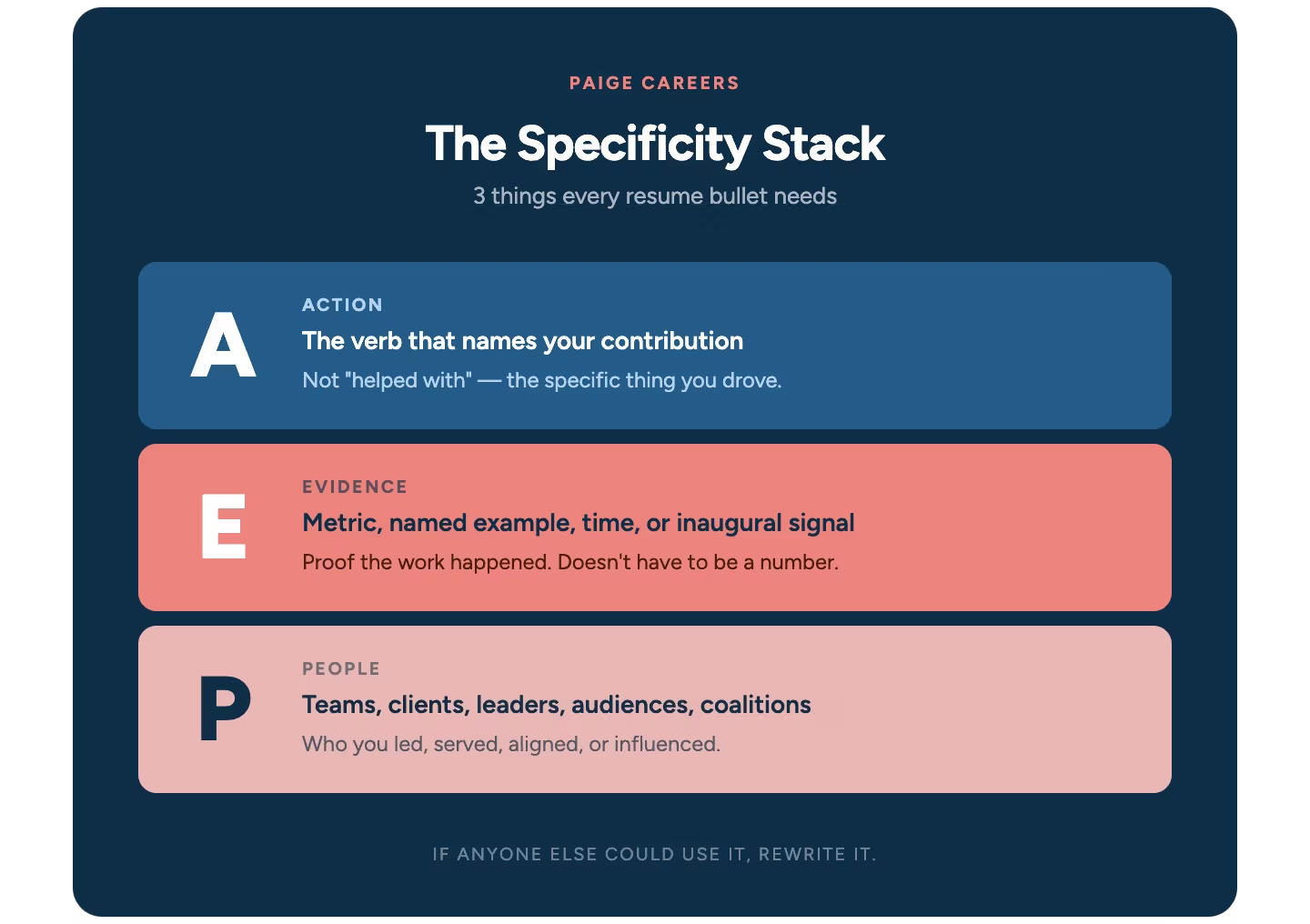
The Specificity Stack: Action, Evidence, People
Every strong resume bullet has 3 components. They don't have to appear in any particular order, but all 3 need to be there.
- A — Action. An active, past-tense verb that names your specific contribution. Not the team's contribution. Not the department's output. Yours.
- E — Evidence. Proof that the work happened and mattered. This doesn't always mean a number — and we'll get to why that matters.
- P — People. The humans involved: who you led, served, aligned, influenced, or worked alongside. This is the dimension most resume bullet points are missing.
Stack all three and you have a resume bullet point that's hard to ignore. Leave one out and you have a job description.
The "A": Why Your Verb Is the First Test
The action verb is the first thing a reader's eye hits. It sets the frame for everything that follows.
Weak verbs bury the lead. "Responsible for," "assisted with," "supported," and "helped" all signal that something happened in your vicinity. They don't signal that you drove it.
Strong verbs name the nature of your contribution:
- Led. Directed. Oversaw. (You were in charge.)
- Secured. Achieved. Negotiated. (You got to a result.)
- Built. Launched. Stood up. Developed. Established. (You created something.)
- Cultivated. Positioned. Prepared. Advised. (You shaped something.)
- Spearheaded. Championed. Drove. (You initiated something.)
Pick the verb that names what you actually did — not the broadest possible description of your role.
The "E": Evidence Has 4 Forms. Only 1 Is a Number.
This is where STAR leads professionals astray. The "Result" in STAR implies quantification — a percentage, a dollar figure, a headcount. And when professionals can't quantify, they either leave the evidence out entirely or pad their bullets with vague language like "significant impact" and "strong outcomes."
Evidence doesn't have to be a metric. It has to be specific. Here are the 4 forms it can take.
Evidence Type 1: Metric
Use this when you can quantify — even with an estimate. "$2M," "40%," "12 agencies," and "14 markets" all count. Specificity is the goal, not precision. A well-placed estimate is almost always stronger than no number at all. For example, you can use hedge indicators like "~200,000" or "$5M+" especially if that number fluctuates regularly.
WEAK: Grew the government affairs program.
STRONG: Expanded state-level policy footprint from 3 to 14 markets over 2 years, adding 6 contract lobbyists and establishing presence in all target states ahead of major federal rulemaking.
Evidence Type 2: Named Example
Use this when naming is more powerful than a number — which is more often than most professionals realize. The specific organizations you engaged, the named programs you built, the actual deliverables you produced — these are proof of real work at a real level.
A hiring manager reading "key industry groups" learns nothing. A hiring manager reading "Chamber of Commerce, National Association of Black Realtors, and American Land Title Association" knows exactly the caliber of relationships you built.
WEAK: Managed external stakeholder relationships to advance the company's legislative agenda.
STRONG: Cultivated relationships with the American Clean Power Association, Solar Energy Industries Association, and Advanced Energy United to advance grid interconnection priorities ahead of FERC's Order 2222 implementation rules.
Named examples are the right move roughly a third of the time — especially for roles where the work is relational, strategic, or regulatory rather than output-driven. You don't always need a metric. You always need specificity.
Evidence Type 3: Time
Time is an underused evidence type, and it does two distinct things.
First, it can show compression: you did something faster than expected, faster than a predecessor, or faster than the stated goal. That signals execution, prioritization, and real stakes.
Second, it can simply anchor the work: "in <6 months," "within the first year," "ahead of 3-year deadline" all tell the reader something about the conditions and the pace. That context makes the bullet more concrete without requiring a hard metric.
TIME AS COMPRESSION: Stood up 50-person government affairs function in 8 months, 10 months ahead of board-projected timeline.
TIME AS ANCHOR: Launched company's first state-level advocacy program in <6 months, establishing presence in 8 target markets before legislative session opened.
Evidence Type 4: Inaugural Signal
Use this when you built something new, launched something first, or were specifically tapped for something that hadn't been done before. You don't need a label for what you did. "First," "inaugural," and "tapped to lead" do the work.
The signal isn't that you're exceptional — it's that this bullet describes a moment that only happened once, and you were the one in it.
WEAK: Created new policy function focused on emerging technology issues.
STRONG: Stood up company's first dedicated AI policy function; developed legislative strategy, built the coalition infrastructure, and recruited and hired initial 4-person team.
The "P": People Are Proof of Scope
This is the component that separates a bullet that reads like a job description from one that reads like a career.
Every role involves people. You are always being hired into a team, serving a client base, and/or influencing a stakeholder group. The seniority of who you advised, the diversity of who you worked with, the breadth of who you served — all of it signals something a standalone task never can.
"People" is broader than most professionals realize:
- Internal: cross-functional teams, departments, C-suite executives, boards of directors, senior leadership
- External institutional: federal and state agencies, Congressional committees, trade associations, industry coalitions, regulators
- Market-facing: clients, customers, members, prospects, end users
- Public-facing: media outlets, journalists, conference audiences, the press, the public
- Governance: boards of directors, advisory councils, trustees, investors
The People dimension scales by role. A government affairs professional who isn't naming agencies, committees, and coalition partners is leaving the most important proof off the page. A software engineer who isn't naming the product teams, customers, or cross-functional partners they built for is missing it too — just differently. The specifics change. The requirement doesn't.
Look at the difference:
WITHOUT PEOPLE: Secured $4.5M in competitive federal funding through HUD Choice Neighborhoods grant.
WITH PEOPLE: Secured $4.5M HUD Choice Neighborhoods grant, leading cross-sector application team of city housing officials, community development partners, and resident advisory board members.
The dollar figure is the same. The scope of who you mobilized to get there is what changes.
WITHOUT PEOPLE: Prepared senior executives for high-profile external appearances.
WITH PEOPLE: Prepared and positioned CEO and EVP of Government Affairs for Senate Commerce Committee testimony, FTC pre-merger briefings, and 2 World Economic Forum appearances, developing briefing materials, Q&A prep, and day-of logistics.
Named executives. Named forums. Named deliverables. That's a bullet only one person can write.
The Swap Test: The Final Filter
The Specificity Stack tells you what a bullet needs. The swap test tells you whether what you've written is actually yours.
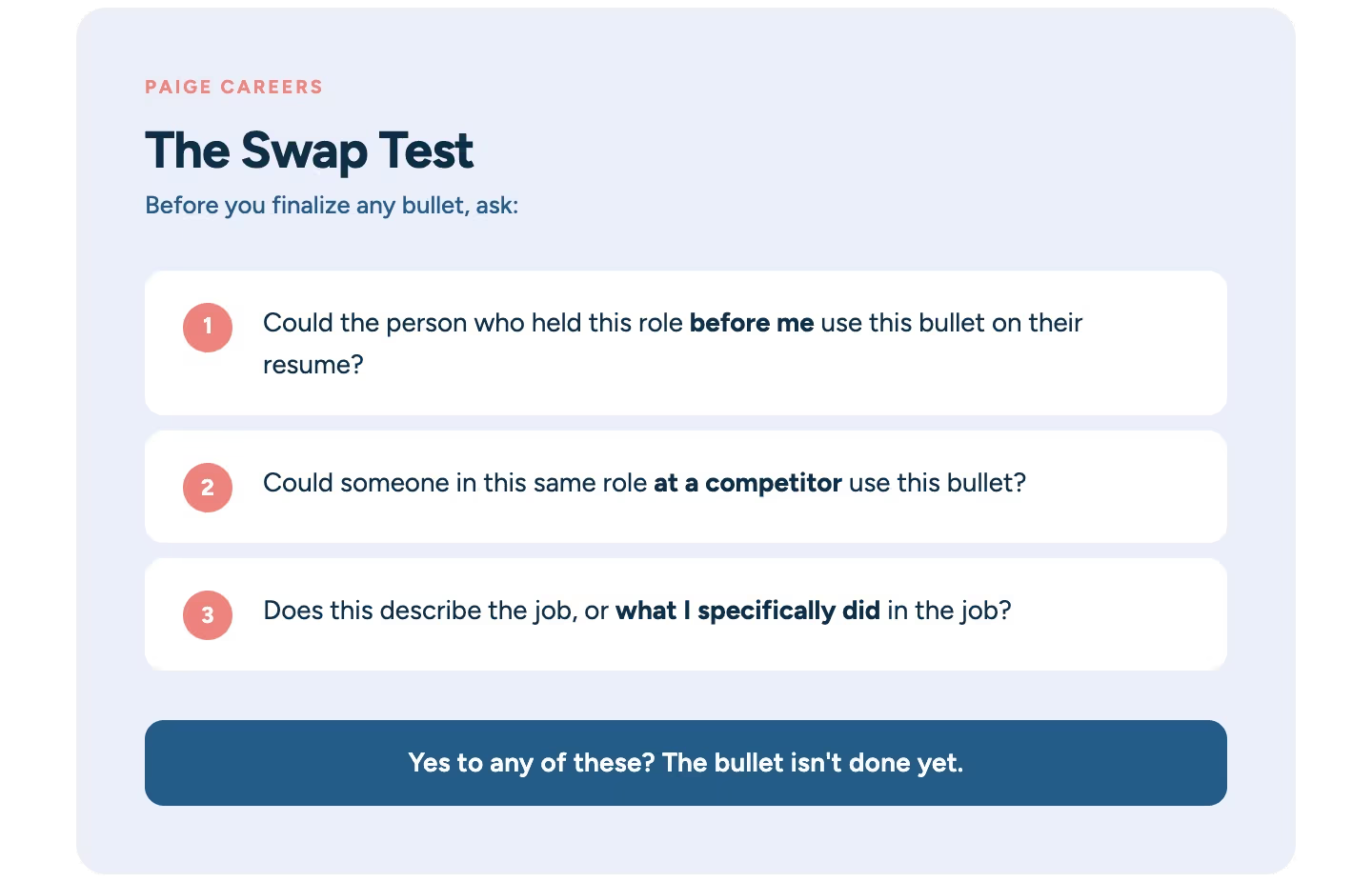
Before finalizing any bullet, ask:
- Could the person who held this role before me put this on their resume?
- Could someone doing this same job at a competitor use this bullet?
- Does this describe the job, or does it describe what I specifically did in the job?
If the answer to any of those questions is yes — or even maybe — the bullet isn't done yet.
Here's what the spectrum looks like for a government affairs director:
FAILS: Managed government affairs and built relationships with key stakeholders to advance policy priorities. (Any government affairs professional. Any company. Any decade.)
GETTING CLOSER, STILL FAILS: Led financial services policy team and engaged banking associations to shape federal capital requirements rulemaking. (Better — but every bank GA director since Basel III became a thing.)
PASSES: Secured 18-month implementation extension for community banks in OCC's final Basel III endgame rule, coordinating with ABA, ICBA, and 8-member internal task force spanning Risk, Compliance, and Legal. (One person did this. This rule. This outcome.)
The pattern behind every bullet that passes: something named, someone named, and something that signals it was yours to do.
Putting It Together: The New Resume Bullet Point Framework in Action
Here's a full before-and-after using all 3 layers of the Specificity Stack — and passing the Swap Test.
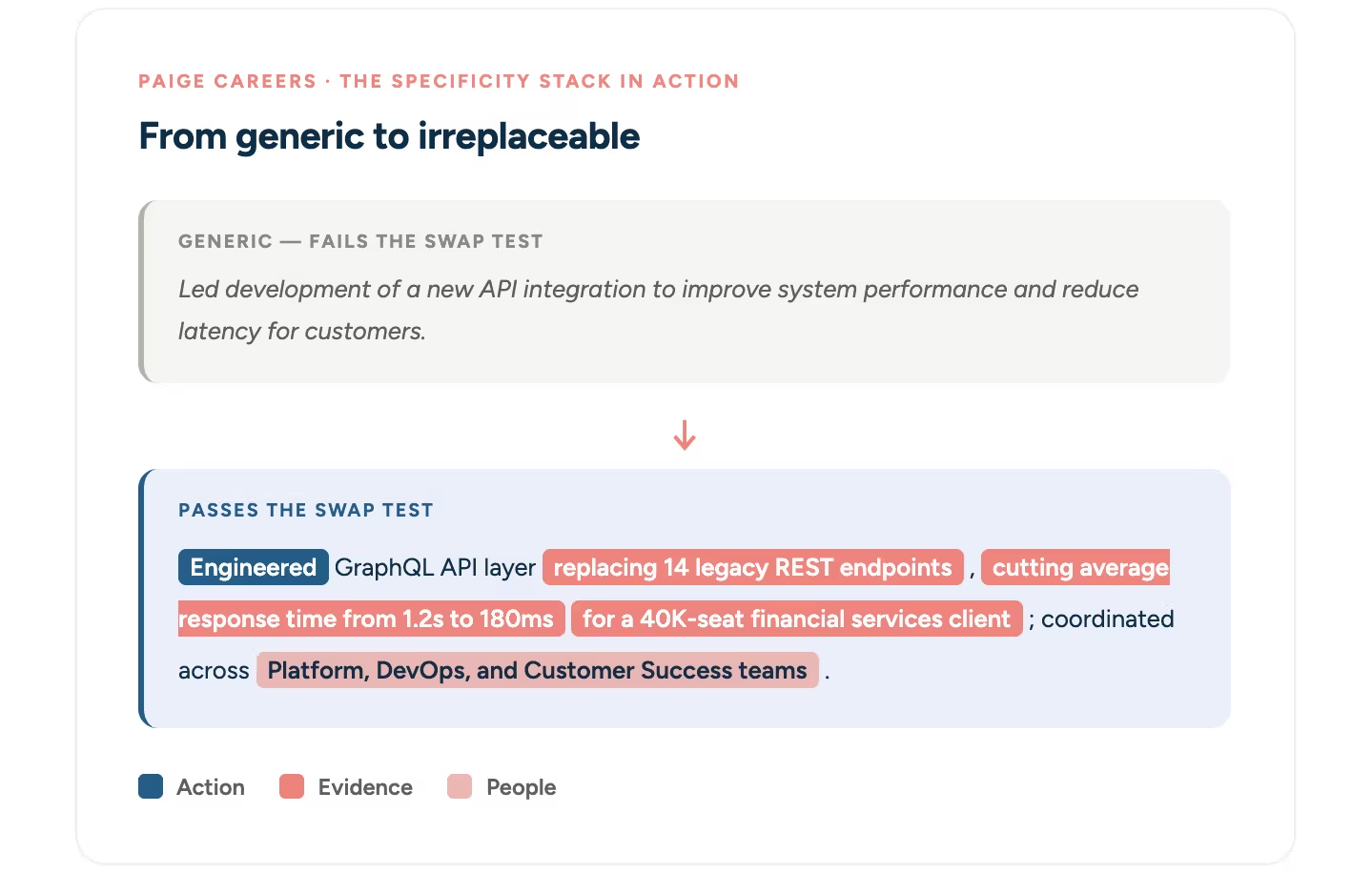
Generic — fails the Swap Test:
Led development of a new API integration to improve system performance and reduce latency for customers.
Passes the Swap Test:
Engineered GraphQL API layer replacing 14 legacy REST endpoints, cutting average response time from 1.2s to 180ms for a 40K-seat financial services client; coordinated across Platform, DevOps, and Customer Success teams.
To spell it out, the new resume bullet point has the following:
- Action: Engineered
- Evidence: 14 endpoints, 1.2s to 180ms — a Metric plus a Time compression signal
- People: Platform, DevOps, Customer Success teams, named client scale
- Swap Test: The legacy endpoint count, the specific latency numbers, and the enterprise client size make it irreplaceable
The Takeaway
STAR is a great interview tool. It's the wrong resume tool.
The Specificity Stack gives you a construction method: Action tells readers what you did, Evidence — in any of its 4 forms — proves it happened, and People shows the scope of your reach.
The swap test gives you a quality filter: if anyone else could claim your bullet, it's not specific enough yet.
A resume isn't a list of duties. It's a case for why hiring you is different from hiring anyone else. Every bullet point should make that case — and it can only do that if it's irreplaceable.
Margaret Gerety is a Certified Professional Resume Writer (CPRW) and founder of Paige Careers, an AI-powered resume builder that combines expert coaching frameworks with AI to help early and mid-career professionals land their next role. She holds a JD from Harvard Law School and a BA magna cum laude from Harvard College, where she was a 4-time varsity athlete and Hall of Fame inductee.