
Anything that's worth reading comes after careful preparation. In my world, that's called resume prep.
Before you touch a single bullet point, you need to answer some questions. Not "What's your job title?" or "When did you start?" The deeper ones. The ones that turn a list of responsibilities into a story worth reading.
I've worked with 300+ mid-to-senior professionals, from directors to C-suite executives. And no matter how senior someone is, they almost always skip the same steps. They jump straight to formatting. They agonize over fonts. They forget to do the actual thinking.
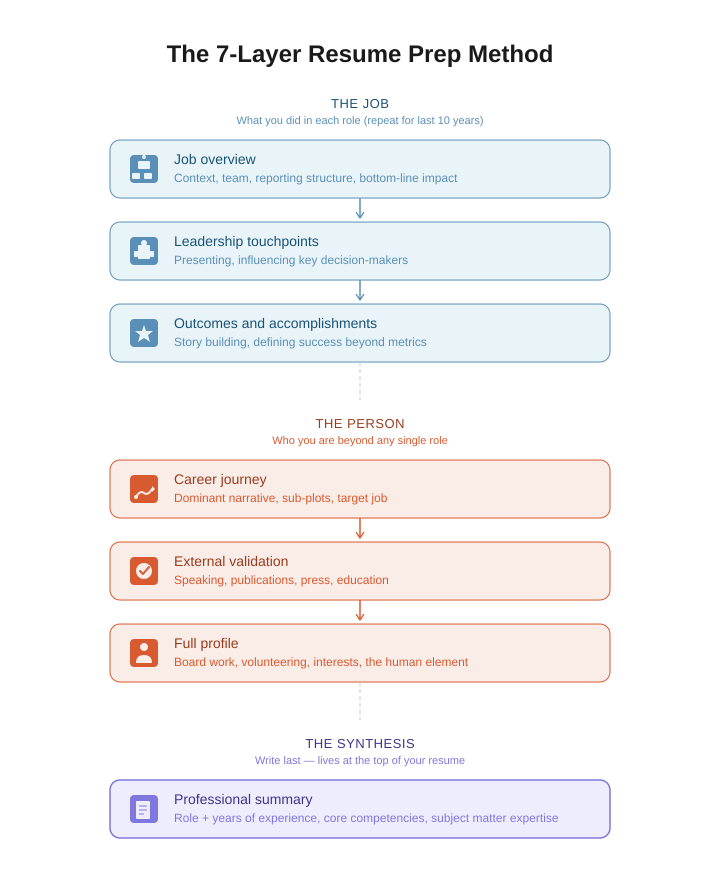
Here are the 7 types of questions I ask every coaching client before we write a single word.
1. The Job Overview
Where do you fit within the organization?
This sounds basic. It's not. Most resumes describe what someone does without explaining where they sit or why it matters. I want to know:
- Who do you report to?
- How big is your team? What kind of professionals are on it? Do you manage anyone?
- What's the team's responsibility within the broader organization?
- How does your work impact the bottom line?
Context makes everything else land. "Led a team of 12" means nothing. "Led a 12-person policy team reporting to the Chief Legal Officer, serving as the primary interface between regulatory affairs and the C-suite" tells me exactly who you are.
2. Leadership Touchpoints
Who are you influencing, and how often?
This is where I push people to be specific. I ask:
- How often are you presenting to senior leadership? To the board?
- What are those presentations about?
- Who outside your direct chain do you regularly brief or advise?
These touchpoints reveal your actual sphere of influence. A Director who briefs the board quarterly on regulatory risk is operating at a different altitude than one who never leaves their department. The resume should reflect that.
3. Outcomes and Accomplishments
What did you actually do?
This is the story-building part. And it's where most people get stuck, because they think "outcomes" means metrics. Sometimes it does. But not always.
I ask:
- What are the key efforts you led?
- What are your top career moments in this role?
- How do you define success? (Not how your company defines it. How you define it.)
Some wins are quantifiable. You grew revenue 40%. You cut costs by $2M. Great. But some wins are about building something that didn't exist, navigating a crisis, changing how decisions get made. Those stories matter too. The goal is specificity, not just numbers.
A note: These first 3 types of questions apply to each relevant, recent job. Typically, that's the last 10 years, maybe less. You don't need this level of detail for a role you left in 2011.
4. Career Journey
How did you get here, and where are you going?
I don't need your full autobiography. But people are curious about how you arrived at what you do today. The brief, relevant version of how your career built toward this moment.
Here's my theory: you need to choose your dominant narrative. You can't confuse someone by saying you're a "jack of all trades" or "I've done everything." That's not a story. That's a shrug.
Your target job helps you decide. If you're pursuing a Chief of Staff role, that shapes which parts of your history to emphasize. If you're going after a VP of Government Affairs position, different threads matter. The dominant narrative isn't just about where you've been. It's about where you're headed.
But you can have sub-plots. Maybe your dominant narrative is government affairs, but you started as a litigator. That legal background becomes a "nice to have" asset that sets you apart from other policy professionals. It's not the headline. It's the differentiator.
This is especially important for career changers. If you're moving from federal government to private sector, or nonprofit to corporate, or law firm to in-house, the through-line is everything. It's the answer to "Why should I hire someone with your background for this role?"
5. External Validation
What proof points exist outside your employer's walls?
This includes:
- Speaking engagements (conferences, panels, keynotes)
- Publications and bylines
- Press mentions or media appearances
- Awards or recognitions
- Education and certifications
These are third-party signals that you're respected beyond your own organization. They also give you credibility in areas your job title might not obviously convey.
6. The Full Profile
Who are you beyond your job?
I once worked with a CFO. On paper, all numbers. Spreadsheets. Financial modeling. Very serious.
Then I found out he was one of 9 siblings and a licensed general contractor who spent his weekends renovating his house. Who wouldn't want to hire that guy?
This section is about:
- Board work and nonprofit leadership
- Volunteer roles
- Professional affiliations
- Skills and interests that round out the picture
The "full profile" makes you human. It creates conversation starters. It can be the thing that gets your resume pulled from the pile.
7. The Summary Section
Only now are you ready to write the top of your resume: your professional summary.
Why wait until the end to tackle this critical section? Because you can't curate effectively until you see the full picture. The stories you want to tell. The job you're targeting. The dominant narrative and the sub-plots. Only then can you write a summary that actually does its job.
A strong summary does three things. It gives a career snapshot (your industry and years of experience). It reflects the skills and competencies your target role is looking for. And it positions you as both qualified and exciting for the role.
To get there, I might ask:
- How would you describe yourself at a networking event?
- What is critical for your target audience (the hiring manager for your target role) to know about you?
- What differentiates you from other applicants who might apply to this role?
- How would an employee describe your leadership style?
The answers here are usually the most interesting, relevant, and powerful things about you. Effectively, your pitch for your target role.
Now You're Ready
If you've covered these 7 areas of questioning honestly and thoroughly, you have what you need to write a resume that actually sounds like you.
You'll stop defaulting to generic verbs. You'll stop listing responsibilities without context.
You'll have stories, not just bullet points.
This is the work most people skip. Don't skip it.
Want help working through these questions? Paige asks them for you, using the same methodology I use with my coaching clients.
Margaret Gerety is a Certified Professional Resume Writer (CPRW) and founder of Paige Careers , an AI-powered resume builder that combines expert coaching frameworks with AI to help early and mid-career professionals land their next role. She holds a JD from Harvard Law School and a bachelor's degree, magna cum laude, from Harvard College.